
Two People Disagree. Can They Both Be Right?
The Pineapple Problem

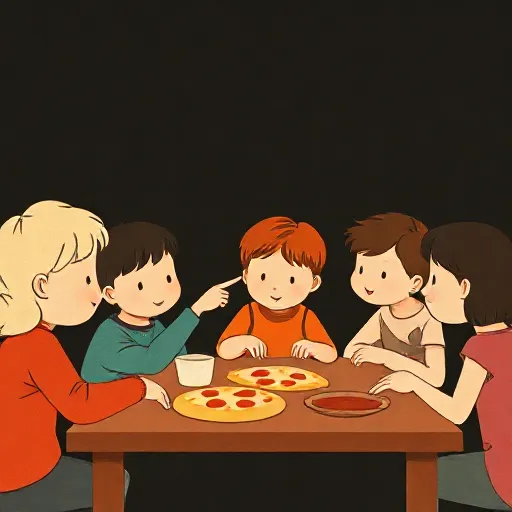
You and your best friend are staring at a pizza. “Pineapple is the best topping,” you say. Your friend shakes her head. “No way. It’s disgusting.” You’re both perfectly sincere, you’re both smart, and neither of you is lying about what you actually taste. Yet you completely disagree. Can both of you be right?
This everyday spat is a live philosophical puzzle. It forces us to ask a huge question: Is truth the same for everyone, or can it change from person to person, from culture to culture, even from one moment to the next? Philosophers call this the problem of relativism — the idea that some truths are not fixed but depend on who is doing the judging. If relativism is correct, then “pineapple is tasty” might be true relative to you and false relative to your friend, without either of you making a mistake. That sounds tidy. But push a little harder, and things get very tangled.
Protagoras and the Wind

The first philosopher known for thinking this way was Protagoras (c. 490–420 BC). He lived in ancient Greece and made a bold claim: “Man is the measure of all things, of the things that are that they are, and of the things that are not that they are not.” What he meant, in part, was that how the world appears to you really is true for you. He used a simple example: the same wind can feel cold to one person and warm to another. According to Protagoras, the wind is cold for the person who feels cold and warm for the person who feels warm. Neither experience is “wrong” — there is no single, correct temperature of the wind that is independent of whoever is feeling it.
This idea shook things up. It suggested that we don’t just discover a single truth out there; we partly make truth through our own perspectives. Plato (428–348 BC) was so worried by this that he devoted a whole dialogue — the Theaetetus — to attacking it. Plato noticed that if Protagoras’s view is right, then when someone believes Protagoras is wrong, that belief must be true for them, too. And if it’s true for them that relativism is false, then relativism seems to defeat itself. We’ll come back to this trap.
When Cultures Clash
Protagoras’s hunch grew into bigger forms of relativism. Cultural relativism claims that what counts as right, wrong, or even reasonable is shaped by a culture’s traditions, history, and language. The anthropologist Franz Boas (1858–1942) pointed out that our emotions and knowledge are heavily molded by the society we grow up in. One culture practices polygamy, another forbids it. One treats privately owning land as natural, another finds that strange. According to cultural relativism, there is no neutral super-culture that gets to judge which way is “truly” correct. Each way is correct within its own framework.
This view often comes with a dose of tolerance: if all ways of life are valid in their own terms, then we should respect them. But trouble brews quickly. Imagine a culture that practices slavery. Is that merely “correct for them”? Most people feel a strong pull to say: no, slavery is wrong everywhere, for everyone. If we can’t say that, cultural relativism seems to give up any way to condemn even the worst injustices. The philosopher W. T. Stace (1886–1967) argued that the kind of tolerance that says widow-burning or human sacrifice are just as good as any other moral code is not a tolerance we want. So here we face a first great tension: relativism promises an open mind but can feel like a spine with no bones.
The Trap of Self-Refutation
The most famous attack on relativism — the one Plato launched — is that it refutes itself. Here’s a modern version. Suppose someone states: “All truth is relative.” Notice that this sentence itself claims to be a truth. But if all truth is relative, then that statement must be true only relative to some perspective. To a person with a different perspective, it could be false. In that case, the claim that all truth is relative doesn’t hold for everyone, and the relativist hasn’t really proved anything. The argument seems to twist around and bite its own tail.
Relativists have fought back. They might insist that they are not making a universal claim but rather proposing a view that is true within a certain kind of conversation. Or they might bite the bullet and say, “Yes, my relativism is itself relative — and that’s fine, because I’m not trying to force it on anyone else.” The trouble is, once you step into a debate and give reasons, you seem to be aiming at truth that your opponent should accept. If truth is always just “true for me,” why bother arguing at all? This puzzle about self-refutation — what philosophers sometimes call the charge of incoherence — is the big wave that every form of relativism must somehow surf.
Tasty, Right, and Wrong: Faultless Disagreement

On less explosive ground, relativism shines. Think back to pineapple pizza. Most people accept that if you sincerely like pineapple and your friend sincerely hates it, neither of you has made a mistake. Philosophers call this a faultless disagreement — a genuine clash of views where nobody is getting the facts wrong. Some contemporary philosophers, sometimes grouped as “New Relativists,” try to explain such disagreements by refining the very idea of truth. According to them, a statement like “Pretzels are tasty” is not simply true or false outright. Instead, its truth depends on a hidden parameter — a “judge” or a “standard of taste.” When you say “pretzels are tasty,” you are expressing a proposition whose truth is only fixed once we know whose taste standard we are using. If it’s your standard, it’s true; if it’s your friend’s standard, it’s false. The disagreement is real because you are both talking about the very same thing — whether pretzels are tasty — but there is no single absolute answer.
Does this trick work for morality, though? That’s where the floor gets slippery. Philosophers like Gilbert Harman (1938–2021) argued that moral right and wrong always depend on a moral framework, much as taste depends on a palate. Yet when we argue about whether it is okay to push a stranger off a footbridge to save five others (a classic ethical dilemma), both sides feel the other is not just different but mistaken in a serious way. Moral disagreements often carry a weight that pineapple arguments do not — a sense that someone who sees things differently is missing something real. So even if faultless disagreement makes sense for pizza, it may not work for promises, fairness, or cruelty.
Why It Still Matters
You aren’t done with relativism when you close this page. Every time you think, “That’s just their opinion,” you are tapping into the relativistic intuition. When you hear about a custom in another country and think, “Who are we to judge?” — you’re doing cultural relativism on the fly. When a friend insists a movie was amazing and you thought it was snoozefest, you are living inside a faultless disagreement. Relativism is not just an old Greek puzzle; it’s a tool you already use to make sense of a world full of clashing views.
But it also asks something hard of you. Can you be truly tolerant without giving up the ability to say “this is wrong” when something genuinely hurts people? Can you respect cultural differences while still believing that some things — like the outlawing of slavery — count as moral progress, not just change? Philosophers don’t have a final answer, but they have sharpened the question. The next time you find yourself in a disagreement where both sides seem utterly certain, you’ll be standing right where Protagoras stood, staring into the wind, trying to measure a world that might have more than one true shape.
Think about it
- If two cultures disagree about whether it’s right to treat animals as equal to humans, is there any fact of the matter, or is each side just correct “for them”?
- Can you think of a situation where you believe someone must be wrong, even though they are perfectly sincere and well-informed?
- If a friend says, “All truth is relative,” do you have to accept that their statement might not be true for you? What would a conversation about that look like?