Can You Really Be the Measure of All Things?
A Sentence That Stopped the Crowd
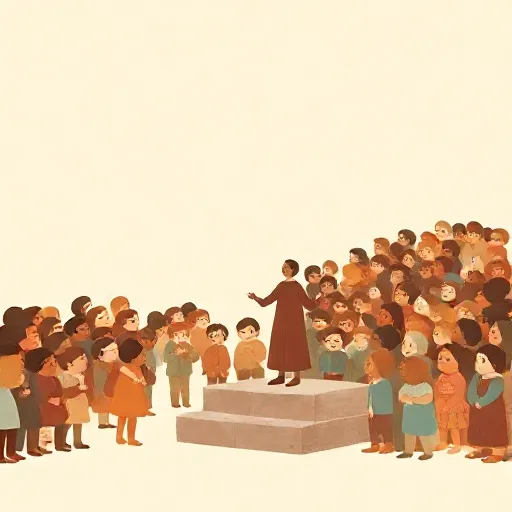
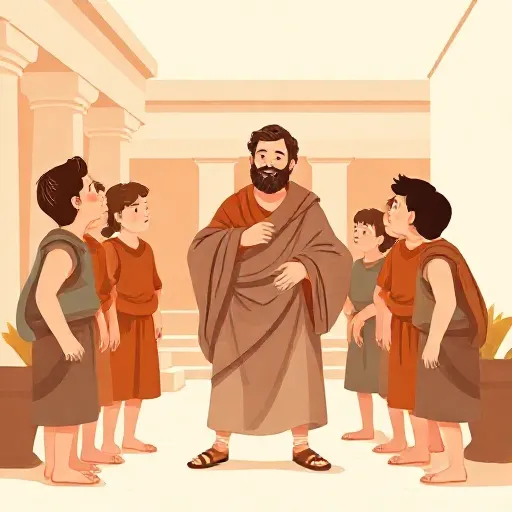
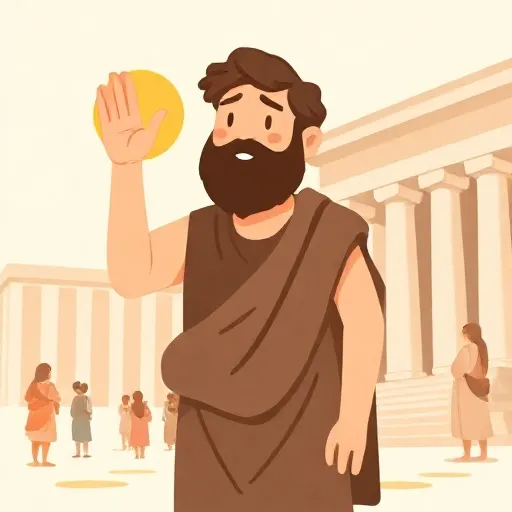
Picture yourself in Athens, sometime around 440 BCE. You’re standing in the agora, the dusty open marketplace where people argue about politics, prices, and the best way to live. A man steps onto a low platform. He’s not wearing fine robes or armour. His name is Protagoras (c. 490–420 BCE), and he calls himself a sophist — a travelling teacher who offers to make his students wise about the things that matter most.
He looks around and begins his speech. What he says next will buzz through the city for decades: Of all things, the measure is humankind — what is, is for it; what is not, is not for it.
That one sentence was the opening of his book Truth. Protagoras wasn’t just trying to sound mysterious. He meant that each of us, as individual human beings, decides what is true and good for us. There is no secret divine rulebook that says what’s really real; the only rulebook is your own experience. And he was willing to teach you how to use that rulebook well — promising euboulia, good deliberation about how to run your household and your city.
What Counts as True? The Man‑Measure Explained

Protagoras’s most famous phrase — often called the Man‑Measure thesis — wasn’t just about facts like “the wind is cold.” Ancient thinkers soon argued it covered all our judgments, from sensations to moral decisions. Plato’s dialogue Theaetetus imagines Protagoras saying: if the wind feels warm to you, it is warm for you. If it feels cold to someone else, it is cold for that person. There’s no hidden “true” temperature that one of you gets wrong.
But Protagoras didn’t stop with breezes. He applied the same logic to value judgments — whether an action is brave or cowardly, just or unjust. Why? Because every judgment you make grows out of your own life story: the experiences, memories, and expectations that make you you. No one else has exactly that history. In his eyes, that makes each person the ultimate judge of how things appear and what they’re worth.
This wasn’t a quiet philosophical exercise. At the time, poets and sages claimed to speak on behalf of the gods or some hidden ultimate reality. Protagoras was pulling the microphone toward ordinary human beings. You don’t need a priest or a mystic to tell you what’s real; you already live it.
Can Everyone Really Be Right?

If each person is the measure of their own truth, a big trouble immediately shows up. Suppose I claim your favourite pizza is disgusting and you claim it’s delicious. Under Protagoras’s idea, both statements would be true — one for me, one for you. But then, critics asked, isn’t the statement “Protagoras’s thesis is false” also true for anyone who believes it? And if that statement is true, then the whole Man‑Measure claim collapses. This is the charge of self‑refutation, and it seemed to pull the rug out from under Protagoras.
There’s another worry too. If my truth is walled off from yours, how can we ever really talk to each other? I say the javelin‑thrower is responsible for an accident; you say it’s the umpire. If we can’t actually contradict anyone, then every debate becomes just two people talking past each other in separate bubbles — a lonely, solipsistic world where teaching would be pointless.
Protagoras had a reply. In the Theaetetus, Plato puts a defence in the dead sophist’s mouth. All beliefs may be equally true as knowledge, but they aren’t equally useful. Wisdom — sophia — isn’t about reaching some absolute truth no one has ever seen. It’s about helping people replace a worse experience with a better one. A doctor doesn’t prove your fever is “false”; she gives you medicine so you feel healthy instead of sick. Likewise, a wise teacher or politician helps a city swap an unhelpful way of seeing things for one that works better. So the measure isn’t just any old opinion — it’s the opinion that makes life more useful in a particular situation. Plural useful solutions can fit the same facts, and no single answer fits all cases.
The Art of the Turnaround: Words and Correctness
Protagoras didn’t just talk about useful judgments; he trained people to make them. Much of his teaching centred on logos — both the power of thought and the skill of speech. He was famous for the claim that “on every matter there are two arguments opposed to one another,” and that a good speaker can “make the weaker argument the stronger.”
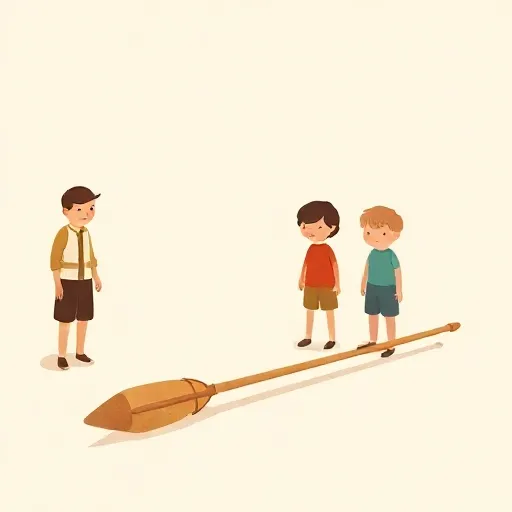
That sounds like trickery, but it fitted his overall view. Since reality doesn’t come with built‑in labels, any event can be seen from different angles. One famous example: a pentathlete accidentally killed a spectator with his javelin. Who was responsible — the javelin, the thrower, or the umpires? Each judgment can be argued. For Protagoras, the challenge was to find the argument that was correct — not the one true answer for all time, but the one best suited to that specific moment, the one most capable of persuading others and bringing order to a messy situation.
He called this search for the fitting argument orthotes — correctness of language and reasoning. The goal wasn’t to bamboozle people but to master the art of choosing which of two opposed logoi (speeches, perspectives) was more advantageous right now. This was a practical superpower in Athens, where you had to speak well to win in the assembly or the courts. Protagoras even dived into grammar, sorting nouns into genders and verb modes, because precise language gave his students an edge.
Gods, Humans, and the City

If Protagoras ever made his listeners gasp as loudly as with the Man‑Measure, it was with the first line of his book On the Gods. He wrote something like this: About the gods I am unable to know whether they exist or not, or what form they have, because the matter is obscure and human life is far too short. Ancient sources called this atheism, but that’s not quite right. Protagoras didn’t deny the gods; he simply said we can’t know — he took an agnostic stance. Human experience, the only measure we have, just doesn’t reach that far.
And yet, when Protagoras wanted to explain how human beings managed to build cities instead of tearing each other apart, he told a myth. In Plato’s dialogue named after him, the sophist spins a story: the gods gave every person a share of aidos (a sense of shame, of respecting others) and dike (a feel for justice). This wasn’t a hidden admission that gods are real; it was a way of saying that what makes us human isn’t clever tools or religious awe — it’s the political instinct we all carry.
Once everyone has a basic fairness‑compass, we can make nomos — human law. Because situations change, nomos changes too. A law that helps one city today might need adjusting tomorrow. The wise leader doesn’t chase a fixed cosmic rightness but figures out which just arrangement is most useful for that community right now. This outlook made Protagoras a natural ally of Athenian democracy, where every citizen had a voice, and collective decision‑making was supposed to steer toward the common good.
Why This Still Matters in Your Own Arguments

Chances are, you’ve already had a Protagorean moment today. Maybe you and a friend disagreed about whether a movie was scary, or whether a rule in a game was unfair. You felt one way, they felt another, and neither of you could prove the other wrong.
Protagoras’s deep question sits right at the centre of that kind of argument: if we each experience the world differently, how do we decide what to do together? He didn’t settle on a final answer, but he gave us two powerful clues. First, take every person’s viewpoint seriously — your experience counts. Second, “true for me” is only the beginning; the real work is figuring out which judgment helps us all live better now.
Two thousand four hundred years after that speech in the Athenian agora, we’re still wrestling with his ideas. Every time a classroom debates whether a rule is fair, every time a family decides where to go on holiday when tastes clash, you’re practicing Protagoras’s craft: not looking for some invisible Final Truth, but seeking the reasoning that fits the moment and respects everyone who is measuring it.
Think about it
- If you and a friend argue about whether a joke is funny and you both really feel differently, is one of you wrong? Why or why not?
- Suppose two cities make opposite laws about the same action — one says it’s allowed, the other says it’s forbidden. Can both laws be right at the same time?
- Imagine a teacher tells you your opinion about a story is mistaken. If Protagoras is right that you are the measure of your own truths, what should the teacher do instead?