The Teacher Who Said Truth Is Whatever You Believe
A Man Who Sold the Art of Winning at Life

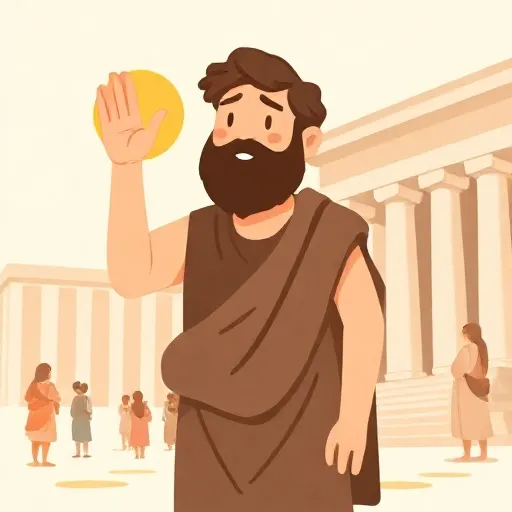
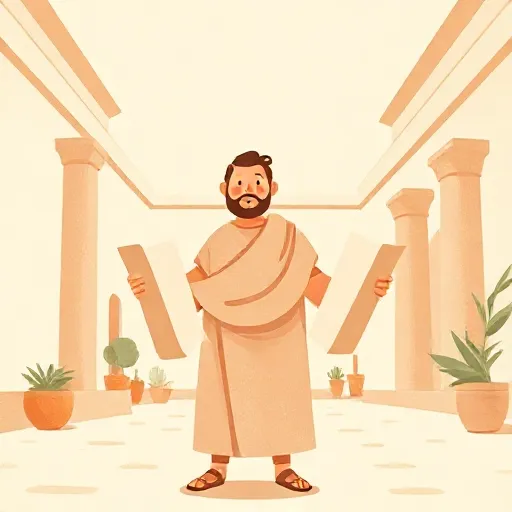
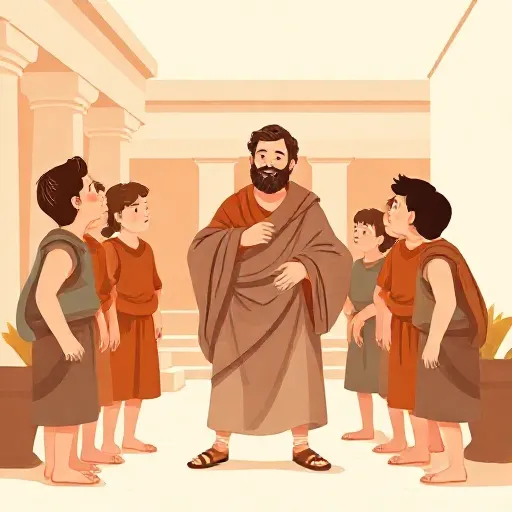
In a grand house in Athens, around 445 BCE, a stranger from the north captured everyone’s attention. His name was Protagoras (c. 490–420 BCE), and he had a startling offer. He would teach you—for a fee—how to manage your own household, how to speak in public so people would listen, and how to become a successful citizen. He called himself a sophist, a word that originally meant a wise person or an expert, but he gave it a new twist. Protagoras was the first person to say openly that he was a sophist and could teach human excellence—the art of winning at life.
That claim was bold, even scandalous, because before him only poets and revered elders were supposed to hand down wisdom about how to live. Yet Protagoras backed it up. In a long speech known as the Great Speech, he told a story of how human beings survived and built civilizations. Early people were weak and had to band together, he said. But they kept fighting unless they developed justice and self-restraint. Those virtues, he argued, are not optional extras. They are natural to us, because without them, families, cities, and the whole human race would perish. So when Protagoras taught someone to be a good citizen, he was really teaching what nature itself demands.
Many rich Athenians flocked to him. He charged enormous fees, drew up laws for a new colony, and for more than forty years enjoyed an amazing reputation as a teacher. He claimed he could argue any side of any question, and he was the first to organize public debate contests—verbal wrestling matches that turned ideas into a spectator sport.
Man Is the Measure—What Does That Mean?

Protagoras is famous above all for a single sentence that still puzzles thinkers today: “Man is the measure of all things, of the things that are that they are and of the things that are not that they are not.” That was the opening of his work Truth, and on its face it sounds mysterious. Plato’s dialogue Theaetetus helps us unpack it. Imagine a cold gust of wind. You feel it and say, “This wind is icy.” I feel the same gust and say, “This wind is warm.” If Protagoras is right, there is no single, objective fact about the wind’s temperature. It is cold for you and warm for me, and both statements are true—relative to the person having the experience. This is subjectivism: the truth of how things appear depends on the individual’s own experience.
Plato shows Socrates stretching that idea to all beliefs. If every belief is true for the person who holds it, then there is no such thing as a false belief. You think a movie is a masterpiece; your friend thinks it is a disaster. Both of you would be right, each in your own private world. But a problem appears immediately. Democritus and Plato both pointed out that this view seems to defeat itself. If “every belief is true for the believer” is itself a belief, then the opposite belief—“not every belief is true”—must also be true for whoever believes it. But that would mean Protagoras’ claim is false. A theory that proves itself wrong by its own logic is self-refuting, and that’s a big trouble for universal subjectivism.
Yet the Theaetetus also suggests a more limited version that Protagoras might have held. When it comes to moral questions, the truth might not be individual but social. What is just or fine for a city is whatever that city believes, for as long as it maintains those beliefs. So if your city thinks a certain practice is right, then it really is right for your city—until the city changes its mind. This is a different kind of relativism: truth relative to a whole community, not to a single person. The two versions don’t fit neatly together, and the ancient evidence is messy. Worse still, Protagoras also said that some beliefs are better than others, and that a wise person—a doctor, a politician, or a sophist—can replace worse appearances with better ones. That seems to assume there really is a fact of the matter about what is better, independent of what anyone happens to believe. It’s a tangled web, and scholars still argue about what Protagoras truly meant.
Nature vs. Convention: Who Made the Rules?

The disagreements about truth spilled into an even bigger argument about right and wrong. The Greeks used two words to separate the sides. Nomos meant law or human convention—the rules we invent. Physis meant nature or the way the world really is. The question was: are moral rules just useful fictions we made up, or do they flow from something real in nature?
Protagoras’ Great Speech put him firmly on one side. He said that justice and self-restraint are not arbitrary inventions. They grew naturally because without them, human groups would tear themselves apart. Morality, for him, was part of physis—a survival tool built into us as social animals. He was, in that sense, a conservative thinker who believed that social virtue is deeply rooted in human nature.
But other thinkers took a far more radical line. In Plato’s Gorgias, a character named Callicles says that conventional morality is a trick. The weak and the many, he claims, invented laws to protect themselves from the strong. In nature, the strong lion takes whatever it wants, and that, Callicles insists, is real justice. Conventional right and wrong are lies designed to keep natural winners in chains. Another writer, Antiphon, argued that laws often tell you to do things that harm your own interests. If you break a law, you suffer only if you get caught. But if you go against your own nature, you suffer automatically—it’s built into the world. So nature’s commands, he thought, are the ones that really matter.
Protagoras stood in the middle of this fire. He believed morality was natural and necessary, but his relativism about truth made it hard to claim that any moral rule was universally and objectively correct. That tension—wanting to ground morality in nature while also saying truth is relative—is exactly what makes his thought so alive. It’s a tension we still feel today when we try to say that some values are more than just opinions.
Gods? Maybe, Maybe Not

Protagoras also had something to say about the gods, and it was extraordinary for its time. His book On the Gods began with a sentence that has echoed through centuries: “Concerning the gods I am not able to know either that they exist or that they do not exist or what their nature is; for there are many things which prevent one from knowing, both the unclarity of the subject and the short span of human life.” This is a clear statement of agnosticism: the position that we simply cannot know whether gods exist.
Notice what he did not say. He did not say, “There are no gods.” He said the evidence is too murky and human life too brief to settle the question. And there’s good reason to think that, in practice, he was not a rebel. He probably supported traditional religious customs because he thought they helped hold cities together. Later gossip claimed that his book was publicly burned and that he had to flee Athens in disgrace. Yet Plato’s dialogue Meno suggests that Protagoras kept a spotless reputation for forty years. Maybe his careful agnosticism, paired with a respect for social custom, kept him safe while other questioners of tradition ran into trouble.
Why It Still Matters

You might never use the word “sophist,” but the questions Protagoras raised are alive in your own life. When you and a friend disagree about whether a song is great and you say, “Well, that’s just your opinion,” you’re borrowing a tiny piece of Protagorean subjectivism. When you wonder whether a school rule is fair just because adults made it, or whether fairness itself has a real nature that the rule might miss, you’re stepping right into the nomos–physis debate. And when you’re not sure whether something exists but still feel it’s important to act a certain way—like respecting traditions even while asking hard questions—you’re touching the edge of agnosticism.
Philosophers today still argue about whether truth is something we discover or something we construct. They argue about whether moral values have any foundation beyond what a group of people decide. Protagoras gave the ancient world one of its boldest expressions of the idea that truth depends on the person looking at it. Whether you find that idea exciting or unsettling, it’s an idea that refuses to go away—and it started with a teacher in Athens who claimed he could make anyone a winner.
Think about it
- If a classmate thinks a movie is terrible and you think it is brilliant, can you both be right about its quality? Or does one of you just have worse taste?
- Imagine your school creates a new rule that nobody is allowed to speak at lunch. Could that rule ever be genuinely unfair, or is it fair simply because the school decided it?
- If nobody can prove whether something exists, is it ever wise to act as if it does? Think of things like luck, justice, or even friendship—do they stop mattering if you can’t measure them?