
Can Two People Believe the Exact Same Thing?
What do you believe when you believe something?

Imagine you’re in your room, watching your cat purr, and you think, “My cat purrs.” At the exact same moment, your friend across town watches her cat and thinks exactly the same words. Did you two think the same thing? If so, what is that thing? Is it something real, like a rock or a number, or just a convenient way of talking about two separate brain events? This question sits at the heart of a long‑running philosophical puzzle: are there propositions?
A proposition is what you believe, doubt, or assert. It is the content of a thought or a statement — the “what is said” that can be true or false. The English sentence “Cats purr” expresses the proposition that cats purr. That proposition is either true or false, and it can be believed by millions of people at once. But does it actually exist?
The ancient idea of “what is said”
The hunt for such a thing began over two thousand years ago. Around 300 BCE, the Stoic philosophers in Athens were the first to clearly separate the physical sounds of speech from what they called the lekta — “what is said.” They noticed that when you say “Cato is walking,” the sound waves hit the ear, but what you actually state is something different: an incorporeal “sayable” that is the real bearer of truth or falsehood. For the Stoics, this lekton, not the noisy words, was the proper subject of logic.
The idea reappeared in the Middle Ages. Peter Abelard (1079–1142) distinguished between the act of thinking and the dictum — what is thought or said. His followers debated hotly: are dicta particular mental events, or are they something more like universal patterns? In 1837, Bernard Bolzano (1781–1848) proposed Sätze an sich — “sentences in themselves” — that are neither physical marks nor mental acts, but abstract content that science tries to capture. Then came the philosopher who shaped the modern debate: Gottlob Frege (1848–1925).
Frege argued that thoughts (his word for propositions) live in a third realm. They are not in the outer world of chairs and sounds, and they are not inside any one person’s head. A thought, he said, is like a public square — anyone with a mind can stand in it. The proposition that 2+2=4 is true even if no one is around to think it. It doesn’t need an owner. On this view, propositions are abstract, timeless objects, just as real as numbers but not made of matter.
The “Metaphysics 101” argument for propositions
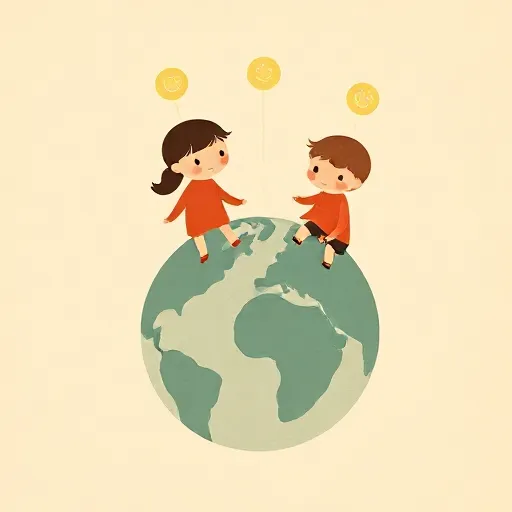
Why would anyone think such invisible objects exist? The simplest reason is what some call the Metaphysics 101 argument. Whenever you have a belief, you can separate what you believe from your act of believing it. For instance, you and your friend both believe that Homer wrote the Iliad. What you believe is the same thing — it can be asserted, denied, doubted, and it is either true or false. That shared object, the argument says, just is a proposition. Without propositions, it seems hard to explain how two minds can grasp the very same content, or how the English sentence “Snow is white” and the Japanese sentence “雪は白い” can mean the same thing.
The argument feels almost too simple: from the fact that you and I can believe the same thing, it leaps to the claim that there is a special kind of entity — a proposition — out there in reality. Some philosophers suspect that the argument hides a trick of language, as if the word “same” lures us into inventing a thing when we really only have similar brain states. But before we judge, we must face some serious doubts about propositions themselves.
Russell, Moore, and the problem of false belief

In the early 20th century, two famous philosophers who had once believed in propositions began to worry. G.E. Moore (1873–1958) asked: when you believe a falsehood, like that the moon is made of cheese, what exactly are you believing? If there is a real proposition “the moon is made of cheese,” it seems to be a thing that exists while being false. But how can a false thing be part of reality? Moore was troubled by the idea that believing a falsehood is just a relation to an object that certainly exists — for if the belief is false, it seems the object should not exist.
His friend Bertrand Russell (1872–1970) proposed a different picture. Maybe believing isn’t a two‑place relation between you and a proposition. Instead, when Othello believes that Desdemona loves Cassio, Othello stands in a multiple relation directly to Desdemona, the relation of loving, and Cassio. There is no ghostly proposition hovering in between. The belief is true if those three real things are actually arranged the right way. This view let Russell avoid a realm of permanent false propositions.
Modern linguists have added another challenge: the substitution problem. If propositions are what “that”-clauses name, then you should be able to swap “the proposition that p” for “that p” without changing the truth of a sentence. But try it: “I imagine that it will snow” is true, while “I imagine the proposition that it will snow” sounds odd and might be false. You don’t imagine an abstract proposition; you imagine snowy weather. Such failures suggest that “that”-clauses don’t always behave like names, casting doubt on the idea that they automatically pick out a distinct kind of object.
If propositions exist, what are they made of?
Suppose propositions do exist. What are they? Frege’s Platonist answer treats them as abstract, structured complexes of senses — ingredients like the sense of “cat” and the sense of “purrs” — that exist outside space and time. But many philosophers find this spooky: how do our physical brains ever make contact with such non‑physical objects?
A more recent view, defended by Peter Hanks and Scott Soames, says propositions are types of actions. Just as a musical score is a type that can have many performances, a proposition is a type of predicative act — the act of mentally or linguistically representing something as being a certain way. When you think “the cat is on the mat,” you perform a token of this act type. Propositions exist, but they aren’t floating in a third realm; they are abstract patterns of possible thoughts. Even if no one has ever performed a particular act of predicating, the type can still exist, much like a difficult dive that no one has ever attempted.
Still another approach, from Stephen Schiffer, treats propositions as pleonastic entities — they exist, but only as shadows cast by our language. If you accept the sentence “Snow is white,” you automatically get the proposition that snow is white, and it is true. Such propositions are a kind of “ontological free lunch”: they don’t add anything genuinely new to the world, but they are harmless and useful. On this view, propositions are mind‑independent on paper, but they don’t create the deep mysteries that Platonism does.
Why the debate still matters

Why should a twelve‑year‑old care whether propositions exist? Because the answer shapes how we understand truth, knowledge, and even right and wrong. If there are no propositions, then what exactly is true or false? We might be forced to say that only sentences or brain states are true, which leads to tricky questions: “Snow is white” is true because snow is white, but what makes a brain state true? Propositions give a clean stop: a belief is true when the proposition it grasps is true.
Propositions also matter for logic. When we say “Everything Thomas said, Charles believes,” we seem to be counting over things that can be said and believed — exactly the role of propositions. Without them, the logic of our everyday talk becomes much harder to explain. And in ethics, the question returns with force: if there are no moral propositions, can we really say it is true that cruelty is wrong, or is that just a feeling? The debate about propositions is not just about weird invisible objects; it is about whether our shared world of ideas has any solid ground.
Think about it
- If you and a friend both believe a certain number is prime, but no one has ever proved it, does the proposition that the number is prime already exist? Why or why not?
- Imagine a machine that records every belief anyone will ever have. Could there still be a true proposition that never gets recorded? If so, where would it “be”?
- Think of the sentences “I insist that it will rain” and “I insist the proposition that it will rain.” Why might the second one sound off, even if propositions are real?