
Are All Necessary Truths the Same One Thought?
The Locket Puzzle
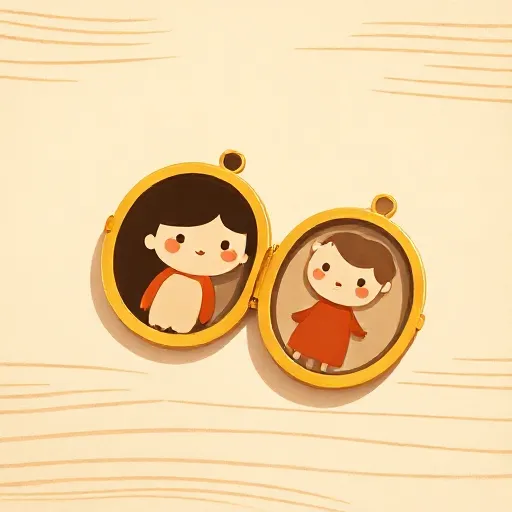
Imagine you have two lockets that look exactly alike from the outside. You open one and find a miniature man in a tuxedo. You open the other and see a sparkling prism. Even though the lockets are identical on the outside, you’d never say they’re the same inside.
Now think about two sentences: “All bachelors are unmarried” and “All brothers are male siblings.” Both are true no matter what — in every possible situation, they hold. But they sure feel different. You could easily know the first one without even thinking about the second. So are they really saying the same thing?
Philosophers call what a sentence says a proposition — the thought or content you grasp when you understand the sentence, and the thing you believe when you take it to be true. The puzzle is whether a proposition is something like the outside of a locket (a simple yes‑or‑no pattern that repeats in every possible world) or more like its inside (a built‑up structure with many parts). This article is about why that difference matters so much — and how it changed the way we think about language, thought, and knowledge.
The World‑as‑a‑Set View (And Why It Cracks)

In the middle of the twentieth century, logicians and philosophers built a new way to study necessity and possibility. They imagined possible worlds — complete ways the whole universe could have been. Some worlds are very different from ours (donkeys talk, gravity pushes sideways), and some are almost the same. The idea was to say a sentence is necessary if it’s true in every possible world.
From there, many theorists took a bold step: they said a proposition just is the set of all possible worlds where the sentence is true. So “snow is white” gets the set of worlds where snow is white, and “grass is green” gets the worlds where grass is green. This view is wonderfully clean. But it has a startling consequence.
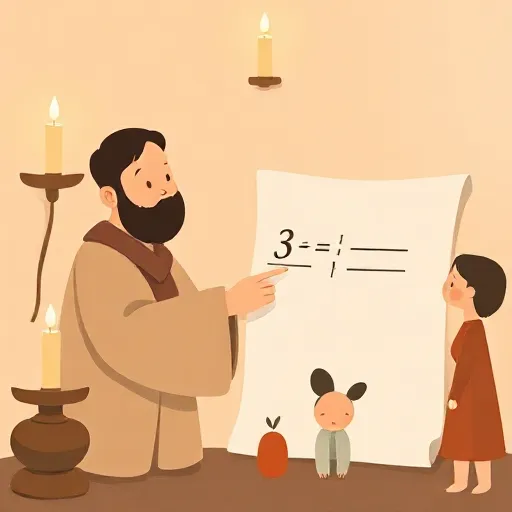
Take any sentence that’s necessarily true, like “2+2=4” or “all triangles have three sides.” On the possible‑worlds view, both are true in all possible worlds. That means each gets the exact same set — the set of all worlds. So they express the very same proposition. If you believe one, you automatically believe the other. If someone learns a new math theorem, they aren’t learning anything new — they already believed that proposition! This flattening of all necessary truths into one giant thought struck many philosophers as absurd.
That is why thinkers began to look for a finer‑grained picture. They wanted a theory where the meaning of a sentence has structure, a kind of inner anatomy. Then two sentences could be true in all the same worlds but still be different thoughts, because they would be built from different ingredients. The search for a good structured proposition account was on.
Russell’s Mountain and the Direct‑Reference Revolution

Long before the possible‑worlds view crumbled, Bertrand Russell (1872–1970) had already drawn a very different map. Russell insisted that the proposition that Mont Blanc is over 4,000 meters high contains the actual mountain — snowfields and all. It is not built from private mental pictures or shadowy senses; the real object is right there, inside the thought.
This meant that for Russell, the parts of a proposition are often concrete things: a person, a mountain, a relation. A sentence like “Socrates is human” expresses a structured whole composed of the man Socrates, the concept of humanity, and an act of “tying” them together. Russell’s picture, though hard to make precise, planted a seed that grew vigorously late in the twentieth century.
Saul Kripke (1940–2022) argued that ordinary proper names are rigid designators: they pick out the same individual in every possible world where that individual exists. If you say “Aristotle was a great philosopher,” the truth of that sentence in another possible situation depends on the properties of the very same man, Aristotle. David Kaplan (b. 1933) then pointed out that some expressions, like the word “I,” are directly referential: their only job is to contribute the speaker herself to the proposition. When you say “I ski,” the proposition is about you, plain and simple — no descriptive detour.
These ideas gave birth to what is now called the neo‑Russellian approach, championed by Scott Soames (b. 1946) and Nathan Salmon (b. 1951). On their view, a sentence like “Scott runs” expresses a structured proposition whose parts are Scott himself and the property of running. The parts are joined together in a way that mirrors the sentence’s grammar. Because different sentences can contain different properties and relations, two sentences that are necessarily equivalent — like “all bachelors are unmarried” and “all brothers are male siblings” — can express different propositions. The locket puzzle is solved: the inside matters.
This solution comes with a surprising twist. If names simply drop their bearers into the proposition, then “Mark Twain is Samuel Clemens” and “Samuel Clemens is Samuel Clemens” end up expressing the same proposition. Both say that a certain man is identical to that same man. Yet one sentence feels informative and the other doesn’t. Saying that they really mean the same thing can seem to make learning or confusion impossible, and many philosophers find that hard to swallow. The debate is far from over.
The Glue Problem — How Do the Parts Hold Together?
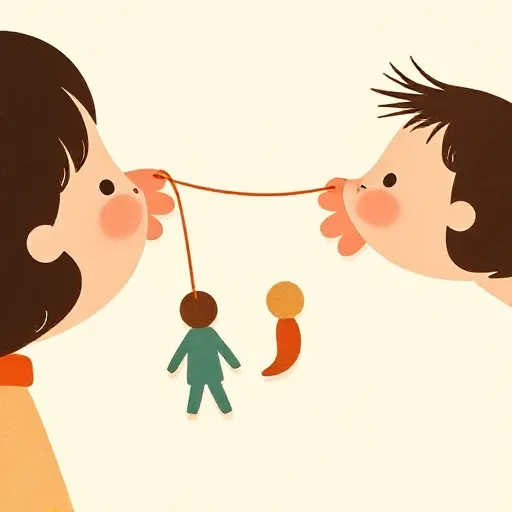
If a proposition is just a list of parts, an ordered tuple like <Scott, the property of running>, why should that list be true or false? A grocery list isn’t true or false — it just is. So something must glue the pieces together in a way that makes the whole answerable to the world. This is the glue problem.
One inventive answer comes from Jeffrey King (b. 1963). He argues that the glue is the very sentence we use, together with the way speakers of a language interpret its grammar. When English speakers see “Dara swims,” they automatically take the ordering of the words as ascribing the property of swimming to Dara. That is a habit we’ve learned — nothing forced it to be that way. The proposition that Dara swims, on King’s view, is the fact that there exists a sentence whose structure, as interpreted by some language community, ascribes swimming to Dara. The proposition gets its truth conditions (it is true if Dara really does swim) from that interpretive act — not from some mysterious abstract cement. The power of representation flows from our minds and languages into the proposition, not the other way around.
Other structured‑proposition theorists reach for a different toolbox. Edward Zalta (b. 1952) and his followers treat propositions as the result of applying logical operations to basic ingredients. You take the property of running, “plug” Scott into its argument place, and out comes the proposition that Scott runs — a complex entity that is true just in case Scott has that property. The glue, in this algebraic picture, is the very operation of plugging. No separate tying relation is needed; the structure is built into the application itself.
What all these accounts share is the conviction that a proposition isn’t just a heap. It has an architecture, and that architecture is what makes it capable of being judged true or false. Philosophers still argue fiercely about which architecture is right, but they agree that the structure itself must explain how a thought touches reality.
Why This Fight Over Thoughts Matters to You

You might wonder: why should I care whether the proposition that 2+2=4 is the same thing as the proposition that all bachelors are unmarried? The answer is that it affects how we understand learning, surprise, and thinking itself.
Imagine you’re doing a math problem and you suddenly realize that 561 equals 3 × 11 × 17 — and that this means it passes a certain test you’d been wondering about. You feel like you learned something. But if the proposition expressed by “561 is a Carmichael number” were identical to the one expressed by the endlessly long conjunction of every necessary truth, you would already have believed it. There would be no genuine discovery. The structured‑proposition story lets you keep your eureka moment: the thought you grasped has a new internal arrangement of parts, even though its truth in all possible worlds was already guaranteed.
The same goes for everyday communication. When a friend tells you “a bachelor is an unmarried man” for the first time, you acquire a new piece of knowledge about the word “bachelor.” On the possible‑worlds view, you’d have already believed the proposition all along, which seems wrong. Structured propositions carve up thoughts finely enough to make sense of why some sentences feel informative and others don’t. This matters not just for philosophy but for building computers that can understand language, for teaching, and for seeing how our minds can hold distinct thoughts about the same eternal truths.
The lockets are still on the table. From the outside they are identical — always true in every world. But when philosophers insist on looking inside, they find whole miniature worlds of difference. And that, it turns out, makes your own thinking a much richer place.
Think about it
- Imagine a language where the sentence “all bachelors are unmarried” and the sentence “all triangles have three sides” are treated as meaning exactly the same thing. What would it feel like to speak that language? Could you ever be surprised by a new mathematical proof?
- If a computer was programmed to believe that “Mark Twain is Samuel Clemens” but not to believe that “Samuel Clemens is Samuel Clemens,” would that computer be irrational? How would you decide which thought it really has?
- When you learn a new fact that you realize was always true — like the secret identity of a character in a story — what changes in your mind? Does that change feel more like adding a new ingredient or like rearranging pieces you already had?