Is ‘Taller’ Something Real, or Just a Way of Talking?
When a Teacher Asked a Tricky Question in Paris
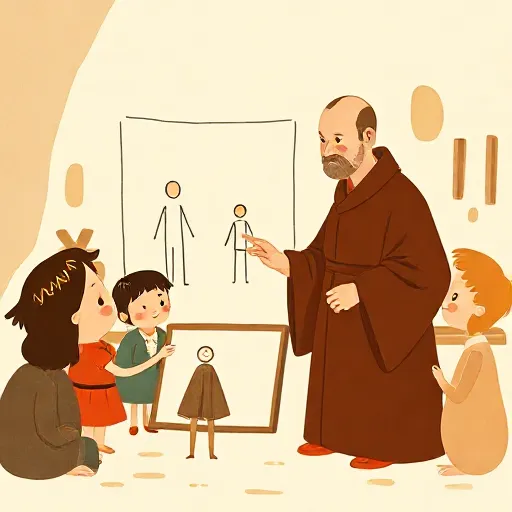
In 1121, the sharp‑tongued teacher Peter Abelard (1079–1142) stood before his students in Paris and offered a puzzle. Imagine Simmias is taller than Socrates. Is “taller than” something real—like a stone or a robe—or is it just a way of saying that the two men have different heights? Abelard’s question wasn’t merely clever wordplay. It pointed straight at a mystery that had been bothering thinkers since the time of Aristotle: what kind of thing is a relation?
Aristotle’s Big Idea: Ten Kinds of Things

Aristotle (384–322 BC) divided everything that exists into ten ultimate categories. Some things are substances—like a person, a horse, or a stone. Other things are accidents—properties that exist only in a substance, such as its color, its height, or its weight. Among the accidents, Aristotle set aside a special category for relations, which he called “things toward something” (pros ti). A relation always points beyond itself. When we say “Simmias is taller,” the phrase is incomplete; we must add “…than Socrates.” Words like ‘taller,’ ‘father,’ or ‘double’ are relative terms because they need a second thing to make sense.
Aristotle insisted that not every relative term points to a real relation. “Head” is a relative term—you are always a head of some body—but a head is a substance, not a relation. So he defined real relations as those accidents that actually serve to relate two things. In his Categories, he suggested a model: whenever two substances are related, such as Simmias and Socrates in height, there must be a pair of accidents, one in Simmias that relates him to Socrates, and one in Socrates that relates him back. This picture—two things plus two linking accidents—became the standard medieval way of thinking about relations.
The Great Debate: Are Relations Real or Reducible?

Medieval thinkers accepted Aristotle’s claim that relations must be accidents, but they split into two camps over what kind of accidents they are. Reductive realists, like Abelard and later William of Ockham (c. 1287–1347), argued that a relation such as “taller than” is nothing over and above the ordinary heights of the two people. When Simmias is taller than Socrates, the only real things are Simmias, Socrates, and their two heights (a quantity). The relation is just those heights in a certain situation.
Non‑reductive realists, such as Albert the Great (c. 1200–1280) and John Duns Scotus (c. 1266–1308), replied that relations are a special kind of accident—something sui generis (of its own kind). They pointed out that relative terms like “taller” are logically incomplete in a way that ordinary words like “white” are not. Every relative term comes with a built‑in partner (“taller” ↔ “shorter”), and you can’t understand one without the other. That, they said, shows that relations have a different nature—a special “toward‑ness”—that goes beyond mere heights.
Reductive realists fired back with a razor‑sharp argument, later made famous by Ockham: “Plurality should not be assumed without necessity.” Why invent mysterious relational accidents when ordinary quantities and qualities already do the job? Non‑reductivists responded that experience forces us to add them: when Simmias grows and Socrates stays the same, Socrates becomes shorter without changing his own height. If relations were nothing but the heights, Socrates would have to undergo a real change in his height, which doesn’t happen. So there must be something extra—a relational accident—that accounts for the new fact.
When God Created the World Without Changing

The debate took an unexpected turn when medieval thinkers looked at problems borrowed from Christian theology. According to the Bible, God created the world at a moment in time. If God is perfect and unchanging, how could He acquire a new relation like “being Creator” without changing? The early Christian writer Augustine (354–430) proposed a startling answer: the relation exists only in the creature, not in God. When a coin becomes more valuable, it does not change; only people’s thoughts about it change. In the same way, God’s “being Creator” is real only on the side of creation.
Later thinkers added a famous non‑religious example from the Roman philosopher Boethius (c. 477–524). Imagine you walk up to a column and stand to its right. Suddenly the column is “to the right of you,” yet the column itself hasn’t budged or acquired anything new. The relation is entirely in you—in your position. These puzzles led to the idea of relations of reason (relatio rationis). A relation of reason does not exist in the world independently of a mind; it is a comparison or ordering that a mind makes.
Thomas Aquinas (c. 1225–1274) put these insights together. He taught that relations can be of three types: (1) real on both sides, like tallness when both people have actual heights; (2) real on one side and merely a relation of reason on the other, like knowledge—you are really related to the thing you know, but the thing known doesn’t have a real relation back to you; and (3) purely a relation of reason, like self‑identity (being “the same as yourself”) which exists only because your mind thinks of one thing twice. Aquinas used this scheme to explain creation, the column example, and even the Christian doctrine of the Trinity—where God is said to contain real relations like Fatherhood and Sonship that are somehow identical with God’s own substance. That forced a rare admission: in God, a substance can be a relation.
Ockham’s Razor and the End of Real Relations
William of Ockham took reductionism to its logical extreme. He agreed that truths like “Simmias is taller than Socrates” are true because the two men have the heights they do—the mind doesn’t make Simmias taller. But Ockham insisted that the word “relation” does not name a real thing at all. It belongs to a special family of concepts called second intentions—concepts that are about other concepts, not about objects. When we say “There is a relation of tallness,” we are just using a mental label to talk about the pair of heights.
Ockham loved the principle now called Ockham’s razor, which says that plurality should not be assumed without necessity. Since heights alone are enough to make comparative statements true, he saw no need to add invisible relational accidents. He still believed real relations exist in one sense—the world truly contains husbands, sons, and tall people—but he denied that there is any extra “relation‑stuff” out there. This was a revolutionary shift. After Ockham, many philosophers began to treat all relations as things that exist only in the mind, even while admitting that their foundations—the ordinary substances and accidents—are perfectly real.
Why the Fight Over ‘Taller’ Still Matters

You use relations every day. You say “I’m taller than my cousin” or “She’s my best friend.” Are those relationships real things, or just convenient ways of talking? The medieval debate matters because it forces us to ask what kind of world we live in. Is it a world full of invisible threads connecting people and things, or just a collection of individual objects that we carve up with labels?
Think about being someone’s child. That relationship seems real no matter what anyone thinks. But what about being someone’s “best friend”? If you stop talking and drift apart, does the friendship slowly vanish, or was it never a solid thing at all? The medievals didn’t settle the question, and we haven’t either. Their arguments remind us that some of the things that matter most to us—like love, loyalty, and belonging—might be partly created by the way we think about them. The next time you sort your phone contacts into “close friends” and “everyone else,” you’re doing exactly the kind of philosophy that started with Abelard in that Paris classroom.
Think about it
- If everyone forgot that you were your mother’s child, would you still be her child? Why or why not?
- Suppose two countries are at war, but no person on Earth knows about the war. Are the countries still at war?
- Imagine two people who were best friends a year ago, but they haven’t spoken since. Does the friendship still exist? Does it depend on what they think, or what they do?