Are You Just Guessing? The Philosopher Who Said All Knowledge Is a Bet
The Case You Can Never Close for Sure
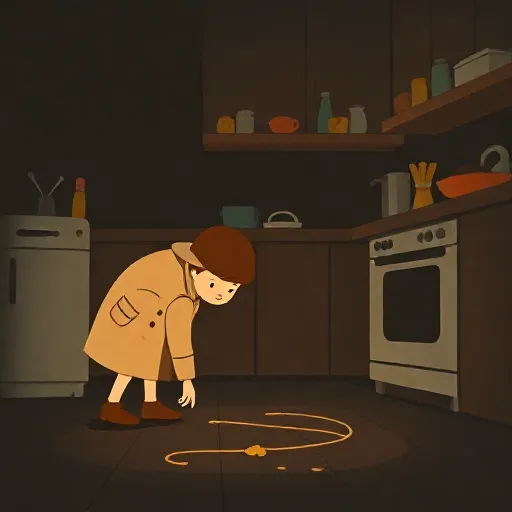
Imagine you walk into the kitchen and find the cookie jar empty, a few crumbs on the counter, and your dog looking especially pleased with himself. You can’t rewind time to see what happened. You have to reason backward from clues to the most likely explanation. But can you ever be totally sure the dog did it? What if a sneaky sibling framed him?
That feeling — that knowledge is always a kind of high-stakes guessing from clues — was the starting point for Hans Reichenbach (1891–1953). Born in Hamburg, Germany, he studied physics and mathematics with brilliant minds like Max Planck and Albert Einstein. When the Nazis came to power, he fled to Turkey and later to Los Angeles. Wherever he went, he was absorbed by one huge question: if we can never absolutely prove anything from experience, how can we possibly claim to know anything at all?
Reichenbach’s answer was deceptively simple: all knowledge is probability. It’s never certainty. And that’s okay — as long as we have good rules for making our guesses.
Probability Means Counting in the Long Run
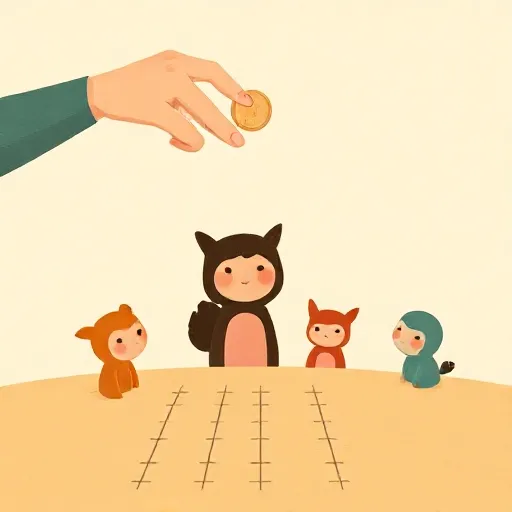
Before Reichenbach, many thinkers treated probability as a measure of your personal confidence — like how sure you feel that it will rain. Reichenbach said that wasn’t good enough for science. He argued for an objective interpretation: a probability is the relative frequency of something happening in a long series of events.
Flip a fair coin once, and you can’t predict the outcome. But flip it thousands of times, and the proportion of heads will settle close to 50%. That limit, for Reichenbach, is what we really mean when we say “the probability of heads is one half.” Probability isn’t inside your head; it’s a real feature of the world, measured by counting over and over in the long run.
This matters because, in his view, every scientific claim — from “water boils at 100°C” to “electrons exist” — is a probability statement about frequencies. We never observe a law directly; we notice patterns in data and bet they’ll continue.
The Straight Rule and the Leap of Faith
So how do we get from what we’ve seen to what we haven’t seen yet? Reichenbach proposed something he called the straight rule: take the relative frequency you have observed and assume it will be the probability going forward. If 90% of the swans you’ve seen are white, then predict that 90% of all swans are white — and that the next swan you meet has a 90% chance of being white.
But he admitted the straight rule itself cannot be proved. You can’t show it works without already assuming the future will resemble the past. His solution: we make a posit — a kind of practical bet or leap of faith. When we have no data yet, we make a blind posit, like a first guess. When we collect more and more data, we can appraise our posits by higher-level frequencies. If you check many different lakes and find 90% white swans in each, your confidence that the true proportion is near 90% gets stronger. But at the very top, there’s always a blind posit: we just have to trust that our betting strategy will work.
Some philosophers pushed back hard. C. I. Lewis, a contemporary, said that if anything is probable, then something must be absolutely certain — maybe your own sense experiences. Reichenbach said no: even your raw impressions only give you probabilities about the world. You could always be dreaming or deceived. For him, the whole edifice of knowledge floats on bets, with no unshakable floor.
The Hidden Puppeteer: How to Spot a Common Cause

Every morning, the rooster crows and then the sun rises. Does the rooster make the sun come up? Obviously not. But how can we prove it? Reichenbach spent decades developing a tool for this: the principle of the common cause.
Suppose two events, A and B, often happen together — like ice cream sales and drownings both going up in summer. Reichenbach argued that if neither causes the other directly, there must be some third event C that raises the probability of both. Here, C is hot weather. Mathematically, once you know it’s hot, knowing about ice cream sales doesn’t tell you anything extra about drownings. The common cause screens off the correlation.
He also hunted for a way to tell which direction the causal arrow points. He imagined marks — like a dye you inject at the start of a process. If you mark a light beam with a colored filter at the source, the mark shows up at the destination; but if you mark the destination, the source stays clean. That asymmetry, he thought, is the fingerprint of cause and effect.
The common cause idea was one of Reichenbach’s greatest hits. It gave statisticians a way to think about hidden variables — the invisible forces that make things happen together. Today, it sits inside the “causal Markov condition” that computers use to map out chains of cause and effect in everything from medicine to economics.
The Critics Who Wouldn’t Let Him Rest

Reichenbach’s work didn’t go unchallenged. Ernest Nagel, a tough-minded American philosopher, pointed out a big hole: if we should evaluate theories using Bayes’ rule (which Reichenbach sometimes suggested), we need a prior probability for the theory before any evidence. But how do you get a frequency for a whole theory? We can’t count how many theories are true in some reference class, because we don’t know which ones are true. Reichenbach’s answers were vague and left the problem festering.
Karl Popper, a Viennese philosopher who loved a good fight, rejected Reichenbach’s whole picture. Popper thought induction — the very idea that past experience makes the future probable — was a myth. Science doesn’t confirm theories, he said; it only falsifies them. Reichenbach replied that even falsification depends on probability judgments when data might be wrong.
Meanwhile, C. I. Lewis kept insisting Reichenbach’s system needed a bedrock of certainty. Reichenbach called that a mathematical confusion. The debate was never fully settled; philosophers still argue about whether all reasoning rests on some unproven faith, or whether we can build a web of guesses that mutually supports itself.
Why It Matters Every Time You Check the Weather

Reichenbach’s fingerprints are all over how you navigate the world. When a weather app says there’s a 70% chance of rain, it’s using exactly his frequency idea: in the past, when conditions looked like this, rain happened 70 times out of 100. When a doctor says “this treatment works,” she’s not promising a miracle; she’s giving you a probability based on how many patients improved in the past.
His common cause principle has become a workhorse in science. Epidemiologists use it to figure out whether a new disease is caused by a virus or by something in the environment. Computer scientists use it to build machines that learn causal maps from raw data. Reichenbach’s deepest lesson, though, is about intellectual humility: you don’t need to be 100% sure to act wisely. You just need better bets than the alternatives, and a willingness to change your mind when new clues arrive.
The next time you solve a small mystery — who finished the cereal, why your friend is upset — you’re doing what Reichenbach described. You gather evidence, weigh frequencies, imagine hidden causes, and accept that you’ll never have a guarantee. That’s not a flaw in your thinking. It’s how thinking works.
Think about it
- If you had to bet your week’s allowance on whether the sun will rise tomorrow, would you say you “know” it will rise, or only that you’re overwhelmingly confident? What would change if you were betting someone else’s money?
- Can you think of something you are absolutely certain about — so certain that no possible experience could change your mind? What would Reichenbach say about that belief?
- Suppose two things always happen together at your school, like the cafeteria running out of pizza every time there’s a fire drill. How could you use Reichenbach’s idea of a common cause to figure out whether one causes the other, or whether something else explains both?