
The Rebel Professor Who Thought School Should Actually Be Useful
A Murder in Paris — and a Life That Defied Expectations

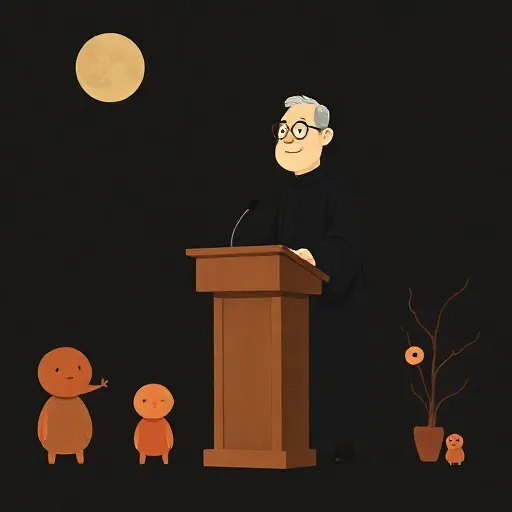
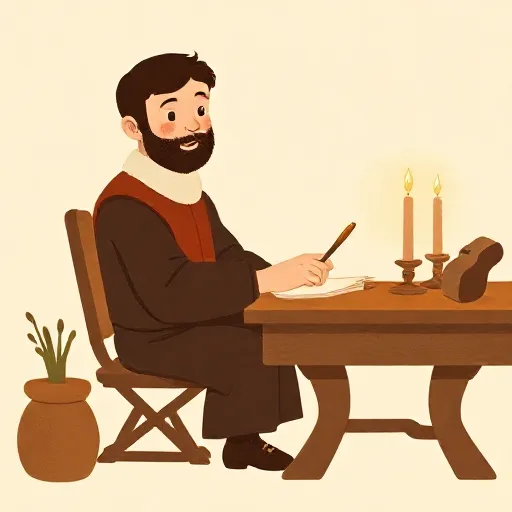
On August 24, 1572, a professor named Petrus Ramus (1515–1572) sat writing in his study. Outside on the Paris streets, a religious mob was hunting Protestants. Ramus had recently converted to the Reformed faith, but his enemies probably used the chaos to settle old scores. By the third day of the massacre, men broke into his room, murdered him, mutilated his body, and threw it into the Seine. Ramus became a martyr to his followers — not just because of his religion, but because he had spent decades fighting a different war: a war against the way universities taught students.
Ramus had come from almost nothing. He was born in a tiny village in Picardy, the son of a man who at times had to work as a charcoal-burner. After losing his father as a young boy, Ramus worked as a foot-soldier and a servant just to survive. When he finally reached the University of Paris, he was so determined to succeed that he slept barely three hours a night, earning money by helping richer students. The grueling schedule gave him a painful eye disease, but it never dimmed his ambition. He earned a Master of Arts in 1536, already burning with frustration at the curriculum he had to endure.
Why Ramus Hated How He Was Taught

The medieval university taught what was called scholasticism, a system that forced students to memorize mountains of rules, definitions, and disputation techniques — often in clumsy, artificial Latin. Ramus thought it was a waste of time. He said that after studying logic from the popular textbook of the day, he had not become more skilled at history, poetry, or even arguing a case. Nothing he learned seemed to connect to real life. According to a story that may not be altogether true, Ramus burst onto the scene in 1536 by defending the shocking claim that everything Aristotle had written was false. Even if the event never happened, it perfectly captured his reputation as a rebel.
His real target was not Aristotle himself but the university professors who, he believed, had buried the ancient philosopher’s insights under centuries of bad commentary. Ramus argued that Aristotle had been a free thinker who questioned everything. The problem was that his later interpreters turned his books into a rigid, illogical maze. Ramus wanted to replace that maze with something that students could actually use. His first two textbooks, published in 1543, were so provocative that they were censored and banned, and he himself was temporarily forbidden from teaching.
Three Laws That Organized All Knowledge

If he was going to tear down the old system, Ramus needed a new one. His answer was a set of iron rules for building any art — by “art” he meant any body of knowledge or skill, from geometry to grammar. Every art, he said, must follow three laws.
The first was the law of truth. Every rule or statement inside an art must be true for the whole subject, not just for a lucky example. Saying “the angle of a triangle is a right angle” would be a mistake, because it’s only true for some triangles. Saying “the angles of a triangle always add up to 180 degrees” satisfies the law, because it holds for every triangle.
The second and most important was the law of justice. It said each art must keep to its own proper territory. You cannot let a rule from mathematics sneak into physics or a claim from astronomy wander into grammar. This is why Ramus objected to Copernicus’s astronomy: Copernicus used mathematical hypotheses to describe how planets might really move, mixing two arts that law required to stay separate. Justice, for Ramus, was about giving each subject its own clean, untangled set of rules.
The third was the law of wisdom. Every art must be arranged from the most general truths down to the most specific details. You start with what is true of all triangles before you discuss isosceles triangles alone. Ramus was convinced that the order of nature matched the natural order of human thinking. Starting with the biggest ideas and drilling down, he believed, was not a human invention — it was built into the world.
Logic That Actually Works for Real People

For Ramus, logic was not a cold, abstract instrument for arguing about angels. It was the ars bene disserendi — the art of discussing something correctly and clearly, a natural skill every mind possesses. He rejected the idea that logic was merely a tool to serve other sciences. Instead, following the ancient Stoics, he made logic a full part of philosophy, one that actually tells you something about the world, not just about words.
His logic had two great halves. The first, inventio, was the art of finding good arguments. Ramus believed you could discover arguments inside a topic by systematic questioning: looking for causes, effects, parts, and opposites. The second half, iudicium or judgment, taught you to organize those arguments into clear propositions and build them step by step. The highest part of judgment was method, which Ramus treated as the one and only correct way to order any art from general to particular. He even claimed that poets like Virgil used the same natural method, even if they sometimes disguised it for artistic effect.
What made his logic truly revolutionary was what happened next: practice. Ramus did not just want students to memorize the rules. He had them take a text — a speech by Cicero or a passage from an ancient writer — and analyze it, pulling out the arguments and seeing whether they followed the natural method. Then came genesis, the moment when students built their own arguments from scratch, imitating what they had studied. This, he insisted, was how learning became useful.
The Freedom to Think for Yourself

Ramus’s fiercest critics called him a usurarius — someone strutting around in borrowed clothes — and accused him of being a skeptic who taught students only to doubt. He fired back that he was no skeptic but a free philosopher. True reason, he argued, can never go wrong, as long as you trust the evidence of your own mind instead of blindly following authority. He wrote that the scholastics treated Aristotle as infallible, even though Aristotle himself had challenged every tradition, including the teachings of his own master, Plato.
Ramus called this the freedom to philosophize, and he believed it was the most important lesson a university could offer. He loved the figure of Socrates, who drew people away from opinions they had simply inherited and led them to think for themselves. Yet Ramus’s followers ran into a painful riddle: if they admired Ramus so much that they treated him like an unassailable authority, had they become the same kind of intellectual slaves he had spent his life denouncing? One loyal disciple tried to solve the puzzle by declaring that Ramus, like Socrates, was simply right almost all the time. It was a move that did not satisfy everyone.
From a Professor’s Dream to Your Own Desk

Ramus never became a towering figure in the history of pure philosophy. But that was never his goal. He wanted to change how ordinary students learned — to make education shorter, cheaper, and more connected to the world of work. His slim, clear Latin textbooks, especially the Dialectica, were reprinted hundreds of times and used in gymnasiums and new schools all over Northern and Central Europe. They helped towns and small states train officials, craftsmen, and pastors without spending many years on endless, grinding disputations.
His influence lived on in encyclopedias designed to capture all human knowledge in a single organized whole, a direct descendant of his vision. The questions Ramus raised are still echoing. Why must you memorize a rule if you never learn to use it? Is a long, slow education always better than a short, efficient one? What is school for, anyway — a life of abstract thought or a life of practical skill? When you sit in a classroom today, wrestling with a topic that feels disconnected from anything real, you are living in a debate that a fiery, black-bearded professor started more than 450 years ago.
Think about it
- If a teacher told you that you must accept every idea in a textbook exactly as it is presented, would you trust your own thinking more or less? Why?
- Ramus believed every subject could be arranged from the broadest rule down to the smallest detail. Can you imagine a subject where that kind of organization would be impossible — and if so, why?
- Is it more important to spend your school time on things that are “useful” right now, or on things that might become useful only years later in ways you can’t yet imagine?