
Erasmus: The Scholar Who Thought Doubt Was a Virtue
A Letter That Shook Europe

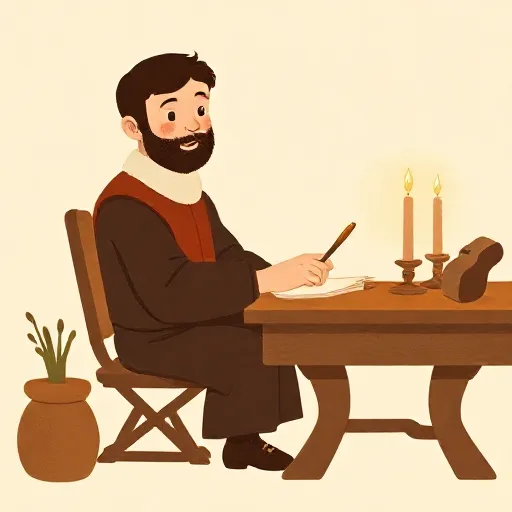
In the autumn of 1524, the Dutch scholar Desiderius Erasmus (1469–1536) sat down to write a letter. It was addressed to Martin Luther (1483–1546), the German monk whose ideas had set Europe on fire. The question on the table was one that had haunted thinkers for centuries: do human beings really choose their actions, or is everything already decided by God?
Luther had declared that free will was an illusion — that every choice you ever make is completely predetermined. Erasmus, as a devout Christian and a careful thinker, was not so sure. He drafted a polite but firm response, arguing that honest doubt was better than false certainty. That letter became one of the most famous philosophical debates in history. It asked questions that still matter today: how sure can we be about anything? Is it ever wise to say, “I don’t know”?
Who Was Erasmus?

Erasmus was born illegitimate, the son of a priest in Rotterdam. He never knew his parents well — they died when he was a boy — and his guardians pushed him into a monastery. Erasmus hated the life of a monk. He felt trapped by rules and rituals that, to him, lacked real meaning. Eventually, he left and found his true calling: books, languages, and teaching.
He became the most famous humanist of his day. In the 1500s, a humanist was someone who studied classical languages (Greek and Latin), read ancient literature, and believed that learning made people better and wiser. Erasmus wrote textbooks on how to write well, collected thousands of adages from ancient authors, and crafted satirical works like The Praise of Folly, which mocked pompous scholars and corrupt leaders. His greatest project was editing and printing the first published Greek New Testament, which allowed readers to check the official Latin translation against the original words.
Erasmus’s work made him a superstar among thinkers. But it also earned him enemies. Church theologians accused him of meddling in sacred texts. They said he was just a grammarian, not a real theologian. Erasmus shot back that understanding words was essential to understanding God’s message. He insisted that critics should argue about ideas, not attack his credentials.
Skepticism: Doubt as a Tool
Erasmus practiced a kind of careful hesitation called skepticism. In philosophy, skepticism doesn’t mean being grumpy or negative. It means withholding judgment when the evidence is unclear. A skeptic says, “I’m not sure — let’s look at both sides.”
This approach fascinated Erasmus. He loved to argue in utramque partem, that is, on both sides of a question. In his dialogues, characters would debate topics like marriage or war, each presenting strong reasons. The goal wasn’t to win a fight; it was to get closer to truth by testing every angle.
Erasmus took this method into his theology. When he examined the Bible, he discovered that some passages seemed to support free will, while others seemed to deny it. The evidence was mixed. A pure skeptic might throw up his hands and say, “Since I can’t know, I’ll believe nothing.” But Erasmus was a Christian humanist. He decided that when Scripture was ambiguous, a believer should trust the long-standing consensus of the Church — the decisions of councils and the shared tradition of the faithful. This wasn’t blind obedience; it was a humble acknowledgment that some mysteries are bigger than any one mind.
His skeptical habits made enemies. Luther despised Erasmus’s waffling. He wanted firm assertions, not endless “maybes.” Erasmus replied that he found assertions so unappealing that he would gladly take refuge in skepticism — except that, as a Christian, he accepted the Church’s authority on core doctrines. To him, doubt was not an enemy of faith but a guard against arrogance.
The Fight Over Free Will

The clash between Erasmus and Luther was more than a personal spat. It exposed a deep divide in how people think about knowledge and belief.
Erasmus published his Discussion of Free Will (1524) as a polite disquisition. He lined up biblical passages that pointed toward human choice and others that emphasized God’s control. He then argued that denying free will destroyed the moral basis of human action. If no one can choose differently, can you really blame someone for doing wrong? What’s the point of telling people to be good if they have no power to change?
Luther fired back in On the Bondage of the Will. He called Erasmus a follower of the ancient skeptics and ridiculed him as a fence-sitter. “The Holy Spirit is no Sceptic!” Luther thundered. He insisted that Scripture was clear and that salvation was entirely God’s work. He said that the human will is like a horse with a rider, but the rider is either God or Satan, and a person does not choose the rider.
Erasmus answered with a longer work, Hyperaspistes (A Defensive Shield). He clarified his position: a skeptic is not someone who doesn’t care about truth, but someone who does not make a final decision easily or fight to the death for a personal opinion. He made an exception for what Scripture plainly teaches and what the Church has long held as essential. On everything else, a wise person stays humble.
Modern readers might ask: who won? Neither really. But the debate crystallized a question that still divides philosophers and theologians: how do we balance certainty and humility? Can you be a person of faith and yet embrace doubt?
Learning to Be Human

Erasmus wasn’t just a theological pest. He was obsessed with education. He believed that human beings aren’t born fully human — they become human through learning. “Man was not born but made man,” he wrote. Without education, a person is at the mercy of brute impulses. With it, you can become a good citizen, a faithful friend, and a thoughtful person.
His ideas on teaching were ahead of their time. He hated force-feeding and physical punishment. Instead, he urged teachers to make lessons engaging and to praise students’ efforts. Cooperation, not coercion, was his motto. He also came to believe that girls and women were just as capable of learning as boys. After meeting the highly educated daughters of his friend Thomas More, he changed his mind about women’s intellect and wrote dialogues celebrating smart, learned ladies.
Erasmus insisted that real learning happens when you internalize what you study — when it becomes part of your own thinking, not just a parrot routine. Imitating an ancient author like Cicero was useful, but only if you digested the ideas and made them your own. A Christian orator, he said, should speak words that taste of Christ, not just of pagan Rome. For Erasmus, the whole point of education was moral: to form better people, not just clever debaters.
The Philosophy of Christ

At the heart of all Erasmus’s work was the philosophia Christi — the philosophy of Christ. It sounds grand, but his meaning was simple: Christian faith is not about rituals, robes, or rules. It’s about an inner quality he called pietas. This word meant a sincere devotion to God that shows up in the way you treat other people. Piety, for Erasmus, was love in action.
He was disgusted by people who treated religion like a checklist: attend Mass, say certain prayers, avoid certain foods, and you’re done. That, he said, was a kind of “Judaism” — clinging to outward ceremonies while ignoring the heart. Real piety was invisible. It was patience, kindness, and humility. It was caring for your neighbor.
Erasmus wanted every ordinary person to read the Bible. He wished that the farmer at his plow might chant a psalm and the weaver at his shuttle might sing a gospel story. You didn’t need a university degree to be a theologian. Anyone with faith and a sincere heart could live the philosophy of Christ.
He also taught that learning and faith should support each other — a partnership he called docta pietas, learned piety. Curiosity was good, but it had limits. There were divine mysteries that human minds could never fully grasp. A wise person, Erasmus said, knows when to kneel in wonder rather than demand explanations.
Why Erasmus Still Matters

Erasmus never founded a denomination or a school of thought. Yet his name kept echoing through the centuries. In his own lifetime, people called anything polished, learned, and wise “Erasmian.” In the Enlightenment, he was hailed as a forerunner of reason and tolerance. In the twentieth century, when wars ravaged the globe, his pleas for peace and his commitment to gentle persuasion were admired anew. Today, when people talk about dialogue across differences, intellectual humility, and the courage to say “I’m not sure,” they are walking in Erasmus’s footsteps.
His life poses a challenge to anyone who thinks they have all the answers. In a world where loud voices often demand that you pick a side immediately, Erasmus whispers: slow down, read more, listen to the other side, and don’t be ashamed of honest doubt. True wisdom, he would say, begins when you realize how little you know.
Think about it
- If you had to argue the opposite of something you strongly believe, what would that feel like? Would it weaken your belief or strengthen it?
- Imagine a classroom where the teacher never tells anyone they’re right or wrong, only asks harder questions. Is that a good way to learn — or just confusing?
- Erasmus thought reading old books could make you a better person. Do you agree? Can a story from five hundred years ago really change how you act today?