
Is Your Will a Captive Horse? Luther’s Radical Answer
A Hammer, a Door, and a Question That Shook Europe

On a chilly October evening in 1517—or so the story goes—a 33-year-old monk named Martin Luther (1483–1546) walked to the Castle Church in Wittenberg, Germany, and nailed a long piece of paper to the door. The paper listed 95 complaints, or theses, about the Church’s practice of selling indulgences: certificates that promised people forgiveness of sins in exchange for money. Luther thought this was not just a bad fundraising idea, but a deep misunderstanding of what it means to be right with God. That single act of defiance lit a fire that would crack Western Christianity apart. But the real earthquake was not about money. It was about a more unsettling question: do you have the power to make yourself good, or is your will, in spiritual matters, completely out of your control?
The “Tower Experience”: From Trying Hard to Letting Go

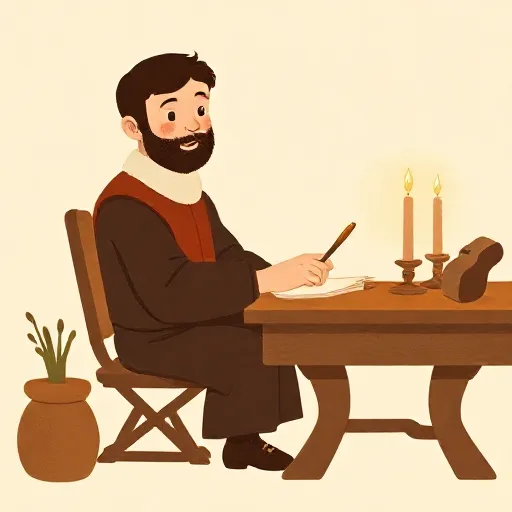
Before he became a famous reformer, Luther was a desperately anxious monk. He spent hours confessing every tiny sin, yet he never felt clean. He believed that if he just tried hard enough—praying, fasting, doing good works—he could earn God’s approval. This idea, that you can do what is in you to move toward grace, was widely taught. But it left Luther terrified. He later described a breakthrough that hit him while studying in the tower of his monastery. He came to see that justification—being made right with God—does not come from our efforts at all. Instead, God gives it as an unearned gift, through faith alone. Luther called this “passive righteousness”: you don’t achieve it; you receive it.
This turned the ordinary picture upside down. The law, Luther argued, is not there to show us how to get saved. It’s there to make us despair of ever getting saved by ourselves. Once a person stops trusting their own strength, they are finally ready to rely entirely on divine grace. Luther began calling this a theology of the cross—a way of thinking in which failure, not success, opens the door to God.
Erasmus vs. Luther: Can You Really Choose?

Luther’s most famous philosophical fight was with the humanist scholar Desiderius Erasmus (1466–1536). In 1524, Erasmus wrote a careful book arguing that, while we need God’s help, the human will still has some power to turn toward the good or away from it. He called this free choice. Luther fired back a year later with a fierce reply titled De servo arbitrio—On the Bondage of the Will.
Luther argued that “free choice” is an empty phrase when it comes to salvation. Imagine your will as a horse, he suggested. It cannot decide who climbs into the saddle. If God rides it, it wants what God wants and goes where God goes. If Satan rides it, it does the same for evil. The horse willingly follows its rider—there is no force or compulsion—but it cannot choose the rider. Luther insisted this is not about feeling forced. When a thief steals out of greed, he acts willingly, even though (according to Luther) his will is enslaved to sin. The only truly free agent, Luther said, is God.
Erasmus also pointed to a famous problem: if God commands us to do good, that must mean we can do it—otherwise the command would be pointless. Luther turned this around: the commandments are there to show us that we can’t obey them on our own. Like a parent who tells a small child to lift something too heavy, the point is to reveal the child’s weakness, not to boast about their strength.
Then there was the even harder puzzle of God’s foreknowledge. If God knows the future perfectly, then what you will do tomorrow is already settled. Luther thought that if God knows you will betray a friend, that betrayal must happen, because otherwise God would be wrong—and God cannot be wrong. So where does that leave your freedom? Nowhere, Luther answered, at least when it comes to the things that matter most. He was even prepared to say that God’s will is the ultimate rule of rightness: something is good not because it meets a standard above God, but simply because God wills it. That extreme view—later called voluntarism—still makes philosophers uncomfortable today.
Why Luther Hated Aristotle (and What It Means for You)

Luther’s quarrel with free will led him into another fight: with the ancient Greek philosopher Aristotle, whose ideas had been woven into medieval university teaching. Luther reserved special scorn for Aristotle’s Ethics. Aristotle taught that you become virtuous by doing virtuous deeds—over and over, until it becomes a habit. That sounds sensible on a soccer field or in school. But Luther thought it was poison when applied to our relationship with God. If you believe you can slowly train yourself to be worthy of salvation, you’ll end up puffed up with pride—the very opposite of the humble trust that Luther thought was necessary.
Instead, Luther insisted: “We do not become righteous by doing righteous deeds but, having been made righteous, we do righteous deeds.” The change is a gift first, an action second. He even described the Christian as simul iustus et peccator—at the same time justified and a sinner. From one angle, you are completely accepted by God. From another, measured by your own track record, you remain deeply flawed. This two-sided truth, Luther believed, could never be captured by Aristotle’s tidy system of virtues—and it kept human pride in check.
Luther didn’t throw out reason entirely. He happily agreed that reason is “a sun and a kind of god” when it comes to building cities, curing diseases, or writing beautiful poems. But in theology—the area of life that deals with God, salvation, and the deepest meaning of things—reason needs to sit in the passenger seat. When it tries to drive, Luther said, it crashes. That’s why he distinguished philosophy from theology so sharply: the same sentence might be true in one realm and not in the other, because they use words differently. When faith says that Christ is present in bread and wine at the Lord’s Supper, ordinary logic stumbles; but for Luther, that just shows that logic has a limited reach, not that faith is nonsense.
Two Kingdoms: How to Be Free and a Servant at the Same Time

If I’m saved by faith alone, and my good works don’t earn me anything, why bother being good at all? Luther’s answer was both surprising and demanding. He wrote that “A Christian is a perfectly free lord of all, subject to none”—yet also “a perfectly dutiful servant of all, subject to all.” Because you no longer have to worry about saving yourself, you are finally free to look outward and love your neighbor without using them as a ladder to heaven. Good works spill out of gratitude, not anxiety.
This double life also shows up in Luther’s idea of two kingdoms and two governments. In the spiritual government, God rules hearts through the gospel and through grace; here Christians are citizens of a kingdom where force has no place. In the temporal government, God uses laws and authority figures—princes, judges, parents—to keep order in a world where not everyone follows Christ. The Christian lives in both at once. If a neighbor is in danger, love might even require picking up a sword as a soldier or a constable, not because it makes you holy, but because it protects the weak.
This wasn’t just theory. When peasants rose up in revolt in 1525, partly inspired by reformation slogans, Luther first urged both sides to negotiate. But as violence spread, he wrote a furious tract backing the rulers—an act that still raises hard questions about his political judgment. At the same time, he insisted that princes are just “masks” of God, not absolute masters. If a ruler commands something against the gospel, you must refuse. Luther’s balancing act—obey the state in earthly things, resist it in spiritual things—echoes through centuries of debates about conscience and authority.
Why Luther Still Haunts Us

You probably aren’t worried about indulgences. But the questions Luther grabbed by the throat are still alive. Every time a neuroscientist suggests your brain decides before “you” do, or a debate flares up about whether criminals are fully responsible for their actions, you’re standing on the same battlefield. Luther’s claim—that the feeling of freedom may be real, but it doesn’t mean your will is uncaused—still makes people squirm. And his reminder that pride can disguise itself as moral effort is worth remembering whenever you’re tempted to think that the good you do makes you better than others.
Luther’s story isn’t a tidy solution. It’s an invitation to look at yourself from two angles at once—a justified sinner, a free servant, a responsible actor who never chose the most important thing about your life. That kind of tension doesn’t go away; it just asks to be thought about again.
Think about it
- If a scientist could predict every choice you’ll ever make, would it still be fair to punish people for bad choices?
- Think of a time you helped someone without wanting anything in return. Did that feel different from helping because you were told to? Why might Luther say that difference matters?
- Can you be proud of being good at something without becoming a little self-centered? How would Luther answer?