Why a 14th-Century Teacher Said You Can't Think Your Way to God
A New University, and a Daring Question

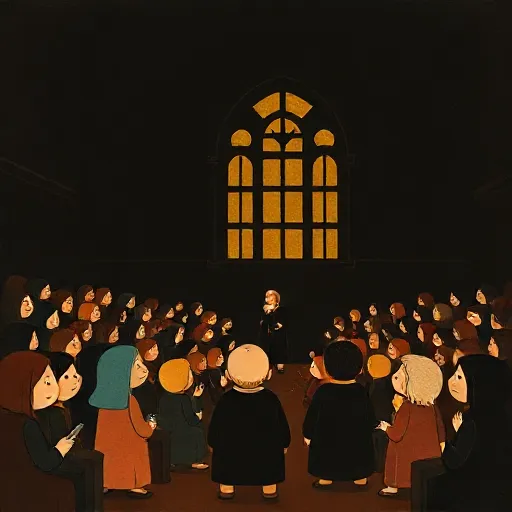
In 1386, the young University of Heidelberg opened its doors. Its first rector — the head teacher — was a man named Marsilius of Inghen (c. 1340–1396). On the very first day of lectures, he told his new students something startling. The ancient Greek philosopher Aristotle had argued that the world had no beginning: it had always existed. But the Christian faith taught that God created the world out of nothing. Marsilius looked at his students and explained that, according to natural reason alone, Aristotle’s argument appeared the strongest. Could reason ever prove creation? No, he said — and that was exactly the point. Reason is powerful, but it has a wall it cannot climb.
The Lifelong Teacher from Nijmegen

Marsilius was born around 1340, probably in the busy trading city of Nijmegen in the Low Countries. He went to the great University of Paris as a student and stayed to become a master in the arts faculty. His lectures were so popular that students packed the halls, many of them from his home region. He even served as rector of the University of Paris twice. Later, when a split in the church (the Great Schism) made Paris a difficult place to work, he helped start the brand‑new University of Heidelberg, where he would be elected rector an astonishing nine times.
He wrote huge numbers of works: commentaries on Aristotle’s logic, physics, and ethics, textbooks on reasoning, and a massive commentary on the Sentences, the most famous theology textbook of the time. Many of those writings survived as handwritten manuscripts in university libraries all over Europe. Marsilius was not a rebel who shouted his ideas; he was a careful, independent thinker who loved clear distinctions. And the biggest distinction of all was the one he drew between what your brain can prove and what you can only believe.
“Only Individuals Exist”: A Mind Full of Blueprints

To understand why Marsilius drew that line, you have to understand a bold claim he made about the world: universals do not exist outside your mind. A universal is a general idea — “humanity,” “redness,” “being a cat.” Many medieval philosophers thought those common natures were real things out in the world, floating inside every member of a kind. Marsilius disagreed. For him, the world contains only individual things: this person, this red apple, this fluffy cat. The view is called nominalism (from the Latin nomen, “name”), because “cat” is just a name we give to millions of similar individuals.
He described the process like this: you see one cat, and it leaves an impression in your mind. Then you see another cat, and that impression is slightly different. Your mind compares them, notices what they share, ignores the differences, and forms a single unified concept — “cat.” That concept doesn’t exist anywhere except in your head. It’s like building a mental blueprint out of all the cats you’ve met.
This changed what Marsilius counted as real scientific knowledge. For something to be a proper object of science, it has to be universal and necessarily true. But individual things in the world change — this puddle dries up, that dog grows old. Only a mental proposition, like “all puddles are made of water” or “dogs are mammals,” can stay fixed and universal. So, for Marsilius, the true object of science is not a thing out there but a proposition inside your mind.
He pushed this love of individual things even into the list of categories — the ten basic ways Aristotle said we can talk about reality (substance, quantity, quality, and so on). Marsilius agreed those ten categories cover things we point to in the world, but he thought there should be an extra eleventh category for words that point to other words — terms like “genus,” “species,” or “noun.” He called it the “category of signs.” It showed just how far he was willing to follow his own logic about how minds and language work.
Where Reason Hits a Wall: Creation and the Soul

Now the really big question: if your mind works by comparing things you’ve sensed, how far can it go toward understanding God? Marsilius gave a surprising answer — surprisingly firm, and surprisingly humble.
He had no doubt that human reason could prove some truths about God. Using sense data and self‑evident statements (like “nothing can both be and not be at the same time”), a philosopher can show that God exists, that God has knowledge, and that God has will. But that is where natural reason runs out of road.
Could you prove, using only your senses and your brain, that God made the world from nothing? Marsilius said no. Every single time you see something come into being — a cake, a tree, a chick hatching — it comes from other things that already exist: flour, seeds, an egg. Your senses never show you something popping out of absolutely nothing. So your mind naturally concludes that nothing comes from nothing. Reason says creation from nothing is impossible. Yet the Christian faith asserts that God did exactly that. For Marsilius, that had to be accepted by faith alone.
The same wall appeared when he considered the soul. He followed his teacher John Buridan (c. 1300–1358) in arguing that there is no rational proof that the human soul survives death. A philosopher named Alexander of Aphrodisias had made the case that the soul is corruptible — that it dies when the body dies — and, if you rely only on natural reason, Alexander’s position looked the most probable. Marsilius himself believed the soul is immortal, but he believed it because of revelation, not because of a logical proof.
This didn’t make him anti‑science or anti‑reason. It made him a careful map‑maker. The philosopher builds knowledge from sense data and self‑evident principles; the theologian starts from Scripture and divine revelation. They travel by different lights. When their conclusions collide, faith has the higher authority, Marsilius said, because faith comes from a source that cannot be mistaken. But you can’t force reason to get there on its own.
Danger: Logic in the Hands of Theologians

Marsilius loved logic. He wrote whole treatises on how terms refer to things, how consequences follow from premises, and how to handle tricky sentences like “the Antichrist does not exist now, but he will.” But he also believed logic could be dangerous when used without care in theology.
Think about this argument: if God is the cause of every thing that exists, and moral evil is a real thing, then God must be the cause of evil. Marsilius acknowledged that the premises are true and that the logic seems solid. Yet he said the conclusion should never be defended as true because it contradicts faith and would deeply confuse ordinary believers who don’t know how to pick apart logical moves. A theologian, he insisted, should write out of reverence for God, not to show off cleverness.
He made the same sort of caution about sentences like “Christ is only God.” Logically, the sentence might be true — after all, if Christ is God and no other person born on earth is God, then “Christ is only God” looks correct. But Marsilius saw danger: the word “only” could sound as if it strips Christ of his human nature, which would echo ancient heresies. So even when logic says something is technically true, a responsible teacher has to think about how it lands in the ears of ordinary people.
That instinct — protect ordinary believers, don’t erode their trust — ran through much of his theology. He argued that when we talk about the sacraments, we shouldn’t say the bread and wine cause grace; rather, God acts directly whenever the sacraments are carried out properly. And when speaking about God’s foreknowledge, he warned against arguments that might accidentally make it seem as if human decisions could change what God has known from eternity. The safer path, he thought, was to repeat what faithful Christians had always maintained: God knows all future choices without being dependent on them.
Why This Divide Still Matters Today

You probably live in a world much less medieval than Marsilius did, but his big question hasn’t gone anywhere. Every day you depend on evidence — a scientist uses data to prove a hypothesis, a detective collects clues to make a case. But there are also things you accept without proof: that your parents love you, that a promise matters, that human beings have dignity. Even in science, you take certain starting assumptions on trust.
Marsilius didn’t ask people to check their brains at the door of a church. He insisted that reason should be taken as far as it will go. But he also thought it’s honest to admit that reason doesn’t go all the way. There are truths — about beginnings, about endings, about the deepest kind of goodness — that no telescope or logical diagram will force you to accept. You can choose to step toward them, or not.
His influence rippled outward for centuries. Students in Krakow, Vienna, Erfurt, and Salamanca studied his logical writings and his Sentences commentary. Later philosophers, even as towering as Francisco Suárez, quoted his views on grace and foreknowledge. The University of Heidelberg he helped found still stands, still noisy with questions. The tension he mapped — reason here, faith there, a chasm in between — shaped how Europe thought about knowing and believing. It probably shapes some of the quiet arguments you have with yourself too.
Think about it
- Is there something you believe deeply that you could never prove to a friend — and would that make your belief any less real for you?
- If human reason shows that something is probably impossible (like a dead person coming back to life), should a person ever trust that it really happened anyway?
- Marsilius said it is safer to protect ordinary believers from confusing arguments. Do you think teachers today should sometimes avoid saying things that are true if those truths might upset people?