Can Reason and Faith Be Friends? A Thinker Says Yes
A Dispute in Padua: Did God Create the World from Nothing?

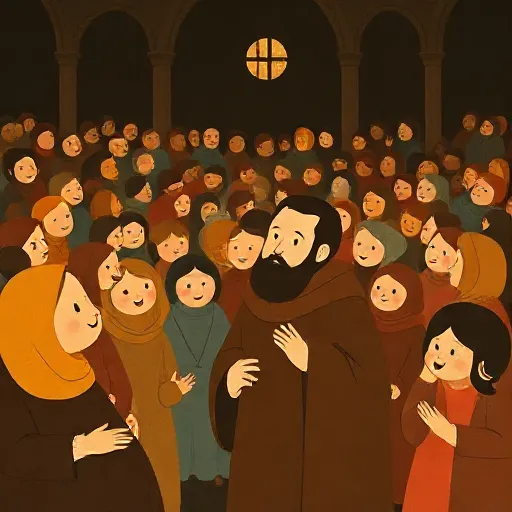
The room was packed with scholars, students, and a few curious noblemen. It was 1480 in Padua, a city famous for its university, and a public dispute was about to begin. The question on everyone’s mind: Where does the universe come from, and what keeps it going? A young Jewish scholar named Elijah Del Medigo (about 1458–1492) stepped forward to give an answer that startled many Christians in the crowd. He argued that God is the efficient cause of the celestial spheres—the power that makes them move eternally—but not necessarily the creator who made them pop into existence out of nothing.
Del Medigo’s claim came from Aristotle, the ancient Greek philosopher, as explained by the Muslim thinker Averroes (1126–1198). According to this view, the heavenly bodies have always existed, and God’s action is to give them their motion, which is the very thing that makes them what they are. Without movement, those spheres would not have any being at all. So God remains the source of their existence, but in a way that fits an eternal universe rather than a one-time act of creation. That idea—creation without a beginning—would later become a key puzzle in Del Medigo’s whole life.
Who Was Elijah Del Medigo?

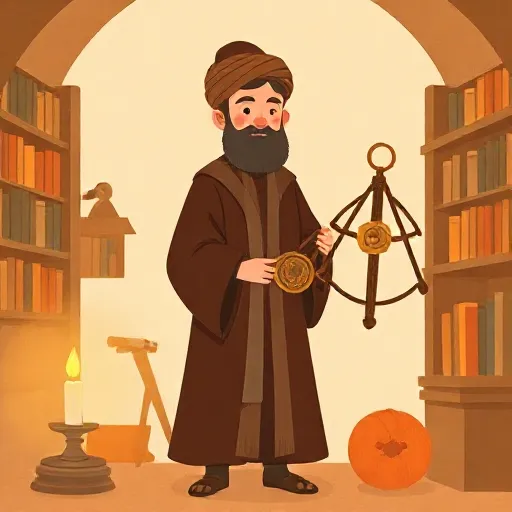
Elijah Del Medigo was born on the island of Crete, then a Venetian colony, into a Jewish family around 1458. As a young man he traveled to northern Italy, probably to study medicine, but soon he was swept up in the excitement of the Italian Renaissance. He spent most of the 1480s moving between Padua, Venice, and Florence, teaching philosophy and writing for a remarkable audience—powerful Christian intellectuals such as Giovanni Pico della Mirandola and Domenico Grimani. To them, Del Medigo was not just a teacher but a prized translator. He turned works by Averroes from Hebrew into Latin, giving Christian scholars access to ideas they could not read in the original.
In Italy, Del Medigo produced commentaries on Aristotle’s physics and psychology, and he wrote original treatises defending Averroes’ interpretation of the natural world. He was a master of Averroism, a school of thought that insisted Aristotle, read correctly through Averroes, gave the final word on how reality works. But something else set him apart: he lived in two intellectual worlds. In Latin Padua he argued about the eternity of the world and the nature of the human mind. Back among Jews, he was a sage in the tradition of Maimonides (1138–1204), the great Jewish philosopher who had tried to harmonize faith and reason centuries earlier. By the end of his life, Del Medigo would write his most famous book entirely in Hebrew, for a Jewish student, and he would never once mention Averroes in it. That book would ask the question his whole career had been circling: Is it okay for a believer to be a philosopher?
Can Philosophy Hurt Your Faith?

Around 1490, Del Medigo returned to Crete. At the request of his student Shaul Ashkenazi, he composed a Hebrew work called Beḥinat ha-Dat—The Examination of Religion. Its driving question was simple and bold: Is studying philosophy—the kind of reasoning Aristotle used to understand nature—forbidden, permitted, or mandatory for Jews? Del Medigo’s answer was clear: for those able to think philosophically, it is not just allowed but required.
Why? Because the philosophical sciences investigate created beings, and the more you understand creation, the better you know its Creator. Philosophy, done right, leads straight to a stronger faith. It does not replace belief; it feeds it. Yet Del Medigo drew a sharp line. Some central teachings of Judaism, he said, are beyond logic entirely—things like prophecy, divine reward and punishment, and the possibility of miracles. These you accept through the Torah, not through argument. A philosopher can and should believe them, but cannot prove them. Faith and reason each have their own proper job.
This reasoning mirrored a famous claim by Averroes: “the truth does not contradict the truth.” Del Medigo never names Averroes in Beḥinat ha-Dat, because his Jewish readership trusted Maimonides far more than a Muslim commentator. But the structure of his argument—that philosophy and revealed religion are different paths to compatible truths—was firmly Averroist. It was also something many people around him found hard to swallow.
The Mystical Alternative: Why Del Medigo Rejected Kabbalah

While Del Medigo built his case on Aristotle and Maimonides, another movement was gaining strength in Jewish life: Kabbalah. Kabbalists looked for secret, mystical meanings hidden inside the words of the Torah and the commandments. They believed that human actions, performed with the right intention, could repair the divine worlds. To Del Medigo, this was not only wrong but dangerous—it replaced sober reasoning with ungrounded speculation.
He rejected the traditional claim that the most important Kabbalistic book, the Sefer ha-Zohar, had been written by the ancient sage Shim‛on Bar Yohay. He thought it was a much later invention. And when it came to the reasons for the commandments, he followed Maimonides’ rational approach: the mitzvot exist to guide people toward good behavior and a well-ordered life, not to affect hidden heavenly realms. As he put it, we humans can barely improve ourselves; how could we possibly fix the divine worlds? For Del Medigo, Kabbalah was the opposite of philosophy—and a threat to true faith.
Two Truths: When Philosophy Says One Thing and Religion Another
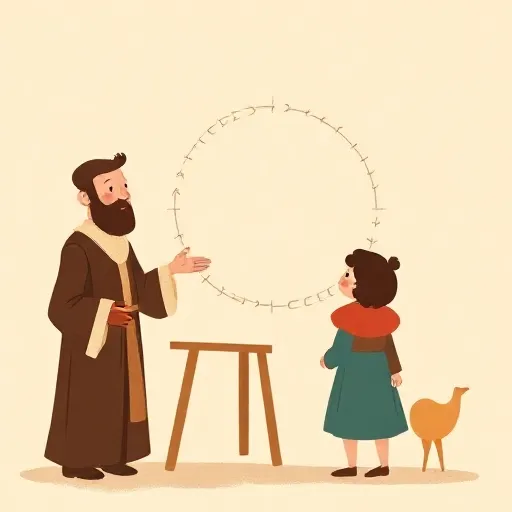
Even if philosophy and faith are both good, what happens when they seem to clash head-on? Del Medigo faced this directly in his Italian works. In his Quaestio de efficientia mundi, he explained God as the eternal efficient cause of the universe through motion, not by creating from nothing. That was the philosophical truth, following Aristotle and Averroes. Yet the Torah teaches that God created the world ex nihilo—out of nothing—at a definite moment in the past. Del Medigo did not try to force them to match. Instead, he quietly introduced a distinction: there is a way of faith (via legis) and a way of philosophy (via philosophica). A believer could accept creation ex nihilo on religious grounds, even while the philosopher in him saw the world as eternal.
This looks a lot like a “double truth” theory—the idea that something can be true in religion and false in philosophy, or the other way around. Scholars have argued ever since whether Del Medigo genuinely believed in two separate, possibly conflicting truths, or whether he thought that, deep down, all truth is one and the apparent conflict just shows we have not understood things fully yet. The evidence is mixed. In his Hebrew works for Jewish readers he stresses harmony, not conflict. In his Latin writings for Christian patrons, he sometimes made room for the two-truth language, maybe to keep the peace. The question remains open, and it is exactly the kind of puzzle Del Medigo wanted philosophers to keep wrestling with.
Why It Still Matters: Navigating Head and Heart

You may never have translated Latin commentaries on Aristotle, but you almost certainly know the feeling Del Medigo was dealing with. You learn in science class that the universe began with a Big Bang about 13.8 billion years ago. Someone at home tells you that God created the world in six days. You wonder: Do I have to choose? Is one of them just wrong? Elijah Del Medigo’s life suggests a different move. You can think hard about the world, use evidence and logic as far as they will take you, and still hold onto beliefs that go beyond what you can prove—as long as you know which kind of knowing you are using in each moment.
He never said that every claim is up for grabs, or that reason is useless. He put some core beliefs safely outside the reach of philosophy, and he trusted that careful study would only deepen a person’s faith, not tear it apart. Whether he was right is still worth asking. Can you be both a curious thinker and a committed believer without breaking either one? Elijah Del Medigo spent his life trying to show that you can.
Think about it
- If you could prove that a religious story was scientifically impossible, would you stop believing it, or would you keep it as a different kind of truth? Why?
- Should people who study philosophy be allowed to interpret sacred books in ways others might find strange? Where should the limits be?
- Imagine you discover a logical proof that the universe had no beginning, but your religion teaches that it did. What would you do, and who would you talk to?