Can a Scientist Believe in Miracles? A 13th‑Century Professor Said No
A University in Turmoil: The 1277 Condemnation
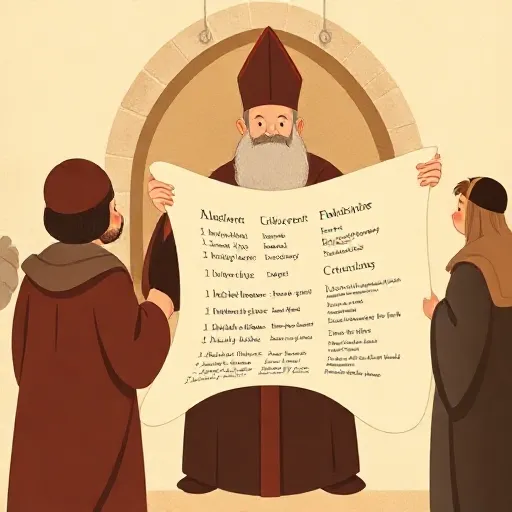
In March of 1277, the bishop of Paris, Stephen Tempier, made a dramatic move. He issued a list of 219 sentences — claims — that no one at the university was allowed to teach. Anyone who did risked being kicked out, or worse. Some of those banned sentences sounded like ordinary philosophy. One said: “That there is no more excellent state than to devote yourself to philosophy.” Another claimed that raptures and visions happen only through nature, not from God. The bishop’s list was aimed squarely at thinkers who seemed to treat human reason and religious faith as two completely different worlds.
Among the targets was a master of arts from Denmark, a man known as Boethius of Dacia (active around 1270). He had never been especially famous, but his ideas had spread through the lecture halls of Paris. The bishop’s condemnation would make him far better known — though not in the way any teacher hopes for.
Who Was Boethius?

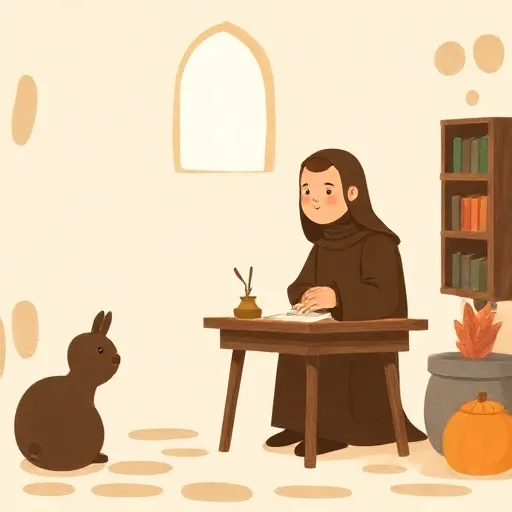
Almost nothing is known about Boethius’s life before Paris. His Latin name marks him simply as “the Dane.” He had probably arrived sometime in the 1260s, and by the early 1270s he was a respected teacher in the arts faculty. That job meant teaching logic, grammar, and the natural philosophy of Aristotle (384–322 BCE) — the closest thing to what we would call science today.
Boethius was an independent thinker. He rarely named other scholars, and he didn’t follow a single famous master. He was certainly not what some modern historians have called an “Averroist” — a follower of the Arabic commentator Averroes — even though he, like everyone, used Averroes’s commentaries. Boethius’s real signature was his insistence that each branch of knowledge has its own rules. This idea would get him into deep trouble.
Each Science Has Its Own Rules
Boethius hammered on one point again and again: “No specialist can grant or deny anything except on the basis of the principles of his own science.” In a university disputation, a principle is a starting assumption you don’t prove — it’s one of the rules of the game. If you’re doing geometry, you don’t appeal to poetry; if you’re analysing grammar, you don’t worry about whether the words are true in biology. Mixing the rules just breaks the whole system.
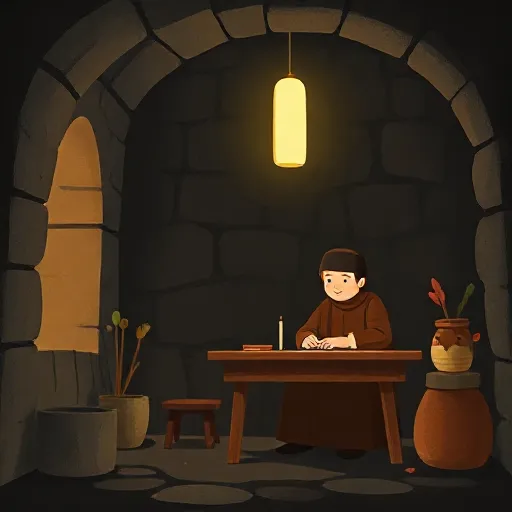
For Boethius, each science was like a sealed room. A natural scientist, or physicus, could explain how a lion runs or an eclipse forms, because those events follow from causes that fit the science’s rules. But if you asked the natural scientist, “Did the world have a beginning, a moment of creation?”, you had broken the rules. The scientist could not even make sense of the question within his own principles. He had to deny a first beginning, not because he knew it didn’t happen, but because his science cannot contain the idea.
Boethius used the language of disputation to make the point. In a formal debate, a respondent must grant only what follows from what has already been granted. When you play that game as a physicist, the claim “the world had a first moment” is as out‑of‑place as a chess move in a soccer match. It’s simply not allowed — so in that room, it counts as false.
This did not mean Boethius hated religious faith. It meant that scientia, the Latin word for both science and strict knowledge, and fides, faith, belonged to different rooms. He drove the point home in a little treatise On the Eternity of the World: “Faith is not knowledge,” he wrote. If a truth comes from revelation, it cannot be proved by Aristotle’s tools. And if it can’t be proved, the sciences don’t need it.
The Eternity Problem: Can Science Prove the World Had a Beginning?

No idea got Boethius into hotter water than the eternity of the world. At the time, many Christian thinkers assumed that reason alone could demonstrate that the world had a beginning in time — that creation was not just a belief but a conclusion philosophy could reach. Boethius disagreed.
He went through each main branch of philosophy. The natural scientist, he said, can only explain how something comes to be from pre-existing matter — that’s generation, not creation. The natural scientist must say that the first human could not appear by generation, so within his science he must deny Adam. The mathematician doesn’t care whether the world is eternal or new; it makes no difference to a triangle’s angles. The metaphysician deals with the highest causes, but even he can’t pull off a proof. To show that God’s act of creation happened at a particular moment, the metaphysician would need to know the divine will — and Boethius called that madness. Humans simply can’t see inside God’s intentions.
So was Boethius saying the world is definitely eternal? No. He only said that no branch of human learning can prove it isn’t. If you want the answer, you have to rely on faith, not science. And that moved the whole question out of the lecture hall and into the church.
The Best Life: A Philosopher’s Happiness

While Boethius worked out what science could and couldn’t do, he also wrote about the very point of being human. In his small, passionate book On the Supreme Good, he argued that the highest happiness possible in this life is to know the truth, do good, and enjoy both.
He leaned on an argument from Aristotle: every creature has a special power, and the best life is one that exercises that power fully. For humans, that power is the intellect. So the ideal life is the philosopher’s — a life of understanding, not of chasing thrills.
Boethius added a clever twist. The philosopher who devotes herself to thinking will, he claimed, automatically act well. She’ll understand what is truly noble and shameful, she’ll be too absorbed to be tempted by cheap pleasures, and she can never overdo it — you can’t think too much. In other words, the search for truth builds a good character without needing separate moral lessons.
That was too much for the bishop’s committee. The claim that “there is no more excellent state than to devote yourself to philosophy” landed straight on the forbidden list. The churchmen probably felt that a life of prayer or service should rank higher. Boethius’s purely intellectual ideal seemed to leave little room for holiness.
Why It Still Matters: When Facts and Beliefs Collide
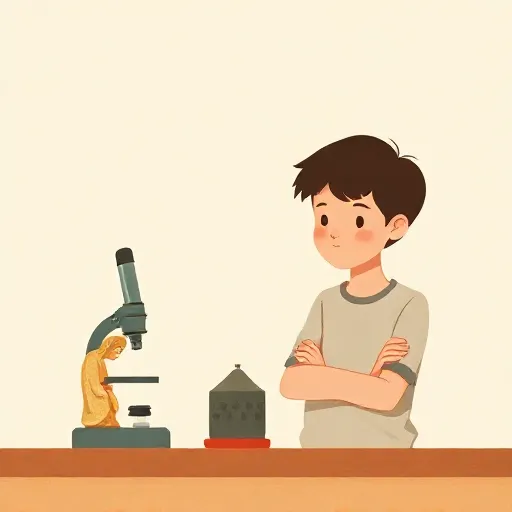
Boethius never tried to choose between being a Christian and being a philosopher. He thought you could be both, so long as you never pretended that science could do faith’s job. But his solution was explosive because it meant that inside the classroom you could say things that sounded completely un‑Christian — and then walk out and be a faithful believer. To the bishop, that looked like hypocrisy or, worse, a secret attack on religion.
Today, many of us wrestle with a similar puzzle. When a biology textbook says life evolved over billions of years, and a scripture says the world was made in six days, can both be true? Boethius wouldn’t tell you which one to pick. He would say: evolution belongs to the science game, with its own rules and its own kind of truth. The meaning of a holy text belongs to faith, a different game with different truths. They don’t clash, because they’re not even playing on the same field.
But that means you have to learn to live in two rooms at once. In science class you can say, “No miracle can be proven,” and in your own heart you can believe otherwise. Not everyone can accept that split, but Boethius thought it was the only honest way. The question he left us is whether the split really works — or whether we end up feeling like we are constantly translating between two languages that were never meant to match.
Think about it
- If a scientist says that everything must be explained by natural causes, is that a proven fact or just a rule she chooses to follow?
- Could something be “true” in a science classroom and “false” in your family’s tradition without anyone being wrong? Or does truth need to be the same everywhere?
- Can you live happily if you never mix what you learn in science with what you believe about life’s meaning — or do the two eventually spill into each other?