The Scholar Who Believed Ancient Philosophy Could Heal a Broken Europe
A Life in the Crossfire
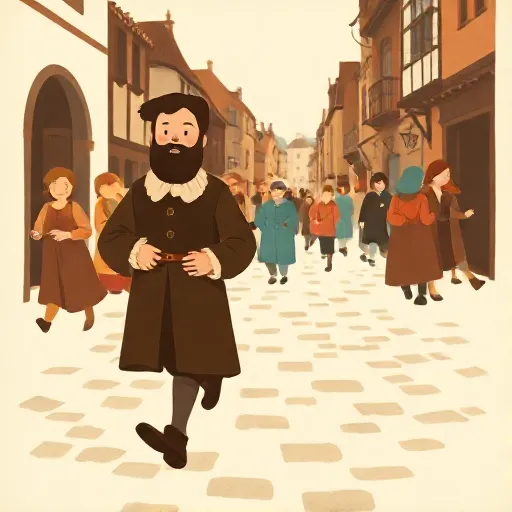
Imagine it is 1572 and you are fleeing your university city because an army is about to sack it. Your neighbours are turning on one another — Catholics against Protestants, Calvinists against Lutherans. The same thing is happening all across Europe. Where can you find a steady mind in the middle of such chaos?
Justus Lipsius (1547–1606) spent his whole life asking that question. He was born a Catholic in a small town near Brussels, studied with Jesuits, and then moved to the University of Leuven to learn law. But his real passion was ancient Roman writing. By the time he was nineteen he had already compiled three books of careful corrections to Latin manuscripts.
In his early twenties Lipsius travelled to Rome, where he combed through rare manuscripts in the Vatican Library and became secretary to a powerful cardinal. There he discovered the letters and essays of Seneca, a Roman statesman and Stoic philosopher. That encounter set him on a lifelong mission: to use ancient Stoic ideas to build a practical philosophy that could help ordinary people endure the horrors of civil war and religious hatred.
Lipsius’s own life was anything but settled. Over the years he moved back and forth between Catholic and Protestant regions, holding professorships at Lutheran Jena, Calvinist Leiden, and finally Catholic Leuven. Each time he changed his public religious allegiance to match the rulers around him. His critics called him a chameleon. Lipsius saw himself as a scholar searching for a philosophy of calm that could work for anyone, anywhere.
The Shield of Constancy

In 1583, while the Netherlands was being torn apart by revolt and repression, Lipsius published a small book that would become a European bestseller. He called it De constantia — On Constancy. It takes the form of a dialogue between Lipsius himself and an older friend, Charles de Langhe, who plays the part of a fully wise Stoic.
The book opens with a confession: Lipsius admits he is desperate to flee his country to escape the misery. Langhe stops him. Running away won’t help, he says, because the real enemy is inside you. The only way to be free is to build constancy, which Lipsius defines as “the upright and immovable mental strength, which is neither lifted up nor depressed by external or accidental circumstances.” Constancy is not about pretending everything is fine. It is about keeping your soul steady no matter what happens around you.
Where does that strength come from? Lipsius’s answer is reason. Reason is a true judge of human and divine things. Its job is to conquer the four main passions that churn us up: desire, joy, fear, and pain. When we let passions run the show we suffer, because we cling to things we cannot keep — our homes, our safety, even our loved ones. Reason teaches us that everything in the world obeys a universal law of necessity. Cities fall, plagues strike, tyrants rise. These are not meaningless disasters; they are part of a divine plan unfolding as steadily as a river flows downhill.
For Lipsius, necessity is not cold fate. It is God’s providence, a carefully woven order. His Christianized Stoicism tells readers, “We are born into a kingdom where obedience to God is true liberty.” Accepting necessity is not giving up. It is the highest freedom, because it frees you from the exhausting battle to control what no human can control.
Yet Lipsius also insists that the wise person does not retreat into a private bubble. He should still be a good citizen, serve his neighbours, and accept public duties. But he does so with an inner detachment — what the ancient Stoics called apatheia, a clarity unclouded by raw emotion. The book became a kind of psychological first-aid kit. It went through more than eighty editions in two centuries, translated into French, Dutch, English, Spanish, and Polish.
The Prince’s Dilemma: Order or Mercy?

Lipsius knew that personal calm meant little if the society around you was ripping itself apart. So in 1589 he published a sequel called Politica — Six Books on Politics. If De constantia taught citizens how to endure, Politica would teach rulers how to govern.
The central character of this new book is prudence, the practical wisdom a prince needs to make sound decisions. Lipsius drew heavily on the Roman historian Tacitus, who had written cold-eyed accounts of power, intrigue, and civil war under the Roman Empire. Borrowing from Tacitus and many other ancient writers, Lipsius constructed a handbook for a prince who rules by reason rather than by impulse.
But one chapter set Europe on fire. Lipsius argued that a state torn by different religions could never be at peace. Therefore, a ruler should allow only one religion in any political community. He did not say the prince should decide Church doctrine — he explicitly denied the ruler any right to meddle in sacred matters. However, he insisted that the prince must enforce religious unity, because religious division always spills into civil war.
Then came a sentence that even his admirers struggled to defend. Using a metaphor from the ancient orator Cicero, Lipsius argued that when a limb of the body becomes diseased and threatens the whole, a doctor must burn or cut it off to save the patient. In the same way, a ruler might have to crush religious dissenters who disturb public order. Those who worshipped quietly and peacefully, however, should be tolerated.
The backlash was immediate and furious. Protestant thinkers like Dirk Volckertsz Coornhert attacked Lipsius for handing tyrants a license to kill. The Roman Catholic Inquisition placed Politica on its Index of Prohibited Books in 1590. Lipsius, who was then living in Calvinist Leiden, found himself accused of cruelty by one side and of crypto-Catholicism by the other. He later revised the book to soften its edges, but the damage to his reputation was done.
Rebuilding Stoicism to Fit Christianity

Lipsius knew that borrowing bits and pieces from ancient philosophy was not enough. If Stoicism was to help Christians, he had to show — point by point — that its core teachings were not incompatible with the Bible. In 1604 he published two dense treatises to do just that: the Manuductio ad Stoicam philosophiam (“Guide to Stoic Philosophy”) and the Physiologia Stoicorum (“Physical Theory of the Stoics”).
His method was equal parts scholarship and surgery. He would carefully explain a Stoic doctrine, then trim away the parts that clashed with Christian belief. The ancient Stoics believed that God was a kind of fiery breath that ran through the whole world, making nature itself divine. Lipsius rejected that pantheism — the idea that God and the universe are the same thing. Instead, he described God as a craftsmanslike fire that contained the seeds of everything but stood above creation, not trapped inside it.
The Stoics had also identified fate with an impersonal chain of causes and effects. Lipsius recast fate as God’s providential reason. He adopted a careful distinction from the Church Father Augustine: fate rules the broad course of things, but human beings still have free will in the realm of “secondary causes.” That meant you could be responsible for your choices even though God’s plan was unfolding across history.
The most important move Lipsius made was to replace the Stoic concept of logos — the rational order that governs the cosmos — with the Christian Logos, the Word of God from the Gospel of John. Christ himself becomes the reason that a wise person follows. In this picture, the Stoic supreme good, the summum bonum, is no longer just virtue. It is the right attitude toward God, and that attitude comes as a gift, not merely through self-discipline.
Lipsius did not pretend to accept everything. He flatly rejected the Stoic teaching that a wise person could choose suicide, because Christianity forbade it. He also rejected the idea that some actions are morally indifferent, because that seemed to loosen the grip of moral law. These cuts were deliberate. His goal was never to be a pure Stoic. It was to create a usable Christian humanitas — a way of being civilised and humane that ancient wisdom and Christian faith could support together.
Why a Chameleon Scholar Still Matters

Lipsius’s own century judged him harshly for changing his religious colours. Yet his Neostoic project outran its author. The Manuductio became the standard textbook on Stoicism for over a hundred and fifty years. It sat on the shelves of philosophers as different as René Descartes, Gottfried Wilhelm Leibniz, John Locke, and Baruch Spinoza. Through them, Lipsius’s blend of reason, providence, and inner freedom seeped into early modern science, ethics, and political theory.
But the man and his project leave us with an unsettled score. Can you really face public calamity by clamping down on your feelings? Lipsius wanted us to extinguish pity, because pity makes a wise person suffer for things they cannot fix. Yet many readers have felt that a world without pity would be a world without kindness. If we detach ourselves from the pain of others, we might protect our own peace, but we might also stop trying to change the injustices around us.
Lipsius himself sensed this tension. He never stopped urging citizens to serve their communities. His own life, with all its shifting loyalties, was a long experiment in trying to stay human while the ground kept moving. His advice was not an answer you can swallow whole. It is a challenge: how can you be steady without becoming hard? When your own little world wobbles — a bullying incident at school, a frightening story on the news, a family argument that seems unending — Lipsius’s question is still the same: can you find a place inside yourself that stays calm, not by running away, but by refusing to let fear run the show?
Think about it
- Lipsius thought that showing pity for someone else’s suffering was a weakness a wise person should overcome. Do you think feeling sad for a friend in trouble can ever be a bad thing? Why or why not?
- If you had to choose, would you rather live in a community where everyone practiced Stoic constancy and rarely showed strong feelings, or one where people freely expressed every emotion? What might be lost in each?
- Lipsius changed his public religion more than once to fit whoever was in power. Does that make his advice about steadiness less trustworthy? Can a person who bends with the wind teach you how to stand firm?