Are Electrons Really Individuals? The Quantum Identity Puzzle
Two Perfect Twins?
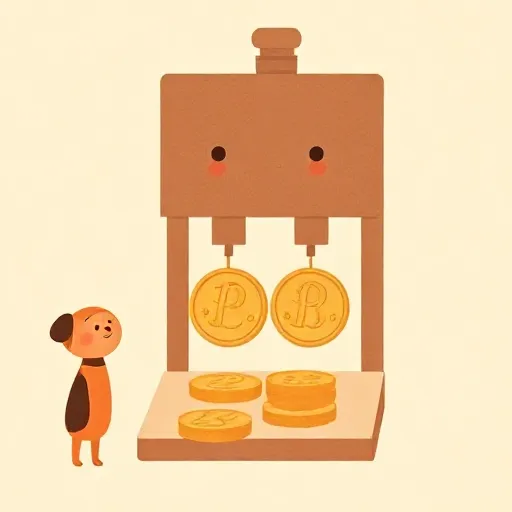
Imagine a machine that can copy any object perfectly. You put in a shiny coin, press a button, and out roll two coins that are absolutely identical — no scratch here, no dent there, not even an atom different. Both sit on the table. Are they two individuals? Most of us would say yes: even if you can’t see a difference, there are still two coins. But if you can’t point to any property that sets them apart, what makes them two separate things? This is the puzzle of individuality: what makes something a distinct, countable object?
For centuries, philosophers thought that objects are individuals because they possess unique combinations of properties. Even two very similar things — like “identical” twins — always differ in some tiny detail: a freckle, a memory, a position in space. If you could list all properties, each object’s list would be unique. This idea is sometimes called the Principle of the Identity of Indiscernibles: no two distinct things can share every single property. If they did, they’d be the same thing.
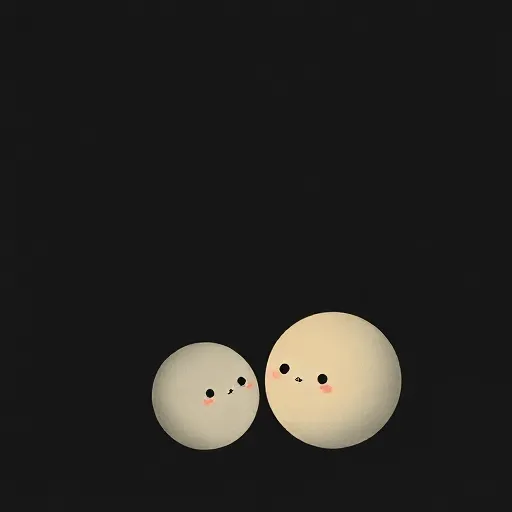
But deep down, what if individuality runs deeper than any list of properties? Think of a pair of perfectly identical spheres in an otherwise empty universe. They share every property — size, shape, even location relative to each other. Could they still be two? Some thinkers say yes, because each has a kind of invisible thisness (called haecceity) that makes it itself and not the other. It’s like a hidden tag that says “I’m sphere A” even though you can never detect it. This view treats individuality as something over and above all ordinary properties.
Quantum physics makes this puzzle far more urgent, because at the smallest scales, particles like electrons seem to have no hidden tags at all.
The Counting Game: Classical vs Quantum
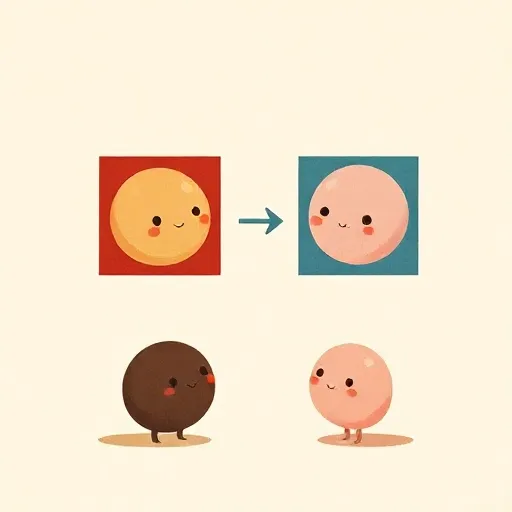
Let’s play a counting game. You have two particles and two boxes. In classical physics (the kind that describes everyday objects), you can put both in box A, both in box B, or one in each. But here’s the twist: when one is in each box, classical physics counts two different arrangements. Why? Because you could swap the particles between boxes and think that’s a new setup — particle 1 in box A and particle 2 in box B is different from particle 2 in box A and particle 1 in box B. Classical statistics (called Maxwell-Boltzmann) gives this swapped arrangement a separate weight, making four total possibilities.
This counting reveals a deep assumption: classical particles are individuals even when they share all intrinsic properties (like mass or charge). They carry a secret “label” — a transcendental individuality — that makes swapping them into a genuinely new situation. Philosophically, that label is often cashed out as haecceity, primitive thisness, or a Lockean substance that has no properties itself but supports them.
Quantum statistics abruptly stops counting swaps. If you have two same-type quantum particles (like two electrons) in the same setup, putting one in each box counts only once — not twice. There are just three total arrangements for particles obeying Bose-Einstein statistics (both left, both right, one each), or only one arrangement for those obeying Fermi-Dirac statistics (exactly one particle per box, because of the Pauli Exclusion Principle). The key point: a permutation of identical quantum particles does not create a new physical state.
This is baked into the Indistinguishability Postulate: swapping particles around makes no observable difference whatsoever. The famous physicist Hermann Weyl (1885–1955) captured this dramatically:
Weyl’s Electrons Without Alibis

Weyl put it like this: imagine identical twins Mike and Ike. In classical thinking, even if they look exactly alike, Mike could always say “I’m here and Ike is there,” and swapping them makes a difference. Each has a metaphysical “alibi” — a hidden identity that sticks. But Weyl insisted that for quantum particles, “Even in principle one cannot demand an alibi of an electron!” You simply cannot ask which electron is which, not because we’re ignorant, but because the question has no answer in nature.
If electrons have no alibis, then perhaps they are not individuals at all. They become non-individuals — things that cannot be uniquely labeled or identified across time. This radical idea traces back to the earliest days of quantum mechanics. Some philosophers and physicists even suggested that quantum objects lack self-identity: the relation “x = x” doesn’t strictly apply to them. That might sound incoherent — how can a thing not be identical to itself? But there are formal ways to make sense of it.
One approach uses quasi-sets. In regular set theory, a set is a collection of distinct, well-defined objects. Quasi-set theory allows collections of elements that are indistinguishable in the strongest sense, yet we can still say how many there are without being able to label them “first,” “second,” and so on. Electrons become m-atoms — objects about which identity is not a well-formed question. This lets us talk about “two electrons” while denying that either is an individual with a unique thisness. It’s a formal framework for a world without alibis.
Can Electrons Still Be Individuals?

Not everyone accepts that quantum particles are non-individuals. Some philosophers argue that electrons can be discerned by their relations, even if they lack intrinsic properties that differ. Take two fermions in the singlet state: they have opposite spin. You can’t point to one and say “it’s spin-up,” but you can say “one is spin-up and the other is spin-down.” This is called weak discernibility — the particles are discerned by an irreflexive relation like “has opposite spin to.” The relation doesn’t require that we already know which is which; it just guarantees numerical distinctness. This move saves a version of the Principle of the Identity of Indiscernibles for fermions and lets them count as individuals after all.
Another route is to use an alternative interpretation of quantum mechanics. In Bohmian mechanics, particles have definite trajectories in space and time. If electrons always have distinct paths, then they can be individuated by their spatio-temporal histories — much like classical objects. Then the individuality doesn’t require hidden haecceities; it’s grounded in a kind of impenetrability: no two particles occupy exactly the same path at the same time.
More recently, the heterodox approach has gained ground. Working physicists routinely distinguish between, say, an electron in a lab and one in a distant star. This approach uses mathematical combinations (symmetric projectors) to say things like “one particle has property A and the other has property B” without assigning labels. Intriguingly, for fermions it always turns out that you can discern them this way, though for bosons indiscernibility remains in certain special states. The catch is that this sort of discernment is ambiguous: there are many incompatible ways to pick out which properties distinguish them, and nature doesn’t seem to choose one. That makes the resulting individuality a bit shaky — it’s not the robust, classical kind where you can point and say “that one right there.”
Why This Matters: The Stuff We’re Made Of

Here’s the astonishing thing: the mathematical formalism of quantum mechanics alone doesn’t force us to choose between the “individuals” package and the “non-individuals” package. Both fit the experimental data. This is a case of metaphysical underdetermination — the physics is silent about which deep story is true. If you’re a realist who wants science to tell you what the world is really like, you face a dilemma: you have to pick a metaphysics, but the physics doesn’t hand you a winner.
Some thinkers try to break the tie by appealing to broader theory — say, quantum field theory, where particles pop in and out of existence and the very notion of individual countable things gets even murkier. Others opt for a third way: structural realism. According to this view, we shouldn’t start with objects at all. Instead, the world is made of structures and relations; what we call electrons are merely “points of intersection” in a web of symmetries and invariants. On that picture, both individualism and non-individualism are misguided, because they assume objects come first.
Why should any of this matter to you? Because you are made of electrons and quarks. If the most fundamental bits of reality don’t cleanly fit the category of “individual,” then the everyday idea that you are a single, self-identical person may be a kind of useful approximation. Nature at its roots might be more like a pattern than a collection of tiny labeled things. The puzzle of quantum identity nudges us to rethink what it means for anything — including us — to be a distinct individual.
Think about it
- Suppose a perfect copying machine could produce an exact replica of you, identical down to the last memory and freckle. Would there still be two persons? How could anyone — even you — ever prove it?
- In a video game, clicking “spawn” creates another identical monster. Is each spawned monster an individual, or just a copy of a pattern? Does the answer change if you can swap them invisibly?
- If the particles that make up your body might not be individuals in the deepest sense, does that change what it means to say “I am me”? Why or why not?