Do Other Worlds Hold Copies of You? The Quantum Puzzle
The Lab That Couldn’t Agree With Itself

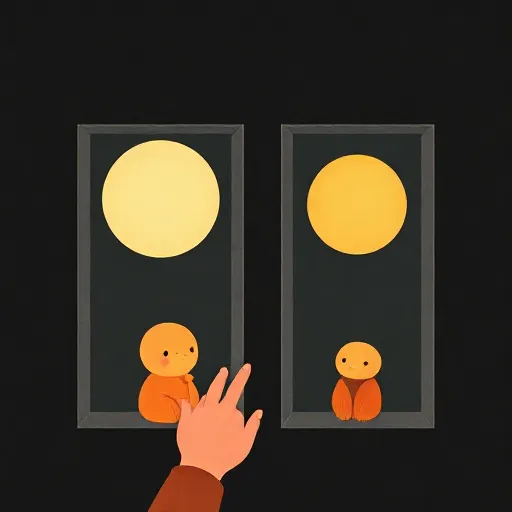
Imagine you are standing outside a tightly closed lab. Inside, your friend is about to measure the spin of an electron. Electrons are tiny bits of matter. Their spin can be “up” or “down.” According to the strange rules of quantum mechanics, before anyone looks, the electron can be in a superposition. That means it is in a fuzzy state where it is both up and down at the same time. Your friend operates her instrument. A moment later she comes out and says, “I saw spin‑up.” For her, the measurement gave one clear result.
But while she was inside, you treated the entire lab—including your friend and her equipment—as one big quantum system. Using the rule that says quantum states evolve smoothly like a wave, you would calculate that the lab ended up in a superposition. That means it is not in a single state where your friend sees “up” or “down.” Instead, it is a blend: a combination of friend‑sees‑up AND electron‑is‑up together with friend‑sees‑down AND electron‑is‑down. Both realities are there at once. So who is right—your friend with her single result, or you with your tangled blur?
This thought experiment reveals the measurement problem, a deep puzzle at the heart of quantum physics. The physicist Hugh Everett III (1930–1982) used a version of this story in the 1950s to argue that the usual rules of quantum mechanics could not give a consistent account of the world. He would soon propose a breathtaking solution: all those conflicting possibilities are equally real, and the world literally branches.
Two Rules That Couldn’t Both Be True

In the standard picture of quantum mechanics that Everett learned, there were two main rules. The first rule, often called the linear dynamics, says that physical systems change smoothly and predictably over time, like a wave rippling across a pond. The second rule says that when someone measures a system, the system instantly jumps to a single, definite outcome. This sudden jump is called collapse. The probability of each outcome is given by how much of the wave was in that direction.
These two rules run into trouble as soon as you treat the observer and her instruments as ordinary physical objects. The first rule alone would leave the whole lab in a superposition of many outcomes. The collapse rule demands that the lab settle into just one. But nothing in the first rule ever says “now collapse.” The theory gives no clue about when a measurement occurs or why an observer should get a single result. If you try to follow both rules, you end up in a contradiction. That is the measurement problem.
Everett’s response was as simple as it was radical: delete the collapse rule. Keep only the smooth wave rule. The resulting theory is called pure wave mechanics. In this theory, the universe never randomly jumps to one outcome. Instead, whenever an observer interacts with a quantum system, the observer and the system become tightly linked in a new kind of state called an entanglement. After the measurement, the observer’s own state becomes a superposition of having seen each possible result. The universe no longer “chooses” one branch; it keeps all of them.
How You Can Feel a Definite Result in a Fuzzy Universe

If the observer herself ends up in a superposition, then there is no absolute, single measurement record. That seems to clash with our everyday experience. Everett answered this worry by introducing relative states. Inside each branch of the superposition, the observer’s record is perfectly definite relative to the state of the particle in that same branch. If the particle ended up “up” in that branch, then the observer in that branch has a sharp record of “up.” There is no all‑seeing, absolute record. But relative to each branch, the experience is completely real and ordinary.
Think of it like colored glasses. If you put on red-tinted glasses, the world looks red; with blue-tinted glasses, it looks blue. No absolute color belongs to the world independently of the glasses. But relative to each pair, the color is perfectly clear. In pure wave mechanics, the “glasses” are the different branches, and the “colors” are the different measurement results. Your conscious experience, Everett argued, rides along one such branch.
He also showed something striking: because the smooth wave rule never collapses, an observer will always have a sure‑fire disposition to report that she got a single, definite result, even when the full picture is a blur. If you ask her, “Did you see a definite outcome?” she will answer “yes” with certainty, even though from the outside she is not in a definite state. The subjective appearance of a sharp world is built right into the physics.
Why You Still See Randomness When Everything Happens

Now a big puzzle remains. In the standard theory, the collapse rule gives precise probabilities—say, 50% for “up” and 50% for “down.” But if every branch actually happens, what does probability even mean? Everett did not think nature contained genuine chances. Instead, he introduced a typicality measure, a way of deciding how “thick” each branch is. He showed that if the measure obeys a few sensible rules, it must be the square of the amplitude associated with that branch.
Using this measure, Everett proved a remarkable result: in the long run, almost all branches (by the measure, not just by counting) contain sequences of records that match the standard quantum statistics exactly. To an observer living on a typical branch, the list of results looks as if it were generated by a random process with the usual probabilities. The randomness is an appearance within each branch, not a deep fact about the universe.
Imagine a giant tree with millions of branches. If you simply count them, most branches might have chaotic patterns that do not look random. But if you weigh branches by their thickness, the overwhelming bulk of the wood is concentrated on branches where the patterns look statistically regular—say, roughly equal numbers of “up” and “down” results. If you are a leaf on one of those thick branches, your personal memory will match the odds perfectly. Everett’s striking claim was that we are such typical leaves.
Many Worlds and Why Everett Grumbled

After Everett’s thesis, the physicist Bryce DeWitt (1923–2004) championed the idea under the name “many‑worlds interpretation.” DeWitt described the universe as constantly splitting into countless separate, non‑interacting worlds, each as real as the one we see. In every measurement, the world copies itself, so there is a world where the cat is alive and another where it is dead. That image—vivid and a little alarming—stuck in the public imagination.
Everett, however, was annoyed by that picture. He never thought branches were permanently sealed off. He insisted that all branches can, in principle, interfere with each other. The possibility of such interference, he argued, is exactly why every branch must be regarded as equally actual. Later work on decoherence helped explain why, in practice, different branches of a macroscopic measurement look completely separate to us. The environment acts like a cosmic beach ball that keeps them from recombining, so we never notice other outcomes. Most contemporary versions of the many‑worlds idea use decoherence to make sense of the stable, classical‑looking world we experience.
The debate is far from settled. Pure wave mechanics itself does not by itself spit out the standard quantum probabilities that physicists use in the laboratory; it needs extra assumptions. Different versions of many‑worlds add different extras. The theory’s power and its puzzles both spring from the same core move: refusing to let the wave ever collapse.
Why This Puzzle Still Haunts Us

Everett’s idea matters because it pushes us to ask hard questions about the nature of reality. If all physically possible outcomes happen somewhere in the branching structure, does that make your own choices less meaningful? Are there other versions of you right now, living lives you almost lived? And if the whole branching tree is determined by the wave rule, what becomes of free will?
Philosophers and physicists still wrestle with these questions. No experiment has yet forced us to accept a literally branching universe, but none has ruled it out either. Every time we push the boundaries of quantum control—building larger superpositions or more sensitive detectors—we test the limits of the “collapse” idea. The measurement problem, which Everett so vividly dramatized with a lab and a friend, remains one of the deepest riddles in all of science. And that is what makes it such an alive, human puzzle: it isn’t just about electrons. It’s about how you fit into the cosmic story.
Think about it
- If every decision you make causes the universe to branch, does that change how you think about making a tough choice—even if you never meet the other “yous”?
- If scientists someday built an experiment that could prove whether the world really branches, what kind of evidence would convince you?
- Right now, quantum theory says a particle’s property isn’t settled until someone measures it. If no conscious being ever looks, does the property have a definite value at all? Why or why not?