
Are There Other Versions of You Living Right Now?
Hannah’s impossible choice

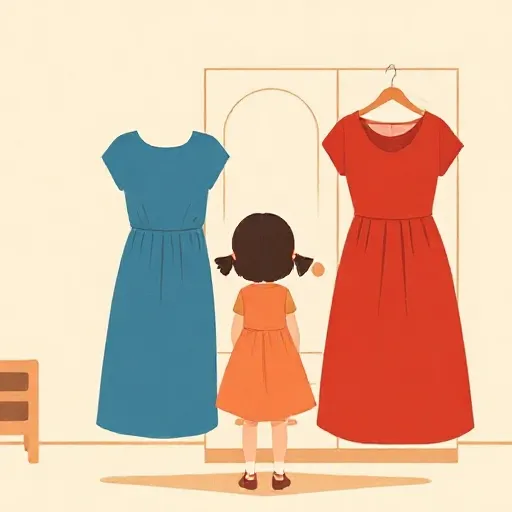
Hannah is thirteen. This morning she has to choose: wear the blue dress or the red one. She stares at both, brain whirring. In the end she grabs the blue one. But something bothers her — what happened to the other choice? Did the red-dress day just vanish, like it never mattered?
You have probably felt the same wobble: what if I’d studied harder, sat somewhere else at lunch, held my tongue? Most of us believe that only the thing we actually do becomes real — the rest are ghosts. But in 1957, a graduate student named Hugh Everett III (1930–1982) proposed a shocking idea. He said every possible outcome of a quantum event really happens, each in its own separate world. That means right now there might be another Hannah who grabbed the red dress, another you reading a different sentence, and a universe where you never even opened this article.
This is the Many‑Worlds Interpretation (MWI) of quantum mechanics. It’s not science fiction — it’s a real proposal that some of the sharpest physicists and philosophers take seriously. Let’s see why, and what it does to our picture of who “you” are.
What quantum mechanics whispers (and what it shouts)
To get the MWI you need one weird fact from quantum physics: tiny particles like electrons or photons don’t pick one definite path. Before anyone measures them, they act as if they’re smeared across all possibilities at once — a superposition. The maths that describes this smearing is called the wave function. It’s a precise equation that churns forward in time and never collapses on its own.
The puzzle is: when we do measure the particle, we see exactly one outcome — say the photon hit detector A, not detector B. Standard textbooks say the wave function “collapses” into one result, randomly, with probabilities given by the Born rule. But collapse has always been the odd part of the story. It happens everywhere, yet no one knows what causes it, and it seems to reach across space instantly.
Everett’s idea was simpler: just delete the collapse. Let the wave function keep going. Then all the outcomes remain inside it, like parallel currents in the same river. The universe doesn’t slim down to one result — it fattens into many. Every measurement creates a branch, a new world where each possible result is real.
So what exactly is a “world”?
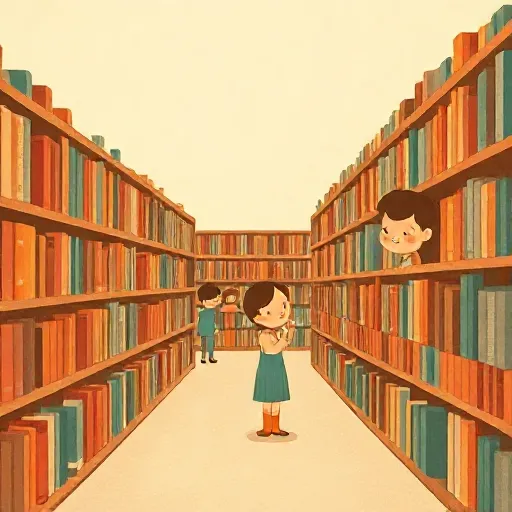
In the MWI, a world is everything you can see and touch: cats, stars, people, grains of sand — all in a definite, classical‑looking state. A world never contains a cat that is half‑dead and half‑alive. That superposition belongs to the Universe as a whole, which is the only big thing that really exists. The Universe contains all the worlds at once.
Think of a movie reel: each frame is a fixed picture, even though the film itself holds millions of frames. Similarly, each world is a kind of static slice — but these slices keep branching forward in time. At any moment your world has a unique past (you remember a single yesterday), but it points toward a fan of futures where many versions of you will live on.
The concept of a world is not perfectly precise — it’s “good enough for all practical purposes,” as physicists say. We can’t define exactly when a splitting happens, just as we can’t say the exact moment a pile of sand stops being a pile. But this fuzziness doesn’t ruin the explanation, because our everyday language already works the same way.
Am I one person or a legion?

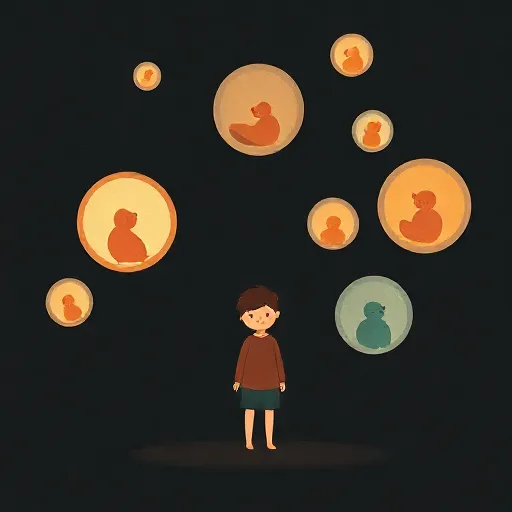
This is where things get deliciously strange. Suppose you do a quantum experiment with two outcomes, A and B. Before the experiment, there is one “you” wondering what you’ll see. After the measurement, there are two descendants — call them You‑A and You‑B — each in a different world, each sure that their result is the only one.
So which descendant is the real you? The MWI says: both. The idea of a single future self doesn’t survive. The philosopher Lev Vaidman compares it to being put to sleep before a quantum experiment and then woken up in room A or room B, without yet knowing which. When you open your eyes you’ll discover which room you’re in — but there’s a version of you in both rooms, each with a different memory of the same past.
This doesn’t mean you should feel split all the time. In normal life, the branching happens at scales we never notice — inside detectors, molecules, stars. Your everyday decisions (like choosing a dress) might cause splitting too, but that’s a separate and debated physics question. What matters is that the MWI stays faithful to the wave function and says the copies are all equally real.
Does probability still mean anything here?

If every outcome happens, the word “probability” sounds hollow. After all, you can’t ask “What are the chances I’ll see outcome A?” when one version of you definitely will see A and another definitely won’t. This is called the incoherence problem for probability in the MWI.
One answer uses measure of existence. Even though all outcomes occur, not all branches have the same “weight.” The squared amplitudes in the wave function give each world a number, called its measure of existence. Worlds with larger measures count more — in some deep sense they are “thicker” — and we should care about them more when we make bets.
Philosophers like David Wallace and Simon Saunders argue that rational decision‑making in a branching universe forces you to behave exactly as if probabilities follow the usual Born rule. Others, like Vaidman, say probability is just a useful illusion: before you know which world you’re in, you have post‑measurement ignorance, and the only sensible bet is to weigh worlds by their measures. This leads to a Behavior Principle: care about all your future branches in proportion to their measure, not in proportion to their number. So you wouldn’t play quantum Russian roulette even if you were guaranteed to survive in some branch, because the worlds where you die would have enormous total measure.
The pushback: is this really a simpler story?

Critics raise several objections, and they’re worth weighing.
Ockham’s razor says we shouldn’t multiply entities beyond necessity. The MWI multiplies worlds by the zillions. That sounds extravagant. But defenders reply: we should count laws, not things. The MWI needs only one law — the Schrödinger equation — without the messy collapse postulate. Compared to collapse theories or Bohmian mechanics (which adds hidden particle paths), the MWI is almost bare‑bones.
The preferred basis problem asks: why does the Universe split into worlds of definite positions and states — cats alive or dead, pointers pointing left — rather than other weird mixtures? The answer relies on decoherence. When a quantum system touches a big environment, certain patterns become stable while others instantly break apart. The result is that only worlds with classical‑looking objects persist long enough for creatures like us to notice.
The wave function isn’t enough is a third worry. The wave function lives in a huge, abstract space (3N‑dimensional for N particles), not in the ordinary 3‑dimensional space we inhabit. Some philosophers argue you need a “primitive ontology” — real stuff in space‑time — to touch and see. MWI advocates respond that we can locate the counterpart of our familiar 3D world inside the wave function by looking at particle densities in each branch. It’s not perfectly neat, but it’s enough to explain why you see a chair rather than a cloud of smeared probability.
Why does any of this matter today?
You might never sit in a physics lab and split your own world on purpose. Yet the MWI touches questions you face every day: what makes you you when your decisions ripple outward? Is there a version of you that stuck with piano lessons, or one that stood up to that bully? The MWI suggests the answer isn’t just a daydream — those versions might be as real as the one you’re living now, each with its own memories and its own future.
The idea also shapes how scientists think about quantum computers. A quantum computer explores many possibilities in parallel; some researchers find it natural to say those computations literally happen in different branches and then interfere to give you a single answer. Whether that’s true or just a poetic way of talking, the MWI forces us to ask what “real” means when the evidence for a universe’s furniture is always indirect.
Perhaps most deeply, the MWI continues a long human story of decentering ourselves. Copernicus showed we aren’t at the center of the cosmos. Darwin showed we share a family tree with all life. The MWI, if right, says your world isn’t even the world — it’s just one twig on a colossal tree of worlds. That can feel dizzying. But it can also feel strangely comforting: nothing is truly lost, just lived elsewhere.
Think about it
- If scientists could prove that another version of you lives the life you wish you’d chosen, would that change how you feel about your own choices? Why or why not?
- Imagine a machine that clones you perfectly and then splits the clones into two rooms with different decor. When you wake up in room A, is the person in room B still “you”? What would you need to know to decide?
- Suppose you care about all your future branches equally — would you take more risks, fewer risks, or the same amount as you do now?