Are There Other Versions of You? David Lewis’s Wild Answer
When a coin could have landed tails…
Imagine you flip a coin. It lands heads. But you know it could have landed tails. What do you mean by that “could have”? Does that possibility exist somewhere — out there, like a shadow of what didn’t happen? Or is it just a thought inside your head?
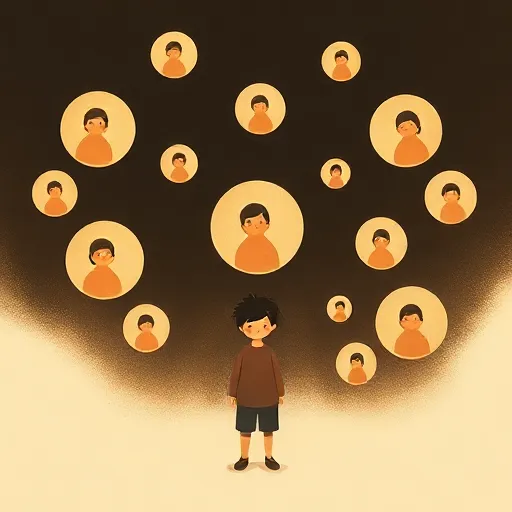
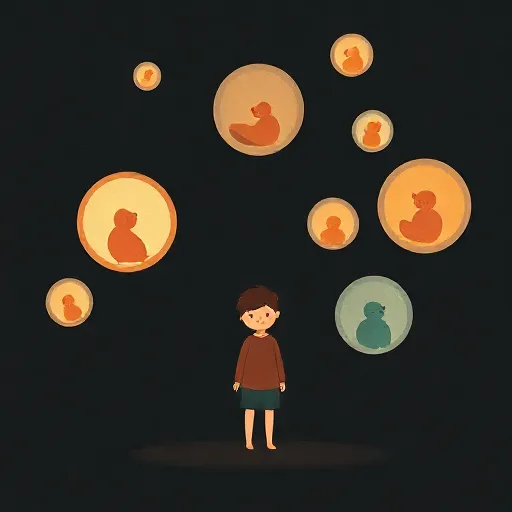
The philosopher David Lewis (1941–2001) gave a startling answer: all those “could haves” are real, concrete universes. He believed in a vast collection of worlds, each as solid as our own, where every possible way things could be is actually happening. And in some of those worlds, there’s a version of you who chose a different path.
Lewis didn’t stop there. He aimed to show that everything — from tables and turtles to laws of nature and free will — could be explained by a single, no-nonsense recipe of what reality is made of. That recipe begins with two ancient questions: What is there? and What is it like? Lewis’s answers combine space, tiny points, and a fierce refusal to treat possibility as a mysterious extra ingredient.
The ultimate building blocks: points and properties
To explain what’s really real, Lewis built from the bottom up. He claimed that the fundamental level of existence contains only spacetime points — the smallest bits of location — and perfectly natural properties and relations. A perfectly natural property is a basic feature that carves reality at its joints, like having a certain electric charge or having a certain mass. It isn’t something fuzzy like “being a chair” or “being funny.” Those are less fundamental and can be explained by how the basic building blocks are arranged.
All other facts about the world, Lewis thought, reduce to facts about these point-sized ingredients and how they are connected. A chair exists because countless tiny points clump together in a certain way. A storm, a star, a memory — all are patterns painted on an enormous canvas of points and properties, with no extra “chair stuff” or “storm stuff” added. This idea is sometimes called Humean Supervenience: roughly, the whole story of the world supervenes on the local arrangement of perfectly natural properties across points.
Crucially, Lewis insisted that these fundamental properties are non-modal. That means describing them never needs words like “must” or “can” or “possible.” They just are. If you want to talk about what could be, you look at different arrangements of the very same kinds of points and properties — other worlds. This move strips possibility of any spooky, built-in magic.
A million real universes

Most philosophers treat possible worlds as useful tools for talking about possibility, without believing they really exist. Lewis went much further. His modal realism holds that possible worlds are just as real and concrete as the one we live in. They contain genuine tables, genuine donkeys, genuine planets — not shadows or stories.
What makes them different from our world is simply that we are not part of them, and they are not part of us. Each world is isolated; nothing that happens in one can affect things in another. Spatiotemporally, they are sealed bubbles. When we say “It is possible that there are talking donkeys,” we mean there is some world out there — one of many — where a talking donkey exists. Talk of necessity (“It must be that 2+2=4”) means something that is true in every world. “Actual” is just a label we give to the world we happen to be in; every world is actual to its own inhabitants.
By building possible worlds out of the same non-modal ingredients — points, properties, and spatiotemporal relations — Lewis believed he had turned the study of possibility into a kind of geography. You don’t need to analyse “could” or “might” as primitive notions. You just describe the arrangement of points in other regions of logical space. This complete subordination of the modal to the non-modal was one of Lewis’s most radical and controversial achievements.
The puzzle of who you are elsewhere

If all these worlds are separate, a new problem pops up. Take a real person — say, you. You might have had an extra inch of height. If that possibility is represented by a world where a person very much like you has that extra inch, is that person you? Lewis said no. Different worlds do not share parts, so you, a flesh-and-blood creature rooted in this world, cannot literally exist in another world with different features.
To handle such de re possibilities — possibilities about specific individuals — Lewis invented counterpart theory. Instead of saying you exist in multiple worlds, you have counterparts in other worlds: individuals who sufficiently resemble you in certain important ways. “You might have been taller” is true if some world contains a counterpart of you who is taller. Counterparts are not identical to you; they represent you via similarity.
What counts as similar enough is flexible and context-sensitive. In a discussion about how your life might have gone, your counterparts might need to share your origins but not your whole future. In another context, we might relax even that. This makes the counterpart relation a bit vague, but Lewis thought that matched how we actually reason — our standards shift depending on what we care about.
Who is winning the election?
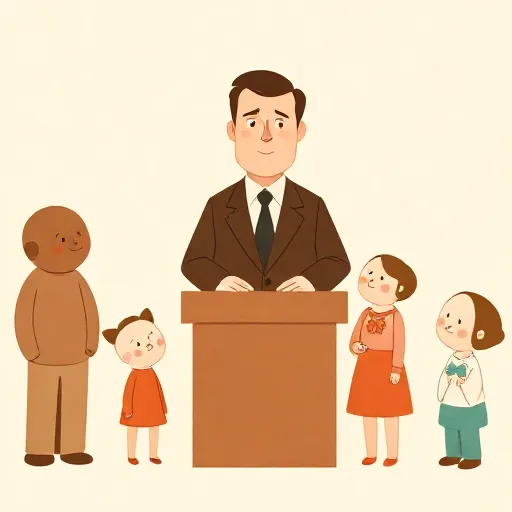
A famous objection came from the philosopher Saul Kripke (b. 1940). He imagined saying, “Hubert Humphrey might have won the 1968 U.S. election.” According to counterpart theory, this is true because there is a world with a Humphrey counterpart who wins. Kripke objected that this seems to dodge the real point: “We are not talking about something that might have happened to Humphrey, but to someone else.” When we care about what Humphrey could have done, we care about Humphrey himself, not a lookalike.
Lewis replied that the counterpart view still makes the statement about Humphrey. Humphrey has the property of “possibly winning” because he has a winning counterpart. The counterpart’s victory represents Humphrey as winning, just as a map represents a city without being the city. For Lewis, this representation was robust enough to capture what we mean.
Counterpart theory proved useful for other puzzles too. Consider a statue and the lump of clay it is made from. Lewis thought they are the same object, but they seem to have different possibilities: the clay could survive being squashed, the statue could not. In counterpart theory, which possibilities we focus on depends on which similarity standards we highlight. When you call the object “the statue,” you emphasise shape; when you call it “the clay,” you emphasise material continuity. Different words evoke different counterpart relations, solving the puzzle.
Why Lewis still sparks arguments
Critics have pushed back hard. If counterparts are picked by similarity, then “I could have been quite unlike what I actually am” becomes tricky — extreme differences might cut the similarity link. Lewis responded that we can have counterparts who are dissimilar in most ways so long as they match in a small but crucial respect, like their moment of birth.
Some philosophers object that counterpart theory breaks familiar rules of logic. For example, it does not validate the necessity of identity: it might turn out that in one world, a counterpart of you is also a counterpart of someone else, so what seemed like separate people could “merge.” Lewis didn’t mind. He was happy to cast doubt on whether traditional modal logic perfectly tracks ordinary talk about what could be.
Nevertheless, the power of Lewis’s framework is undeniable. It handles puzzles that trap other theories — like the bicycle that could have had almost any single part different but could not have had entirely different parts. By allowing that a counterpart of a counterpart need not be your counterpart, Lewis showed how small changes can chain while a total swap doesn’t follow. Similar reasoning applies to split personalities, time travel twins, and even questions about whether you could have been born to different parents.
Today, Lewis’s ideas echo far beyond dusty academic papers. Whenever you watch a movie about parallel realities, wonder whether a decision was really free, or ask what makes you the same person from one day to the next, you are wading into the territory he mapped. He forces us to ask: Is the realm of “what if” a real place, or just a trick of language? And if there really are countless versions of you, does that make your choices more weighty — or less?
Think about it
- If there’s a universe where you chose a different breakfast this morning, does that make your actual choice any less yours?
- Regret often means wishing something had gone differently. If every possible outcome already exists somewhere, does regret still make sense?
- Could a version of you in another world be the same person as you if they have completely different memories and a completely different life? What matters most — physical resemblance, memories, or something else?