Can Two Things Be Exactly Alike and Still Be Two?
A Universe with Only Two Spheres
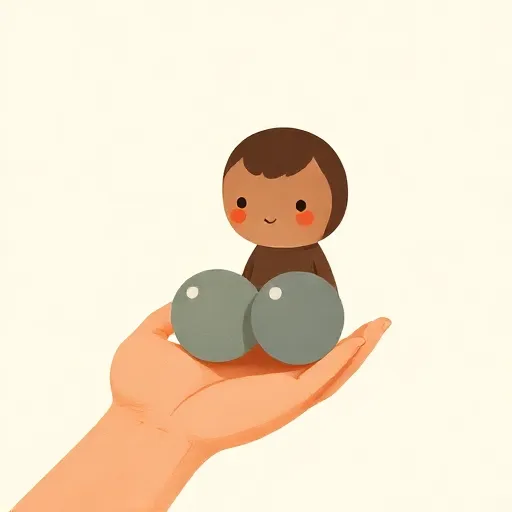
Imagine a space that contains absolutely nothing — except two iron spheres. They are exactly the same size, the same colour, the same temperature, every tiny detail matching perfectly. There is nothing else in this universe, no stars, no people, no other objects. If you were somehow floating there, could you point to two distinct spheres, or only to one?
The philosopher Max Black (1909–1988) asked this in a famous 1952 article. He wanted to test a very old idea: the Identity of Indiscernibles. That is the claim that no two distinct things can be exactly alike in all their qualities. If two things share every single quality, then they are really one and the same thing — so you don’t have two items, just one. Black’s imaginary universe seemed to challenge this. His two spheres appear to be distinct (they sit at a distance from each other), yet they seem to share all the same qualities. So if that universe is genuinely possible, the Identity of Indiscernibles cannot be true.
The idea itself is even older. The 17th-century thinker Gottfried Wilhelm Leibniz (1646–1716) made it central to his philosophy. He argued that no two substances — the basic building blocks of reality for him — could resemble each other perfectly and still be two. For Leibniz, perfect similarity meant being one and the same thing. But Black’s spheres brought this question roaring back into philosophy, and the debate is still far from settled.
Leibniz’s Big Idea: No Perfect Twins

To understand the dispute, you need to know what philosophers mean by qualities or properties. A property is a way something is — being red, being square, being two metres tall, being next to a tower. Leibniz’s principle says that if object A and object B have all the same properties, then A and B are actually one object. In other words, there cannot be a numerical difference (being two) without a qualitative difference (differing in how they are).
But this runs into a tricky problem right away. Think about the property “being identical to A.” Only A can have that property, by definition. So any two things automatically differ in properties like “being identical to A” versus “being identical to B.” That would make the principle trivially true — it tells us nothing interesting. Philosophers call such properties trivializing properties because they short‑circuit the real question.
To make the idea meaningful, we need to focus on properties that don’t already sneak in which object we’re talking about. The most common move is to restrict the principle to pure properties. A pure property is one that does not “mention” any particular individual. Being red is pure; being next to the Eiffel Tower is impure, because it includes that Paris landmark. So a version of the Identity of Indiscernibles becomes: necessarily, no two objects share all their pure properties. (Philosophers label this (PIIa).) An even stronger version, (PIIb), says no two objects share all their intrinsic pure properties — roughly, the properties an object has all by itself, regardless of how it relates to other things. The weakest non‑trivial version, (PII), demands that no two objects share all their non‑trivializing properties, which includes all pure properties plus some impure ones like being a lover of Napoleon (these still say something about how the object is, not just which object it is).
Leibniz himself often expressed his idea in terms of similarity: “It is not true that two substances resemble each other entirely and differ only numerically.” But modern debates usually treat the question in terms of shared properties. And the challenge from Black’s iron spheres is this: if a world contains nothing but two spheres exactly alike in every pure property, then both (PIIa) and (PIIb) are false.
Black’s Spheres: A Challenge to Leibniz
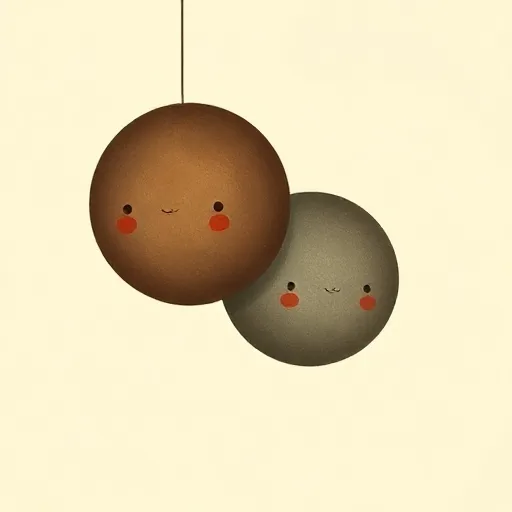
In Black’s imagined universe, the two spheres share all pure properties — intrinsic ones like size and colour, and extrinsic ones too, since there is nothing else for them to relate to differently. If such a universe is genuinely possible, then (PIIa) is dead. Black thought it was possible, and the example convinced many philosophers.
But is the vision reliable? Some critics argue that when you try to imagine two spheres at a distance, you might only be imagining one sphere at a distance from itself — a single object that somehow occupies two places at once. Others suggest that what we actually picture is a single very strange scattered object, shaped like two disconnected blobs, with no parts that are separate spheres. On either of these readings, you aren’t really picturing two distinct indiscernible objects.
A different reply is that Black’s spheres are weakly discernible after all. One sphere is two metres from the other, but neither sphere is two metres from itself. So there is a relation (distance) that holds between them but that each fails to hold with itself. However, this doesn’t rescue (PIIa) — the version about pure properties — because the distance relation is still a pure property they share (both stand in the same distance relation to the other). So the spheres remain a counterexample to the pure‑property version, even if they are weakly distinguishable in a technical sense.
Thus, the debate over Black’s world is alive. The question hinges on whether our imagination is sharp enough to guarantee that a world with two indiscernible objects like these is genuinely possible.
Can You Picture It? Arguments Against the Principle

Philosophers have built other arguments to show that the Identity of Indiscernibles is false. One simple thought is that if you can vividly conceive of two objects being perfect duplicates, then such a situation is possible — and if it’s possible, the principle is not a necessary truth. But your conceiving might be fuzzy: maybe you imagine one object but unknowingly tag it as two. So conceivability alone may not settle the matter.
A more subtle argument starts with almost indiscernible objects. Picture two iron spheres that are exactly alike except that one is a single degree hotter. That seems possible. Now tweak the world so that both have the same temperature. If you can slide from the almost‑identical world to the perfectly identical one, then you’ve reached a world with indiscernible objects. Robert Merrihew Adams (1937–2024) proposed an argument along these lines in 1979. Critics reply that the step from almost identical to perfectly identical is not logically forced; the fact that a tiny difference could be removed doesn’t prove the resulting world has two objects rather than one.
Another challenge comes from science. Physicists sometimes treat fundamental particles such as electrons as indiscernible: two electrons in the same energy state are said to have exactly the same properties. But science describes particles only as far as it needs to explain observations. It never proves that electrons hide no further differences, so the argument is tied to today’s science and might change.
These arguments, though powerful, haven’t silenced defenders of the principle.
Why Think No Two Things Can Be Exactly Alike? Arguments For
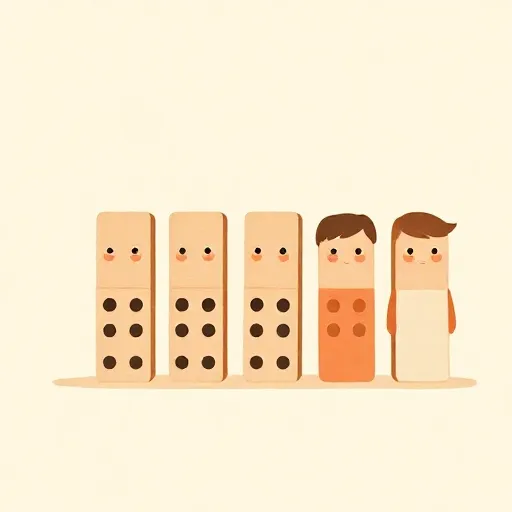
Leibniz himself offered a theological argument. If God existed and created two objects with the exact same intrinsic pure properties, God would have no reason to place them where they are rather than swapping them around — and God, according to Leibniz, never acts without a reason. So God wouldn’t create such indiscernible objects. This argument depends on a very specific idea of God, something many people reject. It also assumes any two objects could be swapped while leaving everything else the same, which might not always hold.
A more recent line pushes a Principle of Sufficient Reason: everything must have a reason or explanation for being as it is. Michael Della Rocca (a contemporary philosopher) has argued that if two objects were perfectly alike in all pure properties yet distinct, their distinctness would have no explanation at all — it would be a brute, primitive fact. A world without such brute facts seems more satisfying to many, so one might accept (PIIa).
Another contemporary argument targets the weakest version, (PII). It notes that if two objects shared all non‑trivializing properties, then for every such property, they would necessarily have it at exactly the same time — they would necessarily co‑vary in all non‑trivializing respects. That would mean the two objects are locked together in a way that violates the plausible idea that distinct objects are independent of each other. For instance, you and a perfect duplicate would always have exactly the same non‑trivializing properties in every possible situation; you couldn’t have one property unless the duplicate had it too. Such a tight connection seems too strong for two genuinely distinct things. So (PII) might be true after all.
These arguments are hotly disputed, and none has convinced everyone. The Identity of Indiscernibles remains a live battlefield in metaphysics.
What About You? Perfect Duplicates and Personal Identity
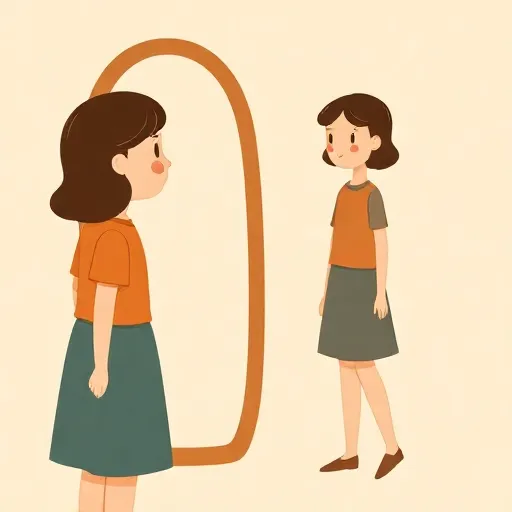
Now bring the question down to your own life. Suppose a machine created an exact duplicate of you — same appearance, same memories, same personality, same everything you can describe without using your name. Would that person actually be you? If you accept a very strong version of the Identity of Indiscernibles, like (PIIb), you might think that if two things share all your pure intrinsic properties, they’d be the same object — so the duplicate would literally be you, and there wouldn’t really be two people.
But many people have the strong intuition that the duplicate is a different person. That suggests you think there is something more that makes you you — perhaps an individual essence that isn’t a pure property and can’t be duplicated. Philosophers call this a haecceity (a “thisness”), but you don’t need the fancy word. The point is that your own feeling that you are uniquely yourself seems to pull against the Identity of Indiscernibles. Yet if the principle is false, why does it strike so many as oddly attractive that perfect similarity would collapse into identity?
The question still matters because it touches how we think about identity, difference, and what it means to be a particular person. The Black spheres have never been spotted in space, but every time you wonder whether a perfect copy of your pet would still be your pet, or whether a machine‑generated duplicate prisoner would deserve the same punishment, you’re walking right into the philosophical territory Leibniz opened. And philosophers are still arguing about it — which means there’s a spot at the table for your own thoughts.
Think about it
- If you met someone who looked and acted exactly like you, shared all your memories, and claimed to be you, what would prove they aren’t the real you?
- Could a video game where all the enemies have exactly the same code and appearance still have separate, distinct enemy objects? Why or why not?
- If a scientist made an atom‑for‑atom copy of your favourite shirt, would it be the same shirt or a different one? What makes something the same?