
Can Two Things Be Exactly the Same and Still Be Two?
Two Spheres in an Empty Universe
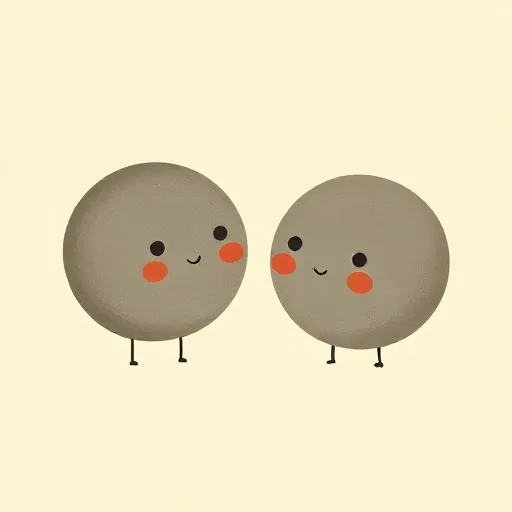
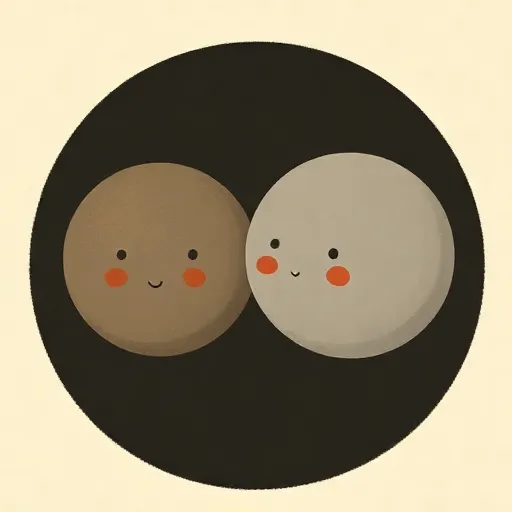
In 1952 the philosopher Max Black (1909–1988) asked his readers to picture a strange little universe. It contains nothing at all — except two spheres. They are both made of pure iron, each exactly one mile across, with exactly the same temperature, colour, and texture. No stars, no people, no dust; just those two balls. Then Black asks: “Isn’t it logically possible that the universe should have contained nothing but two exactly similar spheres?”
If both spheres share every single feature — size, shape, temperature, material, even the fact that each is exactly one mile from the other — is there really two of them? Or is this just one sphere described twice?
This puzzle challenges a famous principle put forward by Gottfried Wilhelm Leibniz (1646–1716). He called it the identity of indiscernibles: if two things share absolutely all their properties, they must be the same thing. Black’s universe seems to show two distinct things with the same properties. So if the spheres are really two, the principle is broken. The puzzle is all about individuation — the question of what makes a single individual different from everything else of its kind.
What If There’s No Difference You Can Measure?

If you try to separate Black’s spheres by pointing to any quality you can measure, you’ll fail. Temperature, colour, mass — they match. Even the relational property “being one mile from the other sphere” is the same for both, because the distance is symmetric. So if Leibniz is right, there cannot be two spheres; there can only be one. But your gut says there could be two.
To save the principle, some philosophers suggest that the spheres differ in a very unusual way. They differ by a property that is not a shape, a colour, or any measurable quality. The property is simply the property of being this individual and no other. Medieval thinkers had already explored this idea when they asked what makes one angel distinct from another, since angels were thought to have no physical bodies. Their answer was a haecceity — a word invented from the Latin haec, meaning “this.” A haecceity is not a physical thing; it is the “thisness” of an individual, an invisible label that makes one sphere This Sphere and the other That Sphere. If each sphere has its own unique haecceity, then they have different properties after all, and Leibniz’s principle can still stand.
The most detailed medieval account of haecceity comes from John Duns Scotus (c.1266–1308), and it takes us deep into the engine room of individuals.
Duns Scotus and the Secret Ingredient of Individuals

Scotus believed that every individual is made of two real components that are distinct but inseparable. The first is a common nature — the shared essence that all things of a kind have, but that is not yet a single individual. Think of the common nature as a generic recipe for being human. The recipe can be used to bake many different cakes; it has what Scotus called “less-than-numerical unity” — it can be multiplied without becoming many different recipes. The second component is the haecceity, the individualising ingredient. When a haecceity joins with a common nature, the result is a this — a particular human being like Socrates or Plato, not just humanity in general.
Scotus argued that haecceities are real parts of individuals, not just words or concepts, because the common nature itself cannot explain why there are many distinct individuals of the same kind. If humanity were already individual, there could only be one human. So something else must contract the nature into a particular. That something is the haecceity. It is an entity that shares nothing real with any other haecceity. Two people are both human, but their haecceities are utterly dissimilar, with no common feature between them.
Scotus used an analogy: just as a specific difference like “rational” distinguishes the human species from other species inside the genus “animal,” a haecceity distinguishes one individual from all other individuals inside the species. And he held that the nature and the haecceity in one thing are formally distinct — you can think about them separately, but you can never pull them apart. Like the roundness and the yellowness of a particular banana, they are really the same thing, but your mind treats them as two aspects.
Why Some Think Thisness Doesn’t Work
Scotus’s system is powerful, but it raises hard questions. If a common nature like “humanity” is the same recipe in many individuals, how can it be truly one thing while being in many places? Scotus answered that inside each individual the nature is numerically single, but in itself it has a weaker unity. Yet thinkers soon found that puzzling.
William of Ockham (c.1287–1347) rejected common natures with less-than-numerical unity altogether. He said that everything that exists is already individual through itself. Humanity is not some shared thing over and above individual humans; “humanity” is just a concept we form by noticing similarities. Ockham held that individuals are primarily diverse — their difference from each other is a basic fact that has no explanation in further components. If you have two perfectly similar iron spheres, they are simply two distinct things because they are two distinct things, not because of a hidden haecceity. This still counts as a kind of haecceitism, because it allows distinction without qualitative difference, but it doesn’t treat haecceities as extra parts of the world.
Many centuries later, the philosopher Robert Merrihew Adams (1937–2024) revived a similar light-footed haecceitism. He suggested that a haecceity is just the property of “being identical with this individual” — a property every thing has automatically, not a separate ingredient. So you can accept that two spheres differ by having different haecceities without piling extra furniture into the universe. The debate, then, is about how much metaphysical weight that difference carries.
So What? Why Your Uniqueness Matters Today

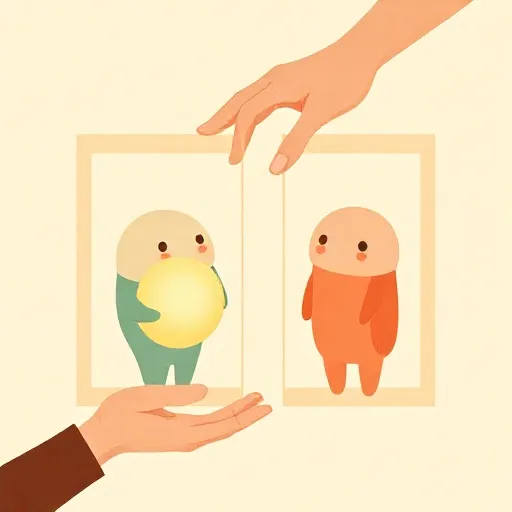
The problem Scotus was tackling is not just about angels and iron spheres. It is about you. If one day a machine built an exact duplicate of your body, down to every atom, memory, and thought — would that duplicate be you, or a new person? The duplicate shares all your qualitative properties, but you are still distinct individuals. Our law already treats identical twins as separate people, even if they share the same DNA and upbringing. The question of what makes you uniquely you — whether it is a special “thisness,” a bare fact about identity, or something else — is still wide open.
Computer files offer a modern echo. When you copy a file, the copy is numerically distinct from the original even though the contents are identical. That distinction matters because you can delete one without deleting the other. In the same way, the idea of haecceity reminds us that “being this particular thing” is a deep feature of reality, one that might not reduce to any list of qualities. So the next time you wonder, “Why am I me and not someone else?” you are stepping into the same conversation that Scotus started over seven hundred years ago.
Think about it
-
Imagine a machine that creates an exact duplicate of you, with all your memories and personality. Would the duplicate be the same person as you, or a new person? How could anyone tell the difference — even in principle?
-
If two supposedly identical objects differ only in that one is “this one” and the other is “that one,” does that difference count as a real property, or is it just a trick of language?
-
In a universe that contains absolutely nothing but two indistinguishable spheres, could a super-intelligent observer know which is which? What kind of fact, if any, would make them two rather than one?