
Can Quantum Weirdness Explain How You Choose?
Is Everything Already Decided?

You’re staring at the last cookie on the plate. Your hand hovers. Should you take it? It feels like you could choose either way — it’s completely up to you. But what if that feeling is an illusion? What if every choice you make was already settled by the state of your brain the moment before, and the moment before that, all the way back to the Big Bang?
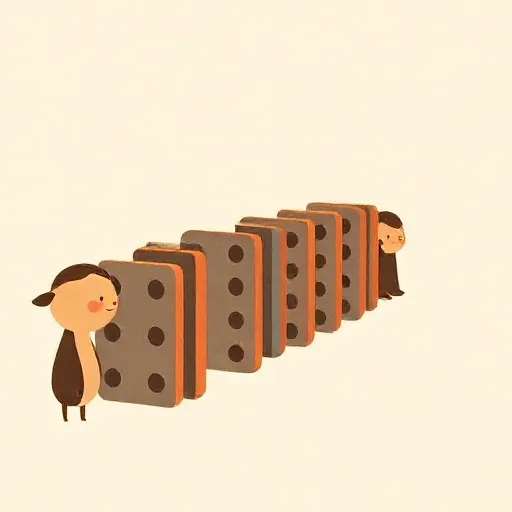
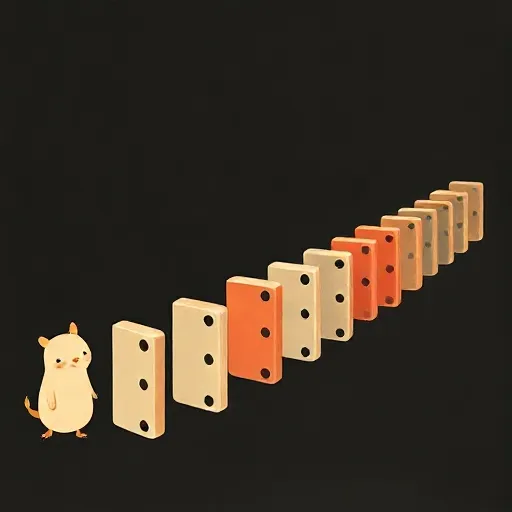
Philosophers have wrestled with this question for centuries. If the world follows strict physical laws, then everything that happens — including your decisions — might be determined: the outcome is fixed by earlier events, like a chain of falling dominoes. This view, determinism, seems to leave no room for free will, the ability to genuinely choose. For a long time, physics itself seemed to agree. Classical physics, from Newton onward, painted a picture of a clockwork universe where each moment follows necessarily from the last.
Then, in the early 20th century, quantum theory shattered that clockwork. Physicists discovered that at the tiniest scales, particles behave with an irreducible randomness. An atom doesn’t emit light at a predictable moment — it just does, and we can only give probabilities. This quantum indeterminacy is not due to our ignorance; it’s a fundamental feature of nature. Pioneers like Niels Bohr (1885–1962) and Erwin Schrödinger (1887–1961) immediately saw a philosophical puzzle: if individual quantum events are genuinely undetermined, maybe they open a fresh door for free will. But there’s a catch. Randomness isn’t the same as conscious, purposeful choice. If your decisions were just random rolls of the dice, they wouldn’t feel like yours either.
So the problem deepens. Could the brain use quantum randomness in a way that doesn’t turn you into a gambling machine?
Can a Brain Cell Use Quantum Uncertainty?
If quantum events are to help explain conscious choice, they must happen somewhere inside your brain. One bold idea, developed from the 1930s onward, focuses on how quantum measurement works. In the standard picture, a quantum particle can be in a superposition — a blend of possible states, like a spinning coin that is neither heads nor tails until it lands. When a measurement happens, the superposition suddenly collapses into one definite outcome. The physicist John von Neumann (1903–1957) noted that this collapse is abrupt and irreversible, a process not described by the ordinary smooth equations of quantum theory.
Later, Eugene Wigner (1902–1995) made a radical suggestion: consciousness itself might cause the collapse. His American colleague Henry Stapp, working from the 1980s, built a framework where each conscious thought is the mental side of a quantum collapse happening in the brain. In Stapp’s picture, an intentional choice — “I will reach for the cookie” — is a mental act that stabilizes a particular pattern of neurons. This is like the quantum Zeno effect: by paying attention to a superposition, you can keep it from changing, essentially locking in a decision. Stapp insists he isn’t changing the standard math of quantum mechanics, only its interpretation, but most physicists consider adding mental states to the core of the theory a huge leap.
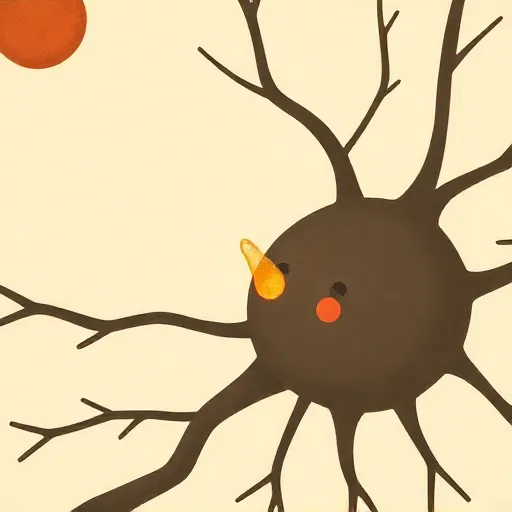
A more concrete proposal zooms in on a single synapse — the tiny gap where signals jump from one neuron to the next. The neuroscientist John Eccles (1903–1997) and the physicist Friedrich Beck suggested that the release of a chemical messenger across the gap, called exocytosis, is triggered by a quantum tunneling event. In their model, mental intention can momentarily raise the probability of that quantum jump, making a neuron fire. Yet there’s a gap between one synapse and a whole conscious thought. How could a single random twitch influence the coordinated activity of millions of neurons that makes up a thought? No one has yet bridged that chasm.
Tubes, Gravity, and the Uncomputable
A far more dramatic proposal comes from the mathematician Roger Penrose (born 1931) and the anesthesiologist Stuart Hameroff (born 1947). Penrose starts with a different kind of puzzle: some conscious acts, like a flash of mathematical insight, feel non-computable — no algorithm could copy them. If the brain were just a classical computer, every thought would be computable. So Penrose looked for a physical process that is both non-computable and could be the stuff of consciousness.
He landed on quantum gravity. Penrose argues that the collapse of a superposition isn’t just a measurement — it’s a real, physical event that happens when a quantum state gets too “smeared out” for spacetime to handle. He calls this objective reduction, and he thinks it is driven by gravity. Because no working theory of quantum gravity exists yet, this idea is highly speculative. But Penrose believes such collapses would be non-computable — not just random, but genuinely creative.
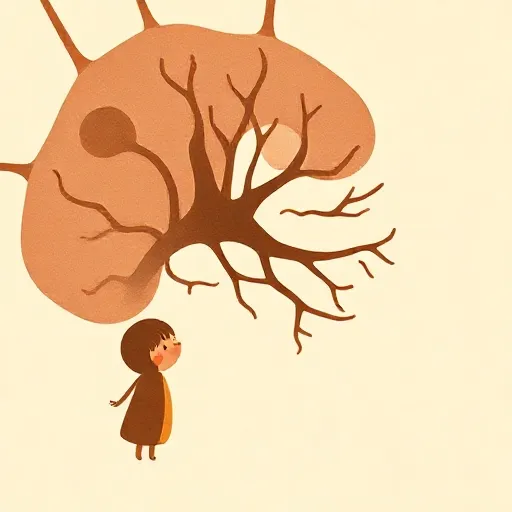
Hameroff suggested a perfect stage for these dramas: microtubuli, tiny hollow tubes that form the skeleton inside your brain cells. In their picture, tubulin proteins inside microtubules can sustain quantum superpositions for just long enough for gravity to collapse them. Each collapse is a flicker of conscious experience. Critics quickly pointed out that the warm, wet environment of the brain should destroy any delicate quantum state almost instantly — a problem called decoherence. The debate has seesawed for years, with some revised calculations suggesting superpositions might survive long enough, and some experiments hinting that anesthetics act on microtubules, strengthening the link to consciousness. But Penrose and Hameroff’s full vision remains a beautiful, unproven myth — one that has stimulated a tremendous amount of real science.
Thinking in a Quantum Way — Without Quantum Physics
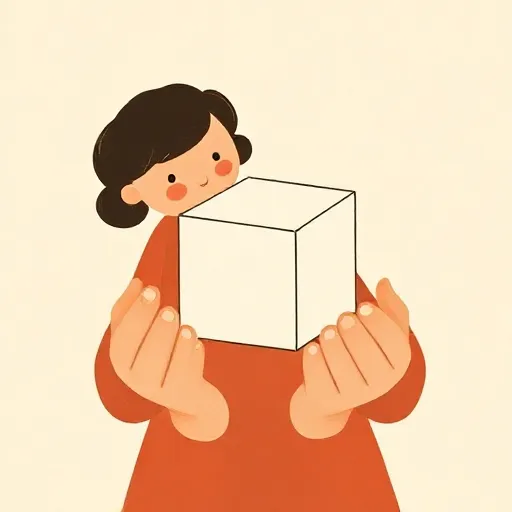
What if your thoughts can behave in a quantum like way even if your brain isn’t a quantum computer? In the last two decades, researchers have built a new field called quantum cognition. The idea is simple: mental states can show the same patterns as quantum systems — like non-commutativity, where the order of questions changes the answer, or entanglement, where meanings combine into a whole that can’t be separated into parts. But all this happens at the level of psychology, not physics.
For example, in a survey, asking “How happy are you?” before “How is your love life?” gives different results than asking them in the reverse order. That’s a real effect that classical models struggle to explain, but quantum models handle naturally. Ambiguous images like the Necker cube put your perception into a kind of mental superposition — you don’t see a mixture; you flip between two clear views, much like a quantum state collapses to one option. Even learning, memory, and the way we combine words into new meanings seem to follow quantum-like rules.
These models don’t claim your neurons are entangled. Instead, they treat the mind itself as a system whose logic is deeper than simple yes-or-no. That opens the door to a non-reductive view: consciousness may have laws of its own that don’t reduce to brain cells, even if the two are deeply connected.
One Reality, Two Faces
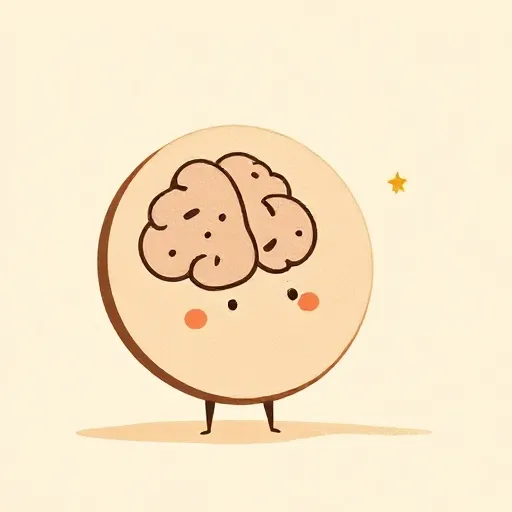
Some thinkers have taken an even bigger step. They imagine that mind and matter are not two separate things that somehow interact. Instead, both are aspects of a single, neutral reality that is neither mental nor physical — a psychophysically neutral ground.
This idea is old. The philosopher Baruch Spinoza (1632–1677) already thought that mind and body are two expressions of one substance. In the 20th century, the physicist Wolfgang Pauli (1900–1958) and the psychologist Carl Jung (1875–1961) developed a quantum-inspired dual-aspect view. They proposed that the deepest layer of reality contains archetypes — ordering patterns that are neither mind nor matter but give rise to both. A conscious thought and a correlated brain state would then be like two sides of the same coin, unfolding from a shared hidden order.
In this picture, the link between mind and body isn’t a direct push-and-pull. Rather, both are informed by the same deeper pattern, which Pauli and Jung called a synchronistic connection when it appears as a meaningful coincidence — like thinking of a friend just as they call. Such events aren’t caused by your thought; they are correlated because both spring from the same ground. The physicist David Bohm (1917–1992) and his collaborator Basil Hiley proposed a similar vision of an “implicate order” out of which matter and mind unfold. And the physicist John Wheeler (1911–2008) said the universe is built from observer-participancy, where meaning links subjective experience and physical facts.
All these speculations reach far beyond today’s settled science. But they point to a possibility: that the mind-matter puzzle isn’t about how brain stuff produces thought stuff, but about how a deeper unity splits into two ways of being that each of us knows intimately.
So What Kind of Chooser Are You?
The search is far from over. The quantum brain proposals — Stapp’s collapse, Beck and Eccles’ synaptic trigger, Penrose and Hameroff’s microtubule gravity — all face sharp criticism and lack the smoking-gun experiment. The quantum mind models have more empirical success but deliberately stay at the psychological level, never promising a physical mechanism. The dual-aspect frameworks offer an elegant story but are even harder to test.
Still, the questions shape your life right now. If every choice is determined, what does that mean for praise and blame? If it’s random, are you any more free? If mind and matter are two expressions of a single reality, then your inner experiences — the taste of a cookie, the nagging thought, the thrill of deciding — are not less real than the atoms buzzing in your brain. They are the other side of that same coin.
So next time your hand hovers over a cookie, pause. Whether your move is a domino fall, a quantum dice toss, a deep archetypal pattern, or something else entirely — you’re standing inside one of the greatest mysteries there is. And that’s a pretty good place to be.
Think about it
- If a scientist could predict every choice you will ever make with 100% accuracy, would it still be fair to praise or blame people for their actions?
- Suppose your decisions were completely random at the quantum level. Would you feel more free, or just out of control?
- Can you think of a moment when a coincidence felt so meaningful that it didn’t seem like pure chance? How would you test whether that feeling tells us something real about how mind and world connect?