Was Your Last Choice Already Decided Before You Were Born?
The Choice That Wasn’t?
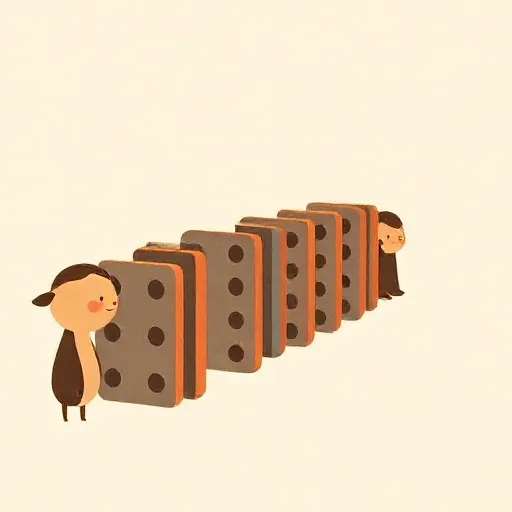
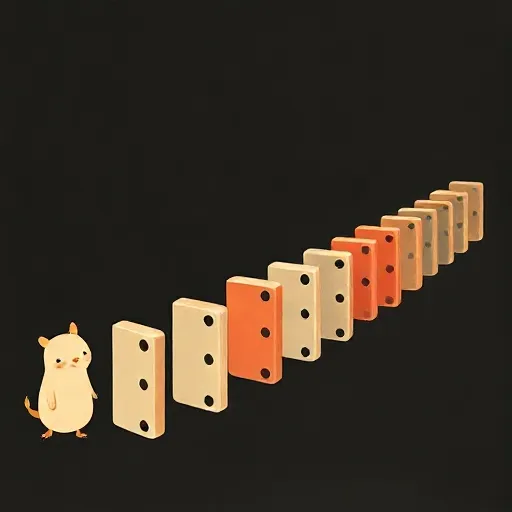
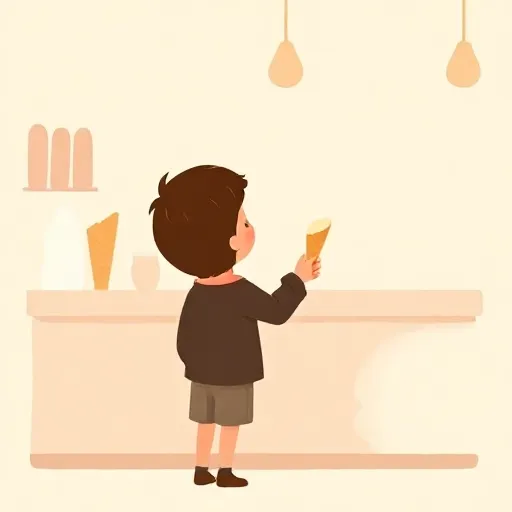
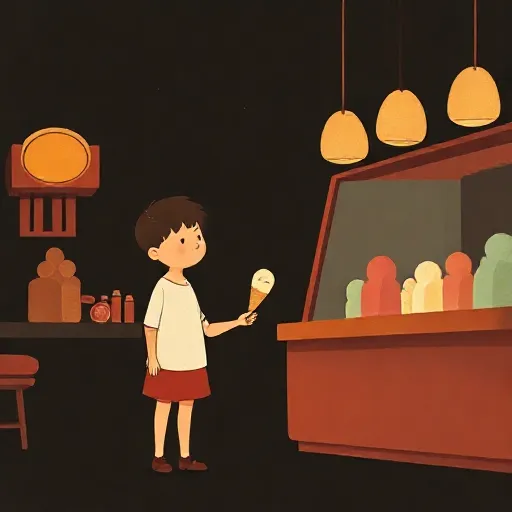
Imagine you are in an ice cream parlor. You stare at the tubs: chocolate chunk on the left, vanilla bean on the right. You hesitate. Then you point at vanilla. You feel like you freely picked it, right? But now imagine that a chain of dominoes stretches backward from your hand, through every thought buzzing in your brain a second ago, through the breakfast you ate, the genes your parents gave you, all the way back to the Big Bang. If the universe is that tightly connected—if every event is caused by earlier events and strict laws—was your choice really yours, or was vanilla the only thing you could ever have done?
Philosophers call this idea determinism (more precisely, nomological or causal determinism). It says that, given the complete state of the world at any moment and all the laws of nature, exactly one future is possible. Every sunrise, every sneeze, every decision is already “written” by the past and the laws. The big question is whether determinism would destroy free will. If it would, then free will and determinism are incompatible. If they can both be true, they are compatible.
We also need a word for the two camps. Compatibilists believe that free will can exist even in a perfectly deterministic universe. Incompatibilists believe it cannot—if determinism is true, nobody ever really chooses between open alternatives. Most philosophers today agree that an argument called the Consequence Argument, developed mainly by Peter van Inwagen (born 1942), is the strongest reason to be an incompatibilist. But there is a powerful reply, famously made by David Lewis (1941–2001), that keeps the compatibilist hope alive. The clash between these two views is the heart of one of philosophy’s oldest and deepest puzzles.
Forks in the Road and Locked Gates
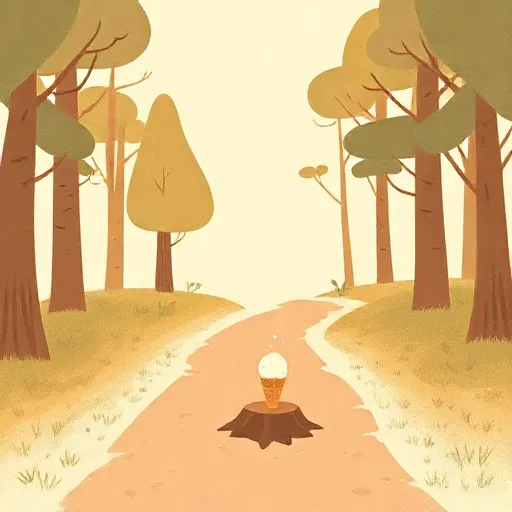
The idea that determinism robs you of choice can feel very natural. When you decide, it seems as if you are standing at a fork in the road. Time behind you is one solid path; ahead there are multiple branches. If determinism is true, however, the road never branches. There is only one track from past to future. You might think you have options, but in reality you are like a train on a single rail.
This picture, sometimes called the No Forking Paths argument, is powerful because it matches the way many of us imagine time and possibility. But it smuggles in assumptions. It treats possible futures as if they are concrete roads that literally branch, and it assumes the past is frozen in an absolute way that stops any alternative branch from even existing. Philosophers of science point out that modern physics has much stranger things to say about time and possibility. So the real work is done by a more careful argument that leaves the road metaphor behind.
The Consequence Argument: Why You Might Have No Alternatives
The Consequence Argument tries to show something stark: if determinism is true, then nothing you ever do is up to you, even the smallest gesture like raising your hand. Van Inwagen asks us to think about a special kind of lack of choice. Say that a proposition P is “powerless” for you if P is true and nobody ever had any choice about whether P was true. For example, you have no choice about the fact that the sun formed long before you were born. You also have no choice about the basic laws of physics; no matter what you try, you cannot make gravity work differently.
Now, determinism says that the entire state of the universe in the remote past (call it H) together with all the laws of nature (L) logically forces every later fact, including the fact that you raised your hand just now. In other words, if the conjunction “H and L” holds, then “you raise your hand” must be true. So we have two powerless facts: you have no choice about H; you have no choice about L. But if you have no choice about H and no choice about L, and the pair (H and L) guarantees your hand-raising, doesn’t it follow that you have no choice about raising your hand either?
Van Inwagen defends a logical rule called Rule Beta: if you have no choice about P, and you have no choice that if P then Q, then you have no choice about Q. He gives everyday examples. You have no choice about the sun exploding a thousand years from now, and you have no choice about the fact that “if the sun explodes then all life on Earth ends”; therefore, you have no choice about all life ending. Apply Beta to the determinism setup: you have no choice about the remote past; you have no choice that “if the remote past and the laws are as they are, then you raise your hand”; so you have no choice about raising your hand. If the argument works, it doesn’t just affect big dramatic actions—it says everything you do is already fixed. You never could have done otherwise.
The Counterfactual Reply: How You Might Still Have Options

David Lewis thought the Consequence Argument looks more terrifying than it really is. He claimed it confuses two very different kinds of ability. The argument makes you think that if you could have raised your hand in a deterministic world, then you would have had the power to change either the remote past or the laws of nature. That sounds absurd—no human can rewind history or rewrite physics. But according to Lewis, that absurd conclusion doesn’t actually follow.
To see why, consider two ways of understanding the claim “I could have done otherwise.” One way is this: I have the ability to do X such that if I did X, I would thereby cause the past or the laws to be different. That really would be an incredible, godlike power. But the compatibilist is not forced to say that. The compatibilist only needs a weaker claim: I have the ability to do X such that if I did X, the past (or the laws) would have to have been different—but not because I made them different. The difference in the past or laws would be a precondition for my action, not a result I bring about. Think of it like this: if I now type the word “butterfly,” it’s true that the history of English spelling had to be a certain way. But I’m not causing that history; I’m just doing something that depends on it.
Lewis’s move uses counterfactuals, statements about what would have happened if things had gone differently. He suggests that if you had raised your hand, perhaps the course of history would have been slightly different all the way back to the Big Bang, or the laws would have been ever so slightly different. That sounds strange because we don’t normally think that way—but maybe that’s what physics allows. What matters is that you don’t have to be a miracle worker to have a genuine choice. Your ability to do otherwise just means there is a possible world, very much like this one, where you choose differently. That world might have a subtly different past or laws, and that is a feature of possible worlds, not a superpower you possess. If Lewis is right, the Consequence Argument does not force us to give up free will.
The Desperate Defense Attorney and the Need to Be the Source
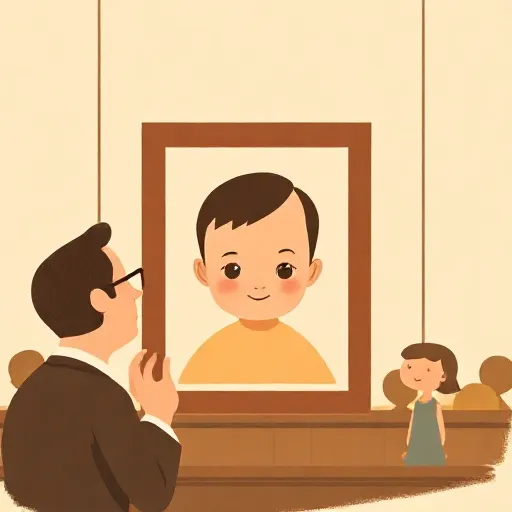
There is another family of arguments for incompatibilism, and it starts with a courtroom drama. A defense attorney tells the jury: “My client did not make himself. He didn’t choose his genes, his parents, or his upbringing. All of that was handed to him. So he cannot be truly responsible for what he did.” If you feel the pull of this plea, you are drawn to the idea that free will requires being the ultimate source of your actions.
Philosophers like Robert Kane (born 1938) and Roderick Chisholm (1916–1999) have argued that moral responsibility demands more than just acting on your own desires. It demands that you, the whole person, start the causal chain—you are an uncaused cause. In ordinary thought, we might say a tree branch didn’t cause itself to fall; the wind did. Similarly, if your every choice is just the final link in a chain that started before you existed, were you ever really in control? Chisholm claimed that to be free, each of us must be “a prime mover unmoved,” something that causes events without being caused to do so.
Many philosophers, including compatibilists, find this too mysterious. They ask a simple dilemma: if determinism is true, your choices are caused by earlier events, so you are not the ultimate source. But if determinism is false, your choices might be undetermined—like a random blip in your brain—and random blips don’t seem to be under your control either. Kane responded that an undetermined choice could still be shaped and influenced by your reasons without being fully determined by them, giving you a special kind of “ultimate responsibility.” But compatibilists like Lewis maintain that being the source of your action just means it flows from who you are: your beliefs, desires, and values. You don’t need to have created yourself from scratch. The debate between these two pictures of sourcehood remains unsettled.
Why Your Next Decision Still Matters

You might wonder why all this matters for your actual life. Think about the last time you were blamed for something, maybe knocking over a drink or forgetting a promise. If it turned out someone pushed your arm or you had a medical condition that forced your hand, you’d say it wasn’t your fault. Those are excuses. But the incompatibilist worry is deeper: if determinism is true, then every action is, in a sense, pushed by forces outside your control. Would it then be unfair ever to blame or praise anyone?
Most legal systems assume people can normally choose otherwise. Parents, teachers, and friends treat you as if you can make genuine decisions—as if your attention to your homework isn’t just a domino falling. Even if you lean toward compatibilism, you can see that the question touches the very core of how you understand yourself. What does it mean to try hard, to change your mind, or to become a better person if your entire story was already scripted in the laws of physics? The Consequence Argument and the counterfactual reply show that this isn’t a simple puzzle with an easy escape. It forces us to examine what abilities are, what laws of nature really are, and what it means for something to be “up to us.” Until that examination is finished, the ice cream parlor remains a deeply philosophical place.
Think about it
- If a friend told you they couldn’t help cheating on a test because every event in the universe made it inevitable, would you accept that as an excuse? What would that say about your view of free will?
- Think of a time you chose one activity over another—like joining a sport instead of the school play. Do you believe you genuinely could have chosen differently? If you do, what kind of evidence would convince you that you were mistaken?
- Imagine a scientist builds a perfect prediction machine that tells you exactly what you will eat for lunch every day next month. When you later eat those exact foods, do you still feel free? Why or why not?