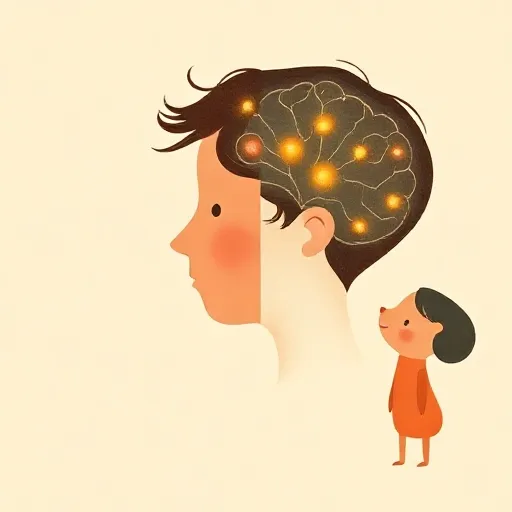

Can You Invent a Language Only You Understand?
A Word Only You Can Understand?

You stub your toe on the corner of a table and feel a sharp, hot ache no one else feels. Suppose you decide to give that exact feeling a private name — say, “zog.” No dictionary defines “zog,” and you could never explain it to anyone else. Could “zog” actually be a word? The question sounds harmless, but the philosopher Ludwig Wittgenstein (1889–1951) thought that if you push this idea seriously, it falls apart. His exploration of whether a private language is possible — a language whose words refer to immediate private sensations and cannot be understood by anyone other than the speaker — became one of the most debated thought experiments in modern philosophy.
The picture of a purely private language didn’t come from nowhere. Earlier, Bertrand Russell (1872–1970) had argued that in a perfect, logical language, every simple object would have its own name. Those simple objects, he believed, include the raw sense-data only you can know — the color patch you see, the pain you feel. A name for such an object, Russell said, would be private to you. To understand the name, all you need is acquaintance with that private object; you don’t need to share it with anyone else. Wittgenstein may well have had Russell’s idea in mind when he set out to challenge it.
Wittgenstein’s Diary Thought Experiment

In his book Philosophical Investigations, Wittgenstein asks us to imagine a person trying to keep a diary of a private sensation. Suppose I want to give the sensation a name, the sign S. I can’t write out a definition anyone else could read — by definition, the language is private. So I try to establish the meaning for myself through a private act of ostensive definition: I concentrate my attention on the sensation as it occurs and, at the same time, make the mark “S.” I imagine that this ceremony links the sign to the sensation, much like a public pointing-and-naming (“That color is called ‘red’”) does in everyday life.
But here the trouble begins. For this act to be a genuine definition, the connection between sign and sensation must persist. I need to be able to use “S” correctly in the future, not just now. Wittgenstein writes, “I commit the connection to memory” can only mean: this process brings it about that I remember the connection correctly in the future. At first glance, that looks like a simple memory task. But can I really establish a rule for “S” that is independent of what merely seems right to me later?
When “Seems Right” Has No Rival

Wittgenstein’s central point is not that memory is unreliable. The deeper worry is that, in the private diary case, there is no way to draw a line between making a mistake and merely thinking one has made a mistake. Suppose later I want to use “S” again. I have to answer: does this new sensation count as the same kind once named “S”? When there is no public object, no test, and no one else to check against, whatever answer feels right to me is, by default, the right answer. But if “whatever seems correct to me is correct,” then the very idea of correctness dissolves. A sign can’t name a particular kind of sensation if nothing can ever count as getting it wrong.
Wittgenstein imagines a critic insisting that I could still remember the original connection. But the memory can’t produce a standard by magic. If there was no real, independent connection to begin with — if the original act of naming didn’t succeed — then a memory of that act can’t supply what was missing. He compares it to a person who buys several copies of the same morning newspaper to confirm that the news is true. An extra copy of an unreliable report adds no reliability. Similarly, an inner “memory” of a merely apparent definition adds no independent support. The problem isn’t that memory might fail; it’s that there was nothing determinate for memory to be about in the first place.
The Manometer Test: Does the Private Object Drop Out?

So far the diary example involves an “I” with no public bodily behavior. But what if the private linguist ties the sign “S” to something observable? Wittgenstein tests this idea using a manometer, a pressure gauge. Imagine I believe that whenever I have a certain private sensation, my blood pressure rises. I write “S” in my diary each time I feel that sensation, and I also check the manometer. If the manometer confirms that my blood pressure is rising each time I write “S,” I might think this proves I have successfully named a private sensation and consistently identified it.
But notice what has happened. The real work of keeping “S” meaningful is now done by the public correlation — the sensation and the manometer reading go together. The sign “S” could now mean something public, like “the sensation that comes with rising blood pressure” or even just “blood-pressure rising.” The purely private sensation, the “beetle in the box” that only I can peek at, has become irrelevant to what “S” actually means. The attempt to build a private language collapses into a public one as soon as you try to give it a genuine rule.
Why It Still Matters, from Birth to a Lonely Island

The private language argument is not just a dusty puzzle about diaries. It challenges a far bigger picture that has haunted philosophy for centuries: the idea that we each live sealed inside our own minds, with purely inner thoughts and absolutely private experiences, and that language is just a code we later translate into public sounds. René Descartes (1596–1650) famously tried to doubt everything except his own immediate thoughts, assuming he could identify those thoughts without any help from the outside world. The same assumption lurks behind the traditional “problem of other minds” — the worry that I can never know whether another person feels pain the way I do. Wittgenstein’s argument suggests that all such pictures misunderstand what makes a word meaningful in the first place.
Think about how you learned the word “pain.” As a small child you cried, and the people around you didn’t pry into a private sensation only you had. They responded to your cries, your winces, the way you held your hurt arm. They said, “That hurts, doesn’t it?” and eventually you used the word too. The meaning was never built on a secret ceremony inside your head; it grew from shared human reactions and a life together. That’s why many philosophers today read Wittgenstein as showing that language is, at bottom, a social practice — not necessarily because you can’t ever be a solitary speaker (a Robinson Crusoe who grows up alone might still develop patterns of rule-following), but because the very idea of meaning requires the possibility of an outside check, a “we” that can agree on how the words are used.
The philosopher Saul Kripke (1940–2022) pushed this theme into a more radical direction. He argued that Wittgenstein’s thoughts about rules and private language expose a sceptical problem for all meaning, even in public language. On Kripke’s reading, there is no fact about me that guarantees I mean the usual addition function by “plus” rather than some bizarre alternative; meaning can only be stabilized by a community that corrects me. Whether or not Kripke’s version matches Wittgenstein’s own view, his interpretation has kept the debate alive and made it clear why the diary thought experiment still matters. It forces us to ask: if no one else can ever check my use of a word, can I even count as speaking a language?
Think about it
- If you invented a secret word for a private feeling and honestly believed you were using it the same way each time, would there be any way to prove yourself wrong? Would it even matter if you were wrong?
- Imagine a child who grows up entirely alone on an island, never seeing or hearing another human being. Could that child ever develop a system of names for their own sensations? Why or why not?
- Suppose you try to teach your secret word “zog” to a friend by pointing to your own headache. What exactly would your friend need to observe to connect the word to the right kind of sensation?