
Is Your Mind Clear? The 350-Year-Old Logic Book That Asked First
The Quiet Thinkers of Port-Royal
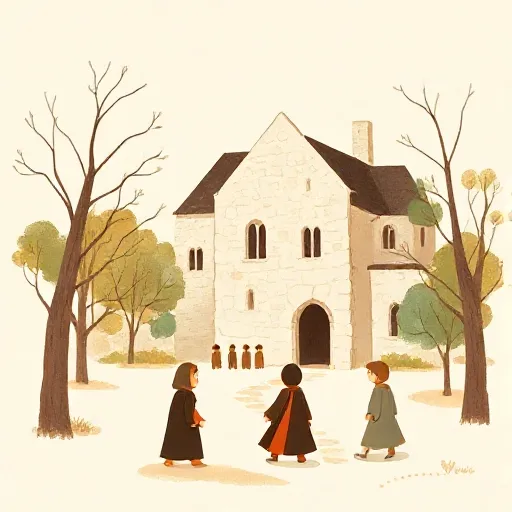
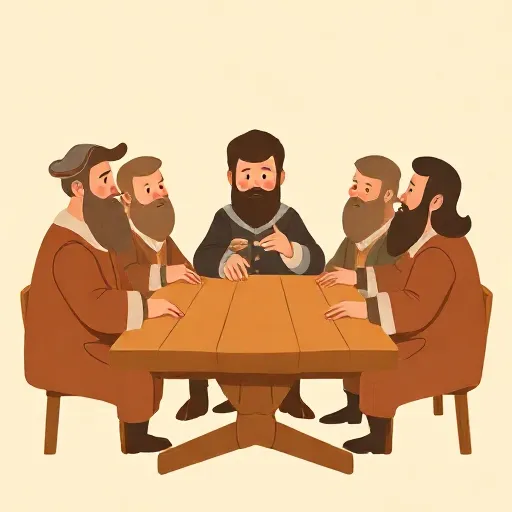
In 1662, deep inside a French abbey called Port-Royal des Champs, two men wrote something unusual: a textbook on logic — the art of thinking. But this was no dusty list of rules. Antoine Arnauld (1612–1694) and Pierre Nicole (1625–1695) believed logic belonged to everyone. They wanted to train people’s minds, not just stuff them with vocabulary. Their book, the Port-Royal Logic, taught readers how to know when an idea is clear, how to judge what’s true, and how to follow a path of reasoning without tripping.
Arnauld and Nicole were part of a religious reform movement called Jansenism, which stressed how deeply human thinking needs help. That mattered because they saw logic as a tool for living well, not just for winning arguments. They also admired the philosopher René Descartes (1596–1650), who insisted that clear and distinct perceptions — the thoughts you simply cannot doubt — are the bedrock of knowledge. The book you’ll explore here took that insight and turned it into a complete guide for the mind.
Ideas: The Pictures in Your Mind

Everything starts with an idea, which the Logic describes as the form whereby we represent things to ourselves. Imagine you picture a triangle. You could picture a specific one — say, a blue equilateral triangle scrawled on paper — or you could strip away the color, the size, even the exact angles, and hold a general idea of triangle that fits all triangles. That process of stripping away details is how the mind builds abstract ideas.
Arnauld and Nicole cared deeply about whether ideas are clear and distinct or obscure and confused. A clear idea hits you like sunlight through a window: you recognize it immediately. A distinct idea goes further — you can separate it from other ideas, just as you can see a triangle has exactly three sides and isn’t a square. Confused ideas, on the other hand, are like blurry photographs. You think you know what’s in them, but you can’t name the parts. Most mistakes, they argued, happen not because people reason badly, but because they start with foggy ideas and never realize it.
Then comes a brilliant move. Every general idea has a comprehension — the set of attributes that make it what it is — and an extension — the list of things the idea applies to. The comprehension of “dog” includes being an animal, having four legs, and barking; its extension includes poodles, huskies, and terriers. The trick: add something to the comprehension (say, “small enough to fit in a hand”), and the extension shrinks — you lose the huskies. This seesaw between comprehension and extension became the engine for much of their logic.
Judgment: When Your Mind Says “Yes” or “No”

A judgment is the mental act of linking two ideas or pulling them apart. When you think “a dog is an animal,” you affirm that the idea dog includes the idea animal in its comprehension. When you think “a dog is not a stone,” you deny any agreement. The Logic calls these thoughts propositions — the sentences your mind forms before you ever speak a word.
Here Arnauld and Nicole did something radical for their time: they insisted that every proposition is either affirmed or denied the moment you think it clearly. There is no neutral “just considering” a clear thought without taking a stance. If the idea is sharp, your mind automatically accepts it or rejects it — like your eyes seeing when they’re open. This might sound strange. Can’t you just entertain the idea “the moon is made of green cheese” without believing it? The authors would reply: if you entertain it clearly, you’re also aware that it doesn’t match the idea of the real moon; that mismatch is a denial, even if you play along with words.
Words complicate everything. People tie words loosely to ideas, and suddenly two parties argue about “honor” while holding completely different comprehensions. Much disagreement, the Logic warned, is purely verbal — a fight about labels, not about the ideas themselves. That’s why they spent so much time showing how adjectives, nouns, and clauses plant hidden judgments (like the difference between “pious men are charitable” and “men who are pious are charitable”). Clarity demands unwinding these knots.
Reasoning: Why Formal Rules Come Second
Part III of the Logic covers syllogisms — the classical three-line arguments (All A are B, All B are C, therefore All A are C). But the authors start with an apology: please don’t think this is the heart of thinking. Most people, they point out, err not because they’ve botched the shape of an argument, but because they’ve swallowed false starting points. Reasoning from a murky idea is like building a castle on swampy ground; even perfect craftsmanship won’t save it.
They still provide rules for valid syllogisms: the middle term must be distributed at least once, no term can become more general in the conclusion than in the premises, and so on. But these rules are the safety net, not the main event. The authors train their real focus on a much simpler principle: the conclusion must already be contained in the premises. When you see a chain of reasoning truly clearly — when the ideas themselves light up — your natural light of reason simply grasps the connection. The formal rules are just training wheels for that inner sight.
The Logic also cheerfully dismisses large chunks of traditional logic about “topics” — methods for finding arguments. If this bores you, they practically say, skip it. Real reasoning is about seeing connections, not about memorizing checklists. That attitude made the book refreshingly human when it appeared.
Method: Climbing the Mountain of Knowledge

The final part of the Logic tackles method — how to organize knowledge so that it’s discoverable and teachable. The star distinction is between analysis and synthesis. Analysis starts with the question you want answered and ascends, like a mountain climber, until you reach truths you already know. Synthesis goes the other direction: it lays down definitions and axioms first, then walks down to the conclusion. Think of tracing a family tree. You can start with a living person and work upward to a famous ancestor (analysis), or start with the ancestor and descend to the present day (synthesis). The path is the same; only the direction differs.
The authors loved the geometry of Euclid — those crisp definitions, the air-tight proofs — but they weren’t shy about criticizing geometers. Some steps in Euclid prove what’s already obvious to anyone paying attention, breaking the natural order of method. Others use reductio ad absurdum, where you assume the opposite of what you want to prove and chase it until it explodes into contradiction. Arnauld and Nicole found such proofs less satisfying because they don’t show why the truth is true — they just show its opposite is impossible. Good method, they thought, should enlighten, not merely silence.
Then they turn to knowledge that doesn’t come from reasoning at all: faith (trust in divine revelation) and opinion (trust in human authority). These aren’t rivals to reason; they’re underwritten by it. Reason tells us that some sources are reliable and that God, if God exists, doesn’t lie. The final pages offer careful rules for weighing testimony, assessing miracles, and avoiding the mistake of ignoring very likely small harms in favor of very unlikely huge ones. They end with a Pascal-like reminder: if something infinitely valuable is at stake, even a tiny chance of gaining it outweighs every finite treasure.
Why Clear Thinking Still Matters

Arnauld and Nicole wrote for a world of candles and quills, but their challenge is yours too. How often do you argue about a word — “fair,” “boring,” “smart” — only to discover each person imagines something different? How many opinions do you absorb without checking whether the idea beneath them is crisp or foggy? The Port-Royal Logic treats you as a thinker capable of seeing clearly, if only you pause and look. It doesn’t promise easy answers; it promises that confusion is not the same as mystery, and that care with ideas is a path to knowing both the world and yourself.
Think about it
- If two friends fiercely disagree about whether a video game is “fair,” but you suspect each means something different by “fair,” how could you help them turn a verbal fight into a real conversation about ideas?
- Think of a belief you hold strongly — maybe about a food, a rule at school, or a friend’s character. Try to list the comprehension of its key idea. Do any parts of that definition feel blurry or borrowed from just words?
- The Logic says you shouldn’t ignore a small chance of a huge loss. In everyday life, we often do exactly that (like skipping sunscreen or procrastinating). When is it reasonable to take a tiny risk of something awful, and when is it foolish?