

Is Giving to the Poor a Kindness—or a Debt You Must Pay?
The Pond Test: Can You Walk Away?

Philosopher Peter Singer asked you to imagine a scene. You’re walking past a shallow pond and spot a small child drowning. You could wade in and save them in seconds, but you’d ruin your new shoes and be late for practice. Could you really just keep walking? Most people feel a powerful duty to help. To ignore it would seem monstrous.
Singer then pushed harder. He pointed out that children in distant countries die every day from preventable diseases. We could save many of them by donating a little money — the cost of a pizza or a new game — to effective charities. Is there really a moral difference between the child in the pond and a child miles away? If not, then walking past a suffering stranger may be more like walking past that pond than we want to admit. This thought experiment, first published in 1972, shook up centuries of comfortable thinking about giving.
Before we can decide what we owe, we need to understand how people in the past understood generosity.
Giving Before Justice: How the Rules Changed
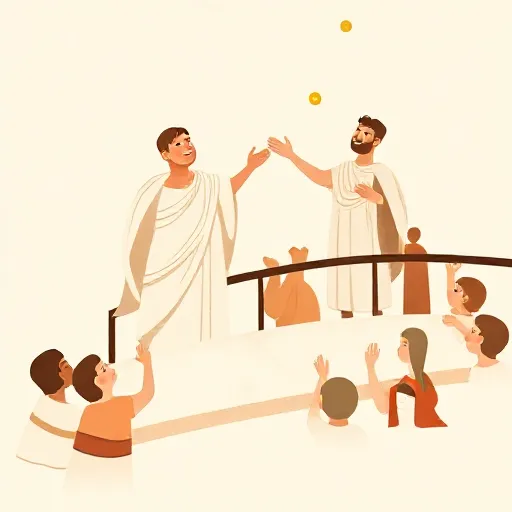
In ancient Athens and Rome, giving was mostly about public goods — funding festivals, building stadiums, or supporting armies. Only the super-rich were expected to give, and they did it partly to gain honor. If a wealthy person refused, they could lose social standing or even be exiled. But nobody thought an ordinary person owed help to the poor.
Christianity changed that picture. Early Christians talked about charity — from the Latin caritas, meaning love. Giving to the least fortunate, regardless of their citizenship, became a universal virtue for everyone, not just the powerful. The aim was to bestow love and relieve suffering, not to erect marble theaters. Other religious traditions developed their own norms. The Jewish concept of tzedakah treats giving to the poor as a strict duty of justice, something owed in proportion to what you have. Islamic practice includes zakat, an obligatory portion of one’s wealth given for religious and charitable purposes.
By the 1700s and 1800s, however, thinkers like Immanuel Kant (1724–1804) and John Stuart Mill (1806–1873) began to doubt private charity. They saw that poverty wasn’t simply a natural disaster — it often resulted from unjust laws, colonial exploitation, and lopsided economic systems. Kant argued that widespread destitution usually points to a government’s injustice, not just bad luck. Mill complained that philanthropists too often “nibble at the consequences of unjust power, instead of redressing the injustice itself.” If poverty is created by unfair rules, then handing out coins might just be a way for the comfortable to feel good while ignoring the broken system.
Justice or Charity? Drawing a Line

Many modern philosophers draw a sharp line between justice and charity. Justice involves what people are owed — rights that can be demanded and enforced. Charity, stripped of its religious overtones, is a voluntary gift, something praiseworthy but not strictly required. You can be blamed for violating a duty of justice, but you don’t have to be charitable (though you might be admired for it).
Allen Buchanan challenges that tidy split. He argues that charity-like duties can be made precise. If a society sets up institutions that identify who must give how much to whom — like a tax to support the homeless — then those duties become perfect duties, just as enforceable as not stealing. For Buchanan, whether giving is required depends on what social arrangements we think are just, not on the label “charity.”
Will Kymlicka disagrees. He insists that charity is always secondary to justice. Our primary job as citizens is to build a just society where basic needs are met by the system itself. Private giving is at best a bandage on a wound that the system keeps open. Kymlicka echoes Mill’s impatience: we should fix injustice at the root, not just tidy up after it. On this view, the demands of justice actually define what charity should aim at — and once justice is done, little room is left for truly optional “charity.” If you donate to a food bank while knowing the government’s tax policy creates the hunger, you are really just doing what justice already demands. Charity, in Kymlicka’s eyes, gets swallowed up by justice.
Effective Altruism: Do the Most Good Possible

Singer’s pond experiment gave rise to a movement called effective altruism (EA). EA asks a simple but radical question: if all lives have equal worth, and you want to do as much good as possible, how should you spend your time and money? According to one of its founders, William MacAskill, EA means using evidence and careful reasoning to determine how to benefit others the most. It doesn’t care about your warm fuzzy feelings — only about outcomes.
EA encourages donating to charities that are rigorously proven to work, like those that distribute anti-malaria bed nets, rather than ones that just feel good. It also inspired the idea of earning to give: choosing a high-paying career so you can donate far more money than you could by working directly for a charity. A more recent offshoot is longtermism, which focuses on preventing future catastrophes — such as a pandemic or uncontrolled artificial intelligence — that could wipe out humanity, preserving the lives of countless future generations.
Critics, including philosopher Amia Srinivasan, say EA has a blind spot. By always calculating how to do good within the current system, EA treats global capitalism and existing political arrangements as fixed facts. It rarely counsels an individual to join a movement to change unjust structures, because such efforts are risky and their effects hard to measure. An EA donor might pay for bed nets while a nearby community desperately needs collective land rights. EA supporters reply that individuals can often save lives right now and shouldn’t wait for a revolution that might never happen.
Kant’s Warning: Respect the Person, Not Just the Need

Immanuel Kant approached giving from a very different angle. He classified beneficence — helping others in need — as an imperfect duty. You must adopt the goal of making others happier, but you have latitude to decide how and when. Unlike perfect duties (like keeping promises), beneficence can’t be spelled out in advance. Yet Kant was uneasy about charity in an unjust world. He argued that if some people are rich and others destitute, it’s usually because the government has failed to secure a just distribution of property. So a wealthy person who tosses coins to a beggar isn’t being truly generous — they’re paying a debt of reparative justice.
Kant also warned that charity can humiliate. When a donor treats a recipient as a mere object of pity, the act reinforces inequality and strips away dignity. His solution was clear: the state, not private donors, must ensure that no one falls into desperate need. For Kantian philosophers today, that means philanthropy should never replace the government’s duty to create a fair social order. Donors must respect recipients as equals and act only in ways that all citizens could, in principle, authorize. Private giving might fill gaps in an imperfect system, but it must never pretend to be a substitute for justice.
Why Your Answer Changes Everything

You face versions of this debate more often than you might realize. When you spot a person asking for spare change, do you feel you must hand over something? If your school runs a fundraiser, is it optional or required to contribute? If your family has some extra money, is it wrong to spend it on a vacation instead of donating to an aid group? These everyday moments are shaped by deep philosophical disagreements.
Effective altruists would urge you to research where your dollar does the most measurable good. Kantians would remind you to resist charity that feels demeaning and to support policies that attack the roots of poverty. Defenders of justice-as-first-priority would say your energy should go toward making your community fairer — for example, advocating for affordable housing or better school funding — rather than only paying for stopgap aid. And virtue ethicists, drawing on thinkers like Aristotle, would ask what kind of person you are becoming: a thoughtful, generous human being with practical wisdom, not just a calculator of outcomes.
The tensions spill into big political questions too. Should governments tax the wealthy heavily and provide for everyone, or should they rely on voluntary giving? Can we accept donations from billionaires who made their fortunes in morally questionable ways? There’s no single correct answer, but the centuries-long conversation gives you tools to think for yourself. What we owe to one another — and why — is one of the deepest questions philosophy can ask.
Think about it
- If you could donate your birthday money to a charity proven to save a child’s life, but it meant giving up a long-wanted video game, would you have a duty to donate? Why or why not?
- Imagine your town has a shelter that runs entirely on donations, but many people refuse to give. Would it be fair for the town to use tax money to support the shelter, even if some citizens don’t want to?
- A billionaire made his fortune by paying workers extremely low wages, then donates millions to build a hospital. Should we celebrate his generosity, or is there something troubling about that story? What should matter more — the gift or how the money was earned?