Can Smoke Mean Fire? Charles Peirce’s Wild Theory of Signs
A Pointed Finger, a Molehill, and a Puzzle
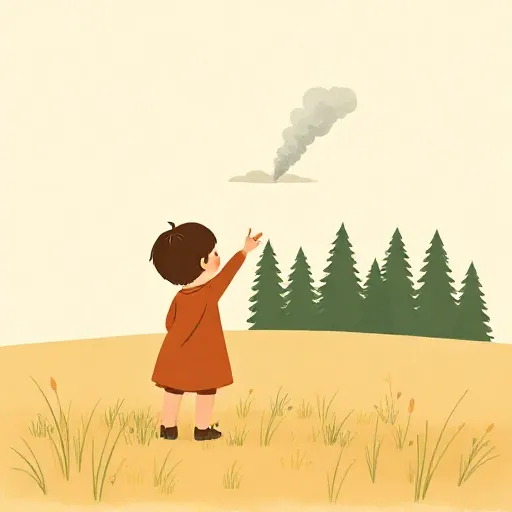
You are walking with a friend when she suddenly points and says, “Look, smoke!” Your eyes follow her finger to a gray smudge on the horizon. Instantly, without thinking, you know: fire.
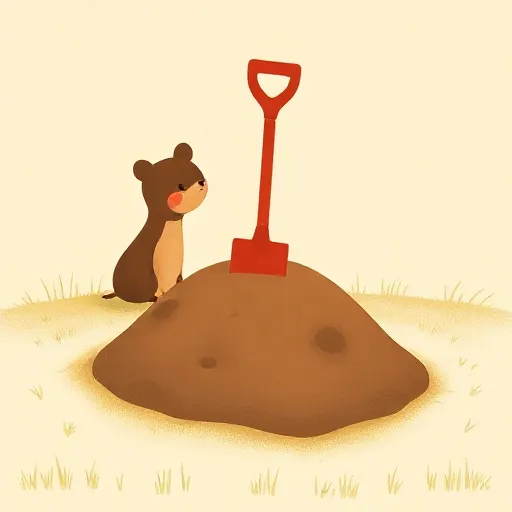
But how did a shapeless puff of air make you imagine something you cannot even see? This everyday miracle—one thing standing for another—grabbed the imagination of the American philosopher Charles Sanders Peirce (1839–1914). He spent his life studying signs, and by “signs” he did not just mean stop signs or emoji. He meant anything that points beyond itself: a molehill, a scream, a portrait, a word. Peirce built a theory so unusual that scholars are still unpacking it today, and it can change how you understand every text you send and every cloud you notice in the sky.
The Three-Part Sign Machine

Most people think a sign is just a two‑part deal: the word “water” and the wet stuff you drink. Peirce disagreed. He argued that every sign is a triadic relationship—a three‑legged stool that falls over if you remove any one leg.
The first leg is the sign‑vehicle: the physical, sensible thing you actually encounter. It might be the sound of a spoken word, the ink shape “fire,” a wisp of smoke, or a feverish forehead. The sign‑vehicle is not the whole sign; it is just the part that does the pointing.
The second leg is the object: whatever the sign‑vehicle is about. Smoke’s object is fire itself. A thermometer’s object is heat. The object sets the rules that a sign‑vehicle must follow if it is going to count as a sign of that object. For smoke to be a sign of fire, it has to come from fire in a real, causal way. The object determines the sign—not by magically creating it, but by laying down requirements. If the gray puff in the distance comes from a fog machine, it has failed to be a sign of fire.
The third leg is the interpretant: the understanding or mental effect that the sign‑vehicle produces in a mind. When you see smoke and think “fire,” that thought—the flash of recognition—is the interpretant. Peirce insisted that nothing is a sign unless it actually generates an interpretant. A puff of smoke on a planet with no life does not signify anything. Meaning is born only when a mind connects the vehicle to the object.
Three Flavors of Meaning: Icons, Indexes, and Symbols

Peirce was not satisfied with just one type of sign. He noticed that sign‑vehicles connect to their objects in three fundamentally different ways, and he gave these three relationships names that philosophers still use.
An icon signifies by resemblance. A portrait, a map, a diagram of a bicycle brake—all icons share qualities with their object. The sign‑vehicle looks, sounds, or feels like the thing. Peirce’s early examples included paintings and the similar shapes of the letters p and b.
An index signifies by a direct physical or existential link. Smoke is an index of fire because the fire causes it. A weathercock is an index of wind direction. A pointing finger is an index of whatever it points at, even if you do not know what that thing is. Indices force your attention; they are the world tapping you on the shoulder.
A symbol signifies by convention, habit, or rule. Almost every word you speak or read is a symbol. The sound “cat” has no resemblance to a feline and is not caused by one; it works only because English speakers agree to use it that way. Traffic lights, mathematical notations, and even a wink can be symbols. Peirce called symbols “potentially general” because they apply to whole classes of things, not just one individual.
In real life, signs are often blends. A photograph is iconic (it looks like the scene) and indexical (light from the scene physically struck the film). A crying emoji is largely symbolic—you had to learn the social rule—but its face is also an icon of an expression. Peirce knew that pure icons and pure indices were rare; still, the categories help us see what a sign is leaning on most.
The Never‑Ending Story of Thoughts

In his earliest writings, Peirce added a twist that feels like standing between two mirrors. An interpretant, he argued, is itself a sign. Your thought “fire” is a new sign that can be interpreted further—you might think “danger” or “marshmallows” or “I should call 911.” Each of those thoughts is a sign‑vehicle with its own object and its own interpretant, and that interpretant will become yet another sign, ad infinitum. Peirce called this chain infinite semiosis.
For the young Peirce, this proved something important: there are no pure intuitions. An intuition would be a thought that pops into your head without being caused by any earlier thought—a first sign in the chain. But if every sign must be an interpretant of a previous sign, and every interpretant becomes a new sign, there can be no first link, and no last one either. Thought is a continuous stream of signs interpreting signs. That idea was radical in the 1860s, when many philosophers assumed the mind contained simple, un‑interpreted building‑blocks of knowledge.
Peirce was untroubled by the infinite chain. It fit his larger project of showing that thinking is always a process, never a finished snapshot. But the never‑ending nature of meaning would later become a puzzle he would try to solve.
From Infinite Chains to a Destination

By the 1900s, Peirce’s thinking had shifted. He began to see the process of interpretation as less like a runaway chain and more like a journey with a goal. This change happened partly because he connected his sign theory more tightly to his ideas about scientific inquiry. When scientists investigate something, they do not bounce randomly from guess to guess; they aim at a truth that would satisfy any reasonable mind in the long run.
To capture this, Peirce split the object into two. The dynamic object is the thing as it really is, the engine that drives the whole semiotic process—the actual fire, the real mole. The immediate object is our partial understanding of that thing at any given moment, a snapshot that might be incomplete or even a little mistaken. Think of a fuel gauge: the dynamic object is the actual level of petrol in the tank; the immediate object is how full the gauge tells you it is right now.
He also split the interpretant into three. The immediate interpretant is the bare, dictionary‑style meaning of a sign before it meets a real situation—the grammar and general sense of the words. The dynamic interpretant is the actual effect the sign produces on a particular person at a particular moment, like your specific jolt of recognition when your friend shouts “Look, smoke!” The final interpretant is the fully settled understanding we would reach if we could carry inquiry to its absolute end, where every question is answered. It acts like a north star: you may never reach it, but it tells you which way to walk.
Why Your Emojis Are Peircean
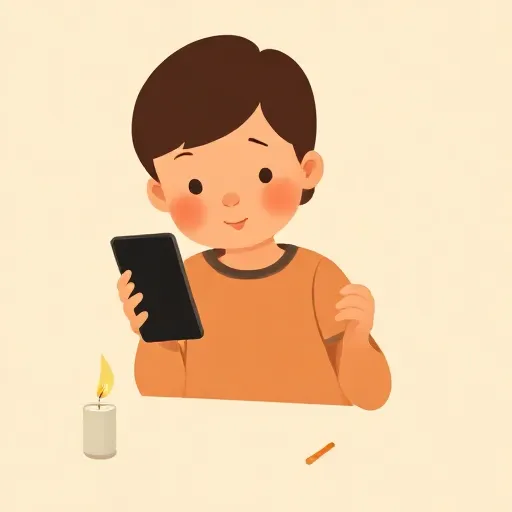
You might never light a fire to send smoke signals, but you send signs all day. A string of emojis, a meme shared with a friend, a voice message left in a hurry—every one of these is an instance of Peirce’s three‑part machine at work.
The thumbs‑up emoji is a symbol: it means approval because you learned the convention. A photo of your pizza is an icon (it looks delicious) and an index (the light from that very pizza hit the camera sensor). When your friend texts you just a single fire emoji, your brain instantly cooks up an interpretant: “she is saying my outfit looks amazing,” or “the new song is hot,” or maybe “the kitchen is literally on fire.” Context shrinks the possibilities. And when you misunderstand each other—when you laugh at the wrong moment—that is simply a mismatched interpretant, the same kind of tangle Peirce spent his life mapping.
Peirce’s insight is that meaning is never a single, frozen package handed from one person to another. It is an event, a tiny performance that happens inside an interpreter and then gets re‑performed, slightly changed, each time it moves to a new mind. So the next time you see smoke on the horizon or a cryptic sticker on a lamppost, you are not just looking at a thing. You are stepping into a chain of signs that has been unspooling since long before you were born, and will keep unspooling long after.
Think about it
- If a tree falls in a forest and no animal ever hears or sees it, is the sound a sign of the falling tree? Why or why not?
- Recall a time someone misunderstood a text message you sent. Could Peirce’s idea of the interpretant help explain what went wrong?
- A fossil shows that a dinosaur once stepped there. Can the fossil still be a sign if humans had not yet evolved to see it? What if no living creature ever interprets it?