Can You Prove Fire Is Hot? The Priest Who Said No
A Bonfire in Paris
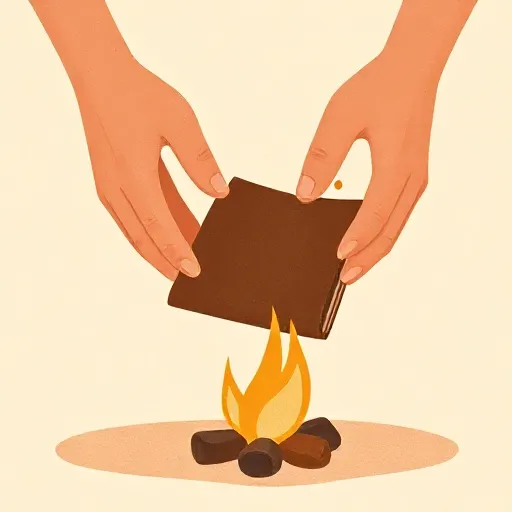
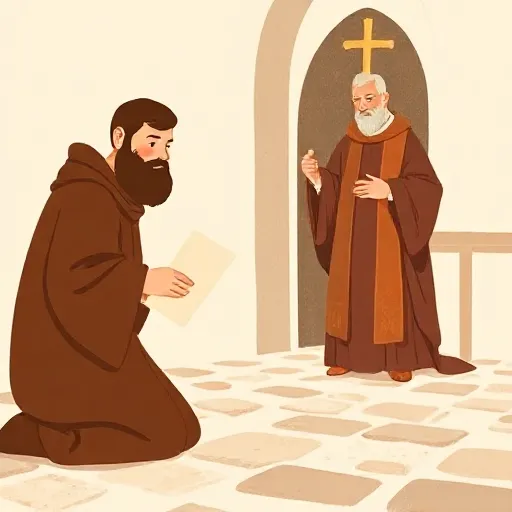
On November 25, 1347, inside the Dominican church in Paris, a university lecturer named Nicholas of Autrecourt (c. 1295–1369) knelt before a gathering of masters and students. He read out a public confession. Then he took his own manuscript — a treatise he had spent years writing — and dropped it into the flames. The Church had ordered him to do this because his ideas were judged to be false, dangerous, and close to heresy. What had Autrecourt written that was so alarming? He had argued that you can never prove, with absolute certainty, that one thing causes another, or even that the objects you see are really there.
The Unbreakable Rule of Certainty
Autrecourt believed that any piece of knowledge that is truly evident — impossible to doubt — must rest on a single foundation. He called this the principle of non-contradiction. The principle says that a thing cannot both be and not be in the same way at the same time. For example, “This bread is wholly on fire and not on fire” is a flat contradiction. It cannot be true.
From this, Autrecourt built a razor-sharp rule for reasoning. If you want to infer a second fact from a first fact with complete certainty, the two must be identical in what they mean. If they are not identical, you can always deny the second without directly contradicting the first. Suppose you say, “I see smoke, so there must be a fire.” Smoke and fire are not the same thing. The sentence “Smoke exists” does not contradict “There is no fire.” So the inference is not evident. The conclusion might be true, but you cannot know it for sure.
Why Fire and Heat Are Strangers
Autrecourt aimed this rule straight at some of the biggest ideas in medieval philosophy. For centuries, thinkers had followed Aristotle in believing that the world is made of substances — the hidden “what-it-really-is” underneath the color, taste, and texture we see — and that these substances have real causal powers. Fire has the power to heat, bread has the power to nourish. Through experience, we come to know these powers.
Autrecourt disagreed. He said we never have direct experience of a cause or of a substance. We see a flame; we feel heat. But we do not perceive the “causing” itself. Fire and heat are two distinct things. Because they are distinct, affirming one and denying the other causes no contradiction. Therefore, logic cannot give us certain knowledge that fire will heat anything tomorrow, or that the bread we eat will keep us alive. Even the existence of substances could not be proved: from seeing a white, round shape, you cannot deduce that an underlying substance — an apple — is really there, because the shape and the substance are different. This was a breathtaking challenge to everyday and scientific confidence.
Trusting Your Eyes — with a Catch
If Autrecourt tore down certainty, did he leave us drowning in doubt? Not entirely. He believed that sense experience could be trusted — but only under the right conditions. To defend this, he made a careful distinction between appearance and judgment.
An appearance is simply what you experience. It is always true as an experience, even if the object is not the way it seems. If a straight stick looks bent when dipped in water, the appearance of bentness is real. The mistake happens when you leap to the judgment “The stick really is bent.” Illusions and dreams do not show that our senses lied — only that we judged too quickly from incomplete or imperfect appearances.
So how can you tell a trustworthy appearance from a misleading one? Autrecourt appealed to the metaphor of light. An object seen “in the full light,” under clear, normal conditions, delivers a clear appearance. These clear appearances reveal the real properties of things, and they can produce true judgments. When pressed for a proof that “full light” is the right criterion, he refused to give one. Like Aristotle, he thought that demanding proof here was absurd. We simply know that black and white are different, he said; that knowledge is a natural consequence of seeing them clearly, not a logical conclusion we prove. In this way, ordinary life — sitting by a fire, eating an apple — was rationally defensible, even if philosophical certainty about causes remained out of reach.
Why It Still Matters: The Question That Won’t Burn

Autrecourt’s trial and forced recantation might seem like a distant medieval drama. But his question refused to disappear. Centuries later, the Scottish philosopher David Hume (1711–1776) made strikingly similar arguments: we never directly see causation, and our expectation that the future will resemble the past is a habit, not a logical proof. Modern science works wonderfully by assuming cause and effect, but even today no one has proved with bare logic that the sun will rise tomorrow.
Autrecourt matters because he was willing to follow a single logical principle wherever it led — straight into a roaring argument with his own world. He shows us that the line between common sense and radical doubt is thinner than we think. Every time you flick a switch and expect the light to come on, every time you take medicine and trust it will work, you are depending on a kind of knowledge that, if you look at it closely, cannot be locked tight by logic alone. That does not mean you should stop eating breakfast. But it does mean that learning to ask “How do I really know that?” is one of the oldest, and bravest, moves in philosophy.
Think about it
- If you saw a magician make a coin vanish, would you be certain the hand caused it to disappear, or could something else be going on? How would you test it?
- Right now, you feel certain you are awake. But what is one thing that happens in dreams that makes you doubt you’re really in a waking world?
- Suppose a friend says they saw a ghost in broad daylight. They are sure their senses were clear. Would that be enough for you to believe them? Why or why not?