Is Math Really About Drawing Necessary Conclusions?
The Word That Changed a Definition
In the spring of 1870, Benjamin Peirce (1809–1880) was finishing the most unusual book of his life. He wasn’t writing a typical math textbook. He was mapping out every possible kind of algebra that followed a few simple rules — a massive survey of imaginary number-systems. But as he worked, he kept fussing over the very first sentence. He wanted to say, once and for all, what mathematics is. His first draft read, “Mathematics is the science that draws inferences.” Then he crossed out “inferences” and wrote “consequences.” Still not satisfied, he added one word that changed everything: “necessary.” The final, permanent version became: “Mathematics is the science that draws necessary conclusions.”
That sentence might sound grand but a little dusty. Yet it hides a big, puzzling idea. What makes a conclusion necessary? And why would someone think that mathematics — all of it, from arithmetic to geometry to the wildest algebras — is simply about drawing conclusions that have to be true? Peirce’s answer kicked off a debate about the relationship between math and logic that’s still alive today.
When Truth Has No Choice

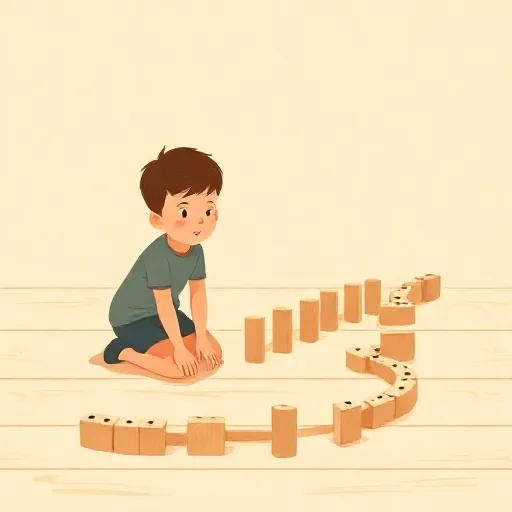
What does “necessary” mean here? Imagine a domino chain. You push the first one, and each domino knocks over the next. If the setup is perfect, the last domino has to fall. It’s not a guess; it follows from the rules of the game. Peirce thought math works the same way. When you start with certain premises — say, the rules of an algebra — and apply them correctly, the conclusions are forced. You can’t wiggle out of them. They’re necessary, not optional.
Notice that Peirce didn’t say mathematics is a pile of fixed truths. He described it as an activity — the act of drawing conclusions. That’s why his definition uses the active word “draws,” not “contains” or “knows.” A mind (or today, a computer) has to do the drawing. He also insisted that math belongs to every inquiry, not just physics or engineering. Even moral questions, he wrote, can be handled mathematically if you set up the right rules and then draw the necessary conclusions. For Peirce, math wasn’t a subject — it was a tool for reasoning about anything that follows rules.
The Algebras Nobody Had Seen

Peirce didn’t just define math; he built new worlds with it. The book he was finishing in 1870 was Linear Associative Algebra, a study of every possible algebra that obeyed the associative law: x ( y z ) = ( x y ) z. In other words, grouping doesn’t change the result. He asked: if you stick to that law (and a few others), how many different algebras can you have with two, three, four, five, or six basic elements? The answer was a beautifully organized catalogue, full of stranger-than-fiction number systems.
Two of the terms he invented for these algebras are still used today. An idempotent element is one that gives itself back every time you multiply it by itself, no matter how many times you try: x to any power equals x. (George Boole had discovered that pattern in the algebra of logic years before.) A nilpotent element, by contrast, eventually vanishes: multiply it by itself enough times and you hit zero. Peirce mapped these families and showed that even within strict rules, enormous variety was possible — each algebra its own miniature universe of necessary conclusions.
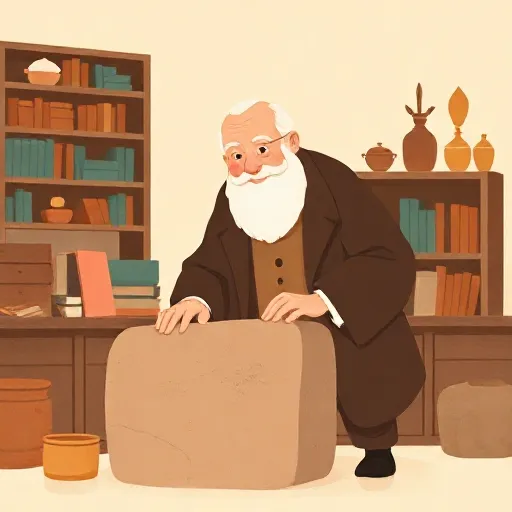
Because the National Academy of Sciences couldn’t afford to print his dense, handwritten manuscript, the staff of the U.S. Coast Survey devised a strange solution. A woman with exceptionally neat handwriting (but no mathematical training) painstakingly copied the entire text onto limestone slabs, 12 pages at a time, so that 100 lithograph copies could be distributed around the world. Eleven years later, Peirce’s son — Charles Sanders Peirce (1839–1914), who became a remarkable philosopher and logician in his own right — had the work reprinted and expanded. Those algebras helped later mathematicians see that math isn’t just one system of rules, but a garden of rule-governed structures, each with its own necessary logic inside.
When Math Meets Logic — a Collision
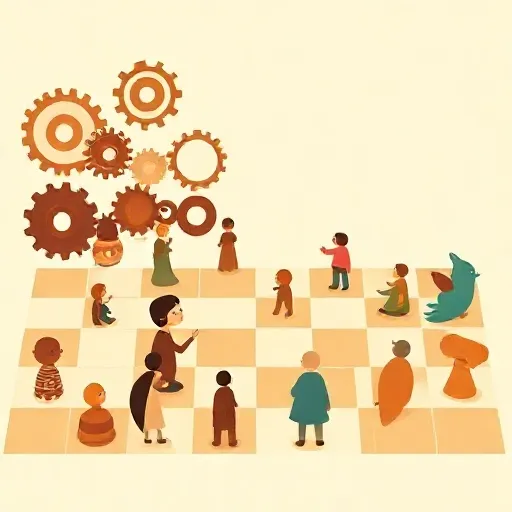
Peirce’s definition contained a quiet but fierce claim about the relationship between mathematics and logic. He believed that math could be used to analyze logic — not the other way around. This was a direct challenge to thinkers who were arriving at the opposite conclusion. The German logician Gottlob Frege (working in the late 1800s) was arguing that arithmetic could be built entirely out of logical laws and definitions. Later, the British philosopher Bertrand Russell (in the early 1900s) optimistically extended that ambition to all mathematics. Their program came to be called logicism: the idea that logic is the foundation, and math sits on top of it.
Peirce disagreed. He saw logic as one territory that mathematics could illuminate — a tool mathematics could model, not a boss mathematics had to obey. In an 1879 lecture, he called his definition “wider than the ordinary definitions” and “subjective,” meaning it focused on the act of reasoning rather than a set of fixed objects. His son Charles later claimed that he helped his father settle on this view, and he fiercely defended it. He developed an entire tradition — algebraic logic, growing from the work of Boole, Augustus De Morgan, and his father — that treated logic as a kind of mathematically tractable structure. This split between algebraic logic and the logicism of Frege and Russell shaped much of what came next in the philosophy of mathematics.
Why Necessary Conclusions Still Matter

You might wonder: does a dusty definition from 1870 affect you? Every time you play a video game, design a spreadsheet, or wonder why a math answer “has to be” the way it is, you’re walking around inside Peirce’s idea. A game engine is a rule-system. If you jump on a platform, the game checks the collision rules and the outcome is forced — a necessary conclusion from the code. Even a calculator “draws” necessary conclusions: you enter premises (numbers and operations), and it spits out the unavoidable result.
Peirce’s vision also sharpens a question you probably ask in math class: am I discovering something that was always true, or am I just playing with rules humans invented? If math is the science of drawing necessary conclusions, then the truth of a theorem depends on the system you’re inside. Change the rules — like switching from ordinary arithmetic to a nilpotent algebra where multiplying something eventually gives zero — and different conclusions become necessary. That doesn’t make them less real; it makes them real within their world. Peirce’s definition pushes you to see math not as a dusty set of facts, but as a live process of reasoning, rule by rule, step by step.
Think about it
- If a computer follows its program exactly and always gives the right answer, is it “doing mathematics” the way you do? What’s the difference, if any?
- Can you invent a tiny algebra of your own — with only two elements and one rule — where the necessary conclusions feel surprising? What does that tell you about necessity?
- If math is about drawing necessary conclusions, why do people disagree so much about what counts as a proof? Is that disagreement part of the drawing, or a sign that something else is needed?