
Is Math Just a Giant Game with Rules?
Hilbert’s Beer Mugs: What Is Math Really About?

In 1899, the German mathematician David Hilbert (1862–1943) wrote a startling letter to a philosopher friend. Geometry, he said, isn’t really about points and lines. Swap those points for “tables, chairs, and beer mugs,” Hilbert joked — as long as the new objects follow the same geometric rules, every theorem still holds. A right triangle made of love, law, and chimney‑sweeps would obey Pythagoras’ theorem just like one drawn on paper.
Hilbert was putting his finger on a deep idea: maybe math isn’t about special, invisible objects like “the number 2” floating in a perfect realm. Maybe math is entirely about what you can prove from a set of starting rules. This view is called deductivism, and for a few decades around 1900 it was the hottest way to make the philosophy of mathematics clean, simple, and free of spooky stuff.
What Deductivism Says: It’s All About the Proof

So what exactly does a deductivist believe? Take the ordinary math sentence “2 + 2 = 4.” The deductivist says this sentence doesn’t report a fact about a special object called 2. Instead, it’s really making a claim about sentences: namely, that the sentence “2 + 2 = 4” can be deduced — proved step by logical step — from the axioms of arithmetic. Axioms are the starting rules you accept without proof, like “0 is a number” or “every number has a successor.”
The deductivist applies the same trick to every mathematical statement. “2 is prime” becomes “The sentence ‘2 is prime’ follows deductively from the axioms of arithmetic.” “Every group has exactly one identity element” becomes “That theorem follows from the axioms of group theory.” No more mysterious talk about what numbers are — only talk about what we can prove from rules.
This idea had big names backing it. The British philosopher Bertrand Russell (1872–1970) opened his 1903 book by declaring that pure mathematics is just the study of “if these axioms, then that theorem” statements. The mathematician Moritz Pasch (1843–1930) insisted that geometric proofs must stay valid even if you replace all the words with meaningless signs. And the American logician Haskell Curry (1900–1982), writing after the shock of Gödel’s incompleteness theorems, still defended a version of deductivism, arguing that math is the science of formal systems and that any consistent set of rules can count.
Why Put Proof First? The Clean Promise of Deductivism
Why would anyone think math is “just proving things from axioms”? Four main reasons drove deductivism’s popularity.
First, proof is the heart of mathematics. Ask any mathematician: you don’t accept a claim until it’s been proved. Deductivism takes that one step further — it says a mathematical truth is a proved statement, not something that merely gets verified by a proof. If the proof exists (even if no one has found it yet), the statement is true.
Second, deductivism looks philosophically clean. It doesn’t need to explain what numbers or triangles really are, or how we can know about abstract objects that seem to exist outside space and time. The only epistemological job left is to understand how we know logical deductions work. And on the metaphysical side, you don’t have to fill the universe with invisible mathematical entities. The rules and proofs are just strings of symbols — types that don’t require a ghostly existence.
Third, deductivism seems to respect objectivity. What follows from a set of axioms is an objective fact, independent of what anyone thinks. It’s not a matter of opinion. So math stays objective without needing a separate world of Platonic forms.
Fourth, deductivism offers a neat picture of applications. If you find a physical system that satisfies the axioms of a branch of math, all the theorems must apply to it. For example, if a set of physical objects obeys the axioms of group theory, any group‑theory theorem will hold for them. This suggests math works in science because science tries to find real‑world setups that mirror the axioms.
But these attractions came with serious headaches — some of them still unsolved.
When Math Has No Axioms: The Babylonian Problem
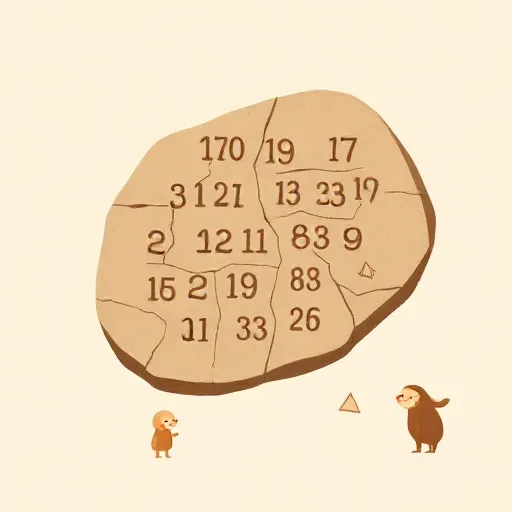
The first trouble: unaxiomatic mathematics. Long before Euclid, mathematicians in Babylon and Egypt were solving equations, calculating areas, and predicting planetary motions. They didn’t have a tidy list of axioms. How can deductivism explain what they were doing? If truth is provability from axioms, then their results weren’t true until someone later wrote down the axioms — an odd thing to say.
Deductivists have a reply. The Babylonians might have used implicit axioms, the principles they accepted without spelling them out. And even if they left their rules unspoken, their methods reliably tracked what a proof from those rules would deliver. So they still had mathematical knowledge, just not in the explicit, formal style deductivism prefers. Still, the point shows that math doesn’t always look like a tidy logical game.
The Snake That Eats Its Own Tail: An Infinite Regress

Here’s a more logical knot. A deductivist says “2+2=4” really means “The sentence ‘2+2=4’ follows from the axioms.” But that new statement — “The sentence … follows from the axioms” — looks itself like a mathematical claim. After all, proof theory is a branch of math. So shouldn’t the deductivist apply her recipe to it, too? That would give: “The sentence ‘The sentence “2+2=4” follows from the axioms’ follows from some axioms.” And then again, and again. We could get an infinite regress with no finite expression of what “2+2=4” really says.
The deductivist can stop this snake by denying that facts about what a formal system proves are mathematical facts. Instead, they are plain facts about symbol‑sequences: either there is a finite sequence of sentences obeying the rules that ends in “2+2=4,” or there isn’t. That’s a determinate, non‑mathematical fact, like the fact that a certain string of letters is in a book. We might use math to check it, but the fact itself isn’t loaded with mathematical commitment. So the regress halts, but only by drawing a sharp line between math and the study of proofs — a move not everyone thinks is convincing.
The Truths Proof Cannot Reach: Gödel’s Hammer

The biggest challenge to deductivism arrived in 1931, when the young Austrian logician Kurt Gödel (1906–1978) published his incompleteness theorems. He showed that any powerful, consistent set of axioms for arithmetic will always leave some true statements unprovable. There will be sentences that are true, but that no finite proof from those axioms can ever capture.
For the deductivist, truth just is provability. So an unprovable true sentence would be impossible. The only way out is to say that such a sentence is neither true nor false, because neither it nor its negation follows from the axioms. But that clashes with how mathematicians understand arithmetic. Most mathematicians believe arithmetic is truth‑complete: for any precisely stated arithmetical sentence, either it or its opposite is true, even if we can’t prove which. The famous Goldbach conjecture (every even number greater than 2 is the sum of two primes) is either true or false, period — not “only true if we can deduce it from some chosen axioms.”
A deductivist could reply by idealizing the axioms into a “complete” system that somehow decides every sentence, but that system would be infinitely complex or uncomputable, losing the clean appeal of deductivism. Or, following Curry, she could accept that many formal systems exist and that truth is relative to which system you pick. But then a statement like “Goldbach’s conjecture is true” means different things in different systems — contradicting the conviction that arithmetic has one, objective truth.
Gödel’s hammer didn’t crush deductivism outright, but it made clear that if math is just provable consequences, then some genuine truths will forever hide in the shadows.
Why It Still Matters: From Symbols to Structures

So did deductivism die? Not completely. It forced philosophers to get sharper about the difference between syntactic consequence (what can be proved by symbol‑pushing) and semantic consequence (what holds in all possible interpretations of the axioms). Gödel himself, in 1929, proved that for first‑order logic the two notions match up exactly — but only for that restricted logic. Higher‑order logics, needed to capture many ordinary mathematical ideas, break the equivalence.
The twentieth century saw deductivism give way to structuralism, a family of views that understand math statements as describing what holds in any structure that satisfies the axioms, not just what is provable. Structuralism keeps the insight that math is about relations between objects, not about mysterious objects themselves, but it escapes the narrowness of pure provability. Nevertheless, deductivism’s core insight — that math is a matter of consequence from rules — lives on in the way we teach and do mathematics. When you solve an equation by applying justified steps, you’re following a deductivist script. And the nagging question remains: Are numbers real, or are they just the shadows of our rules? Hilbert’s beer mugs still clink across the lecture halls of philosophy.
Think about it
- Suppose someone proved that a simple math statement is true, but that no set of reasonable axioms could prove it. Would you still call it a “truth”? Why or why not?
- When you use math to design a skateboard ramp, is the math part of the physical world like the wood, or is it just a useful invention that happens to predict how the wood will behave?
- If every mathematical truth is just what you can prove from some rules, could there ever be a final, perfect set of rules for all of math? What would it mean if there isn’t?