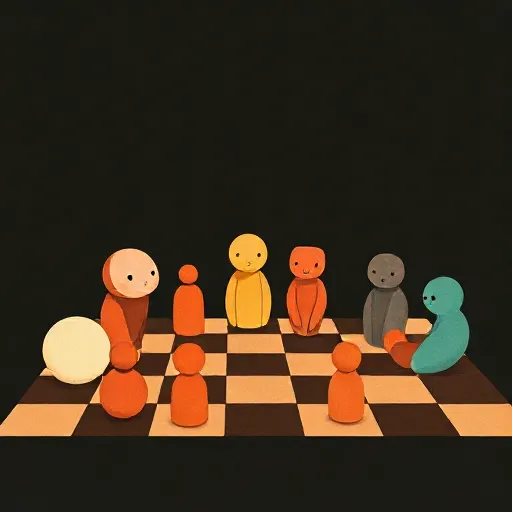
Are Numbers Real, or Just Pieces in a Game?
The Grumpy Philosopher Who Hated the Game Idea
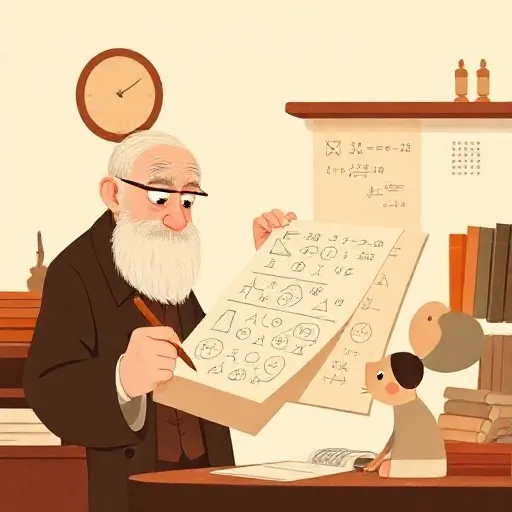
In 1903, the German logician Gottlob Frege (1848–1925) sat down to demolish a rival idea — and he did so with fury. He believed some mathematicians were treating their subject like a meaningless board game. One of them, Johannes Thomae (1840–1921), had written that arithmetic is “a game with signs which one may well call empty.” Frege shot back with sarcasm: “In order to produce it we would need an infinitely long blackboard, an infinite supply of chalk, and an infinite length of time.”
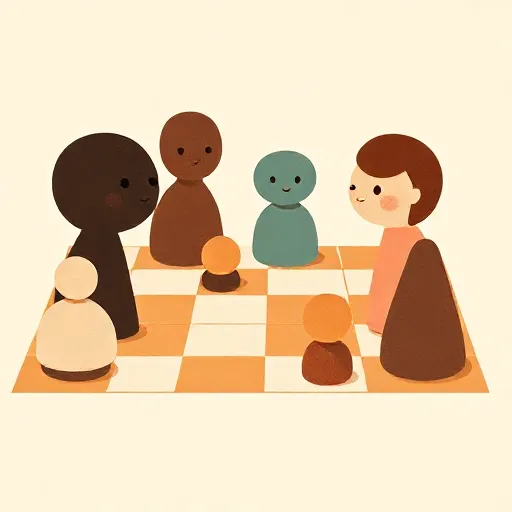
Frege was attacking what we now call formalism. For a formalist, mathematical symbols — “1,” “+,” “3” — don’t refer to anything. They are empty marks. Doing math is just pushing those marks around according to fixed rules, exactly the way you move chess pieces. The position Frege tore apart is called game formalism, and his criticisms have shaped the debate ever since. Oddly, later scholars discovered that Thomae probably didn’t hold that extreme view; Frege may have been attacking a straw man. But the genie was out of the bottle: could mathematics really be nothing but a game?
Two Big Problems: Why Math Works, and What Counts as a Proof
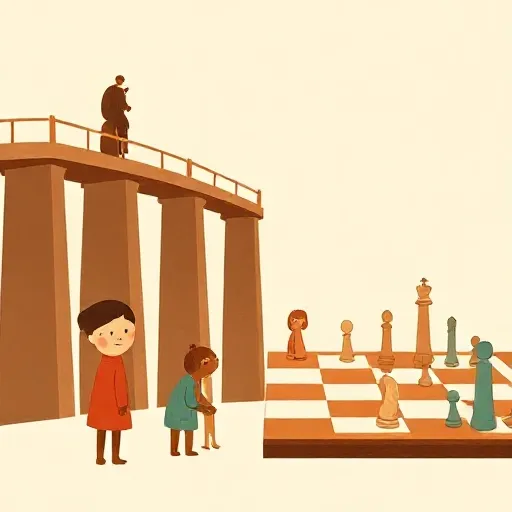
If math is a game with empty symbols, why does it predict where Mars will appear next week? Why can engineers use it to build skyscrapers? Frege insisted that applicability is what separates a science from a game. A chess move doesn’t tell you anything about actual castles, but “2 + 2 = 4” tells you something about apples, planets, and money. For Frege, that was proof that numbers refer to real, abstract objects — a view called platonism.
There is a second problem, often called the metatheory problem. When we talk about the game — what strings count as a proof, whether a rule is allowed — we are doing a higher‑level study called metamathematics, or syntax. Syntax deals with expressions themselves. But standard syntax needs infinitely many distinct expression‑types, like “0,” “0+0,” “(0+0)+0,” and so on. Those types look just as abstract as numbers. So even the formalist who says math is about symbols ends up committed to an infinite realm of abstract objects. The game formalist can’t escape platonism by moving the abstract objects from numbers to symbols.
Wittgenstein’s Cranks and Carnap’s “Anything Goes”
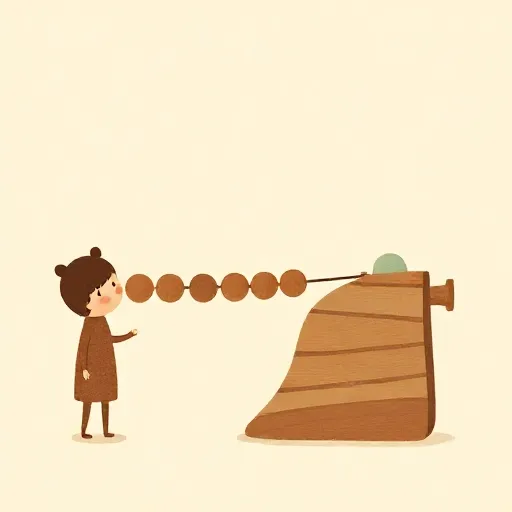
The young Ludwig Wittgenstein (1889–1951) tried a radical shortcut. In his Tractatus Logico‑Philosophicus, he argued that mathematical sentences are pseudo‑propositions — they aren’t true or false in the usual way. Instead, numbers are just exponents of repeated operations on sentences. If Ω(p) means applying some operator Ω to a proposition p, then “2 + 2 = 4” amounts to saying that doing Ω twice, then twice again, yields the same result as doing it four times. In slogan form, numbers are “exponents of operations.” The idea was clever, but it couldn’t handle inequalities (“2 ≠ 3”) or almost any mathematics beyond a thin slice of addition. Wittgenstein himself seemed to give up on it by the end of the book.
Rudolf Carnap (1891–1970) took a more relaxed approach. In The Logical Syntax of Language (1937), he proposed a Principle of Tolerance: in logic and mathematics, “everyone is at liberty to build up his own form of language, as he wishes.” You can pick any system of rules you like, even an inconsistent one, as long as you don’t pretend it’s true about some hidden world. The only test is pragmatic usefulness. But when we actually apply one of these uninterpreted systems to the world — for example, using arithmetic to count people in a room — we need bridge principles linking the empty symbols to real things. Carnap admitted that his pure calculi couldn’t supply those bridges without adding extra rules, and he never convincingly explained why those rules wouldn’t smuggle meaning back in. Gödel’s incompleteness theorems further showed that we can’t prove a system’s own consistency from within, so we can’t even be sure a chosen game won’t collapse into utter nonsense.
The Computer Science Twist: Proofs Are Programs
Mid‑career, Haskell Curry (1900–1982) and W. A. Howard discovered a startling link. They showed that in certain type theories, a mathematical proof corresponds precisely to a computer program, and a proposition corresponds to the type of its proofs. This is the Curry‑Howard correspondence, and it gave formalists a powerful new metaphor. If math is just a system of computable rules, and if the meaning of a theorem is literally the set of its proofs — which are syntactic objects — then we never need to appeal to a mysterious realm of numbers and sets “out there.” The whole thing lives in a formal language and a computer.
Some modern proof‑theoretic semantics embrace this picture. However, the metatheory problem reappears: the type‑theoretic proofs are still abstract objects, infinite in number. A programmer can’t actually execute every proof that “exists” in the system. And the challenge of bridging pure math to empirical measurement — the number of people in a room, the length of a shadow — remains unsolved.
Short Sentences, Impossible Proofs
Today, a few philosophers still defend versions of game formalism. In the 1940s, Nelson Goodman (1906–1998) and W. V. Quine (1908–2000) tried to build mathematics using nothing but concrete ink marks. They promised that math would be just “strings of marks without meaning.” But they faced an ugly problem: concretely undecidable sentences. Consider a short statement like “2^(2^(2^(2^(2^2)))) + 1 is prime.” The statement itself fits in one line, yet proving or disproving it might require more paper, time, and atoms than the universe can provide. If truth depends on a concrete proof existing somewhere, then many such sentences would be neither true nor false — a result that would butcher most of ordinary mathematics.
Philosophers like Alan Weir (born 1963) have tried to rescue formalism by arguing that we can legitimately idealise; we can talk about proofs that don’t physically exist, just as we talk about “infinitely many primes” without meaning concrete objects. The debate over whether this is a consistent escape route is still very much alive.
Why This Old Fight Matters When You Do Homework
The next time you solve a math problem — balancing an equation, finding a pattern, checking a proof — you are stepping into the middle of this centuries‑long argument. If numbers are just game tokens, then math is something we invented, like the rules of Monopoly. If they refer to a real, abstract world, then math is something we discovered, like a continent. The answer touches everything: why math works in science, whether an alien civilization would have the same number 5, and whether a computer really “knows” what 7 means.
Neither side has won. Formalists have found incredibly creative ways to build mathematics without assuming a ghostly realm of numbers, yet the problems of applicability and metatheory keep biting back. Platonists can explain why math fits the universe so well, but they must explain how we, with our warm, physical brains, can ever bump into a non‑physical truth.
So next time your teacher says “2 + 2 = 4,” don’t just write the answer. Wonder which side you’re on.
Think about it
- If aliens on another planet developed a completely different game of arithmetic — where 2+2=5 — would they be making a mistake, or just playing with different rules?
- Suppose a friend says, “Math is totally made up, like a video game.” What would you point to in the real world that might change their mind?
- If every proof of a mathematical claim is too long for any human to write down, can we still call the claim “true”? Why or why not?