
Can an Idea Be True If You Never Finish Testing It?
A boy, a book, and a question that never went away

When Charles Sanders Peirce (1839–1914) was about your age — 12 or 13 — he found a logic textbook by a man named Richard Whately. He devoured it in days. From then on, he saw every question as a logic problem, whether it was about science, language, or how to live.
Peirce grew up in Cambridge, Massachusetts. His father Benjamin was a famous mathematician at Harvard who taught young Charles by giving him hard problems and checking his solutions. That habit — thinking through difficult questions entirely on your own — never left him.
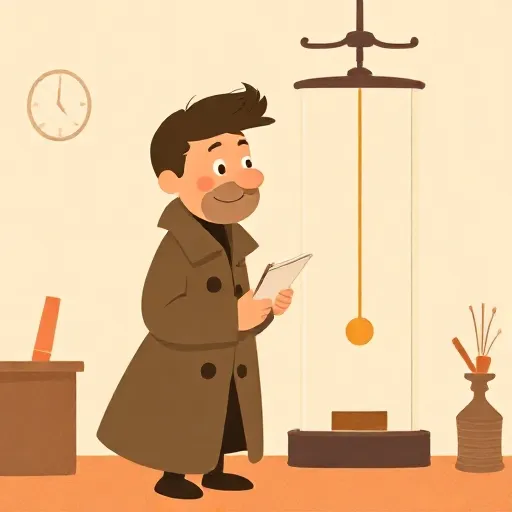
For 32 years, Peirce worked as a scientist for the U.S. Coast and Geodetic Survey, measuring gravity with swinging pendulums he often designed himself. Day after day, he made careful measurements. He noticed something strange: no matter how precise your instruments are, your results are never exactly the same twice. That tiny fact would eventually blow up his whole view of how the universe works — and lead him to completely rethink what it means to call something “true.”
Your idea of “clear” is probably wrong

In 1877 and 1878, Peirce published two articles that would become his most famous work. The first was called “The Fixation of Belief,” and the second was “How to Make Our Ideas Clear.” Together they introduced a new approach to philosophy that later became known as pragmatism.
Here’s the core idea: the whole meaning of a concept is just the sum of all the practical effects you could possibly observe from it. Suppose you say a rock is “hard.” What does that really mean? Peirce’s answer: it means that if you try to scratch it with a knife, the knife won’t leave a mark; if you hit it with a hammer, it will resist; and so on for every possible test you could run. If two words — say, “hard” and “solid” — led to exactly the same set of expected results in every possible situation, they would mean exactly the same thing, even if they sounded different.
This sounds simple, but it has a sharp edge. Peirce was saying that if an idea has no imaginable effects on anything anyone could ever observe, then that idea is empty. Not mysterious. Not deep. Empty.
His view was shaped by the fact that he spent decades as a real working scientist. He wasn’t doing philosophy from an armchair. He was swinging pendulums, measuring coastlines, and checking chemical compounds. To him, a meaningful concept had to have experiential “cash value” — something that makes a difference in what you can see, touch, or measure. Much later, scientists like Einstein would say something similar: the meaning of a physical concept is determined by an exact method of measuring it.
Years after introducing pragmatism, Peirce renamed his own version pragmaticism — a word he admitted was ugly enough to be safe from kidnappers. He wanted to distinguish his scientific philosophy from other ideas being sold under the name “pragmatism” by people like his friend William James.
Why Peirce thought you can never be 100% sure
Peirce was a fallibilist. That’s a technical word for a simple idea: you can never be absolutely certain about anything. No matter how good your evidence is, there’s always a chance you’re wrong.
This wasn’t pessimism. Peirce didn’t think truth was impossible. He thought it was the destination that any group of honest investigators would eventually agree on, if they kept asking questions forever. The process of science, he argued, is self-correcting. Different researchers can start from wildly different assumptions, but as long as they keep testing, their results will gradually converge toward the same outcome. That final point of convergence — the place everyone would eventually land if inquiry never stopped — is what Peirce meant by “the truth.”
Notice the catch: we’re never at the finish line. At any given moment, you’re somewhere on the road. You can’t know for sure how far you still have to go.
This connects to another of Peirce’s big claims: do not block the way of inquiry. He called this his first principle of reason. If a question has possible answers that would make some observable difference in the world, never assume it’s unanswerable. Never shut down investigation just because the answer might be uncomfortable or because nobody has figured it out yet. Keep the path open.
The detective’s loop: guess, deduce, test, repeat
Peirce argued that all reasoning comes in three flavors, and they work together as a cycle. He called them abduction, deduction, and induction.
Abduction is the guess. You encounter something surprising — say, a lump of ice sitting alone in the middle of a hot desert. Your brain immediately starts proposing explanations: maybe someone put it there. Maybe a freak hailstorm dropped it. You don’t seriously consider the idea that aliens threw it from a flying saucer — that explanation isn’t plausible, a term Peirce used for the kind of educated guess that’s worth taking seriously. Abduction is the creative leap; it’s how you come up with a hypothesis to test.
Deduction is the next step. You take your hypothesis and ask: if this were true, what else would have to be true? What other observable facts should follow? You figure out the logical consequences of your guess. This is the only one of the three forms of reasoning that’s airtight — if the premises are true, the conclusion must be true.
Induction is the testing. You go out into the world and check whether the deduced consequences actually happen. For Peirce, induction in its most basic form is reasoning from a sample to a whole population: you pull a random handful of balls from an urn, see that most of them are red, and then infer that most balls in the whole urn are probably red. Induction is never a guarantee — your sample could mislead you — but it’s how we learn.
The full scientific method, in Peirce’s picture, loops endlessly. Surprising fact → guess an explanation (abduction) → work out what else would have to be true (deduction) → check if it is (induction). If the tests pass, you keep going and deduce further consequences. If the tests fail, you loop back and dream up a new hypothesis.
Peirce also insisted on something he called the economy of research. Research takes time, money, and energy, and you can’t do everything. You have to choose which hypotheses are worth testing and which experiments will give you the biggest return of knowledge for what you invest. Scientists do this all the time, whether they call it that or not.
The universe rolls dice — and that’s a good thing
Most scientists in Peirce’s time believed in determinism: the idea that everything that happens is completely fixed by prior causes, like a row of dominoes stretching back to the beginning of time. Peirce thought this was wrong — not as a philosophical preference, but because the evidence pointed the other way.
All those years measuring gravity had taught him something: real measurements don’t produce neat, identical numbers. They produce a scatter of slightly different results. If you measure the same thing a thousand times, you get a distribution — a spread — not a single point. And here’s the kicker: the more precise your instruments become, the more variation you notice, not less.
Peirce called his anti-deterministic view tychism, from the Greek word for “chance” or “luck.” He argued that there is genuine, objective spontaneity in the world. At the smallest scales, nature is not a machine whose every gear is locked in place. There’s real randomness — not just in the quantum realm (which hadn’t been discovered yet, but Peirce would have welcomed it with open arms), but everywhere, in varying degrees.
But Peirce didn’t think the universe was pure chaos. He thought nature had habits — statistical regularities that emerge and solidify over time. A law of nature, in his view, wasn’t an unbreakable rule imposed from the outside. It was a habit the universe had developed, and habits can change. Even the most entrenched regularities, like the law of gravity, evolved over cosmic history and could, in principle, keep evolving.
This had a wild implication: science isn’t shooting at a fixed target. The target itself might move.
Peirce connected all this to evolution. Just as Hegel had described an evolution of ideas, Lyell an evolution of geological formations, and Darwin an evolution of biological species, Peirce thought everything evolved — including the laws of nature themselves. And the engine of this evolution, he believed, was not selfish competition. Against the harsh “social Darwinism” popular in his day, which argued that the ruthless winners deserved their winnings, Peirce offered a startling alternative: evolutionary love. He called it agapeism — the idea that the deepest driver of growth is the willingness to sacrifice your own advantage for the good of others. He dismissed the greed-justifying version of Darwinism as “The Gospel of Greed.”
Why any of this still matters to you

Peirce died broke in 1914, largely unknown outside a small circle. His manuscripts were scattered, lost, and stashed in a trunk in a basement at Harvard’s library until the 1950s. For decades, his ideas were available only in a chopped-up, poorly edited collection that made him look incoherent. Scholars are still piecing together what he really thought.
Yet his fingerprints are everywhere. The modern scientific method — guess, deduce, test — traces directly back to him and William Whewell. His ideas about probability and the economics of research show up in how drug trials are run and how tech companies decide which features to build. Intelligence analysts and computer scientists now use Peirce-inspired algorithms to generate and test hypotheses automatically, for everything from catching criminals to monitoring aircraft health. The core logic behind social network analysis — the tool used to map terrorist networks — connects directly to mathematical structures Peirce invented.
But you don’t need to be a scientist or a spy to use Peirce’s ideas. Every time you realize you were wrong about something and replace your belief with a better one, you’re living inside his loop. Every time you ask “what would happen if I tried this?” before committing to a decision, you’re following his pragmatic rule. Every time you refuse to declare a question permanently closed, you’re honoring his first principle: do not block the way of inquiry.
Peirce thought truth was real. But he also thought you’ll never fully hold it in your hands — only chase it, together with everyone else who’s willing to keep asking questions. The point isn’t to arrive. The point is to never stop moving.
Think about it
- If two scientific theories predict exactly the same results for every experiment anyone could ever do, do they actually say the same thing, or could one still be “truer” than the other?
- Peirce thought even the laws of nature might slowly change over billions of years. If they do, would that make everything we currently “know” unreliable, or would science just adapt?
- When you change your mind about something important, what finally makes you give up the old belief — and could you ever be certain you’ve now got the right one?