Can a Belief Be True Just Because It Helps You?
A Squirrel, a Tree, and a Useless Argument

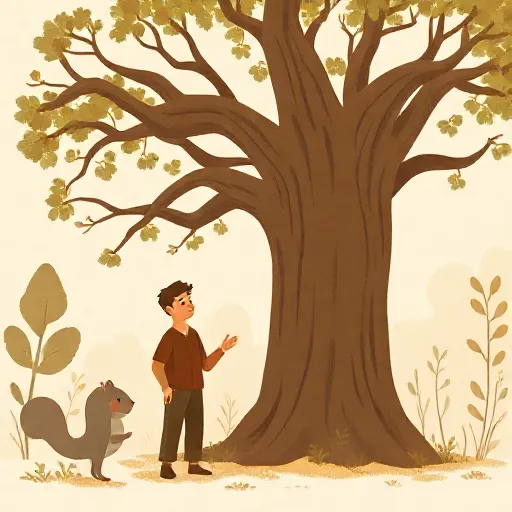
Imagine you are hiking with friends and someone spots a squirrel on a tree trunk. You try to get a look, so you circle the tree. But the squirrel is clever: it scuttles around the trunk exactly as fast as you move, always keeping the wood between you and it. You never see the squirrel. Did you go round the squirrel or not?
The philosopher William James (1842–1910) told this story in 1907. He watched his friends get stuck in a furious debate. The argument felt impossible to settle — until James asked a simple question: what practical difference would each answer make? If “going round” means passing north, east, south, and west of the squirrel, then yes. If it means moving around to face the squirrel’s front, right side, back, and left side, then no. Once the words were clear, the fight evaporated.
That move — settle a dispute by asking what difference it would make in practice — is the heart of pragmatism, a philosophy born in the United States around 1870. Its founders were James and his friend Charles Sanders Peirce (1839–1914). They believed many philosophical battles are only battles about confused words. But when they tried to use the same tool to explain truth, they split sharply. Their argument is still alive today every time someone says, “That’s true for you but not for me.”
Peirce’s Rule: What Would It Mean in Practice?
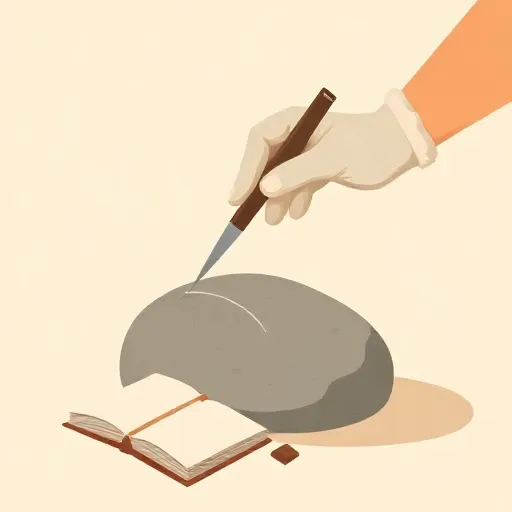
Peirce wanted a rule for making ideas clear. In 1878 he wrote his Pragmatic Maxim: to find out what a concept really means, think about what effects you would expect to see if the concept applied to something, and what actions you would take because of it. The whole meaning of an idea, he said, is the sum of its possible practical consequences.
Take a simple example. Suppose you call a rock “hard.” What does that involve? It means that if you try to scratch it with a knife, it will resist. If you want to break a window by throwing something, a hard object will do the job. A soft one won’t. The meaning of “hard” is not a mysterious inner essence — it is a pattern of experiences and useful predictions. If a word leads to no conceivable practical difference, Peirce thought it was empty jargon. He used this test to challenge ideas like the medieval doctrine that bread and wine become flesh and blood during Mass while still looking and tasting like bread and wine. For him, that was a noise with no real meaning.
Peirce called his method a “laboratory philosophy.” Just as a scientist tests a hypothesis by expecting some specific measured result, we can clarify any concept by asking what result we would accept as counting for or against it. Notice that the maxim is not a full theory of meaning — Peirce later built a complex theory of signs — but it was his tool for getting rid of fake problems.
Two Friends, Two Different Truths

When Peirce applied his maxim to the idea of truth, he arrived at something surprising. He said we can’t define truth as “what is real” without first understanding reality. And to understand reality we need to see what difference it makes to call something real. His answer: the real is what would be represented in the opinion that all honest investigators would eventually agree on, if they kept inquiring long enough. Truth, then, is the end of inquiry — not a final finish line we will someday cross, but a goal that pulls our questioning forward.
This is a deeply social picture. Peirce didn’t trust a single person’s feeling of certainty. He pointed out that the sciences make progress not by one genius doubting everything, but by a community of inquirers checking each other’s work over time. “We individually cannot reasonably hope to attain the ultimate philosophy which we pursue,” he wrote. “We can only seek it, therefore, for the community of philosophers.” For him, truth was the opinion that would survive all future challenges, even centuries of new evidence.
But James took pragmatism in a different direction. He argued that a belief can be called true when it “proves itself good in the way of belief” — that is, when holding it helps us link our experiences together satisfyingly and navigate the world without crashing into painful surprises. He wrote that “the true is only the expedient in the way of our thinking, just as ‘the right’ is only the expedient in the way of our behaving.” A scientific theory is true because it lets us predict and control events. But he also thought that a religious belief could be true because it brings moral strength or inner peace, as long as it doesn’t clash with other vital commitments.
This horrified Peirce, who saw logic as a strict method that should not bend to personal comfort. He was so alarmed that he renamed his own view “pragmaticism,” hoping the ugly name would keep it safe. James, in contrast, thought philosophy had to honor both the tough-minded person who sticks to facts and the tender-minded person who needs ideals. As he saw it, the history of philosophy is a clash of temperaments, and pragmatism was the peacemaker.
No Doubts Without a Reason
Both friends agreed on one big thing: you cannot force yourself to doubt everything. Descartes had taught that we should throw out all beliefs that are not absolutely certain. Peirce called that a fake exercise. Real doubt, he said, arises only when something surprises us and our habits fail. We don’t test each belief from scratch; we trust the huge background we never think to question — that the ground will hold us when we walk, that our memory is roughly reliable — and we fix beliefs only when a specific problem emerges.
James added that we have two deep goals: to gain truth and to avoid error. If you try too hard to avoid every mistake, you may shut yourself off from any new belief, including true and important ones. He argued that when a question is living, forced, and momentous — for example, whether to trust morality or whether life is worth living — it is sometimes rational to believe even before the evidence is complete. This was his “will to believe,” a carefully guarded permission, not a license to believe anything you like.
Peirce never accepted that move, but he offered his own metaphor for how we actually learn: reasoning is not a chain where one broken link spoils everything. It is a cable made of many slender fibers, each individually weak but entwined to support enormous weight. Our best protection against error is not a single airtight proof, but endless cross-checking with others in the long, slow work of inquiry.
Democracy Is a Way of Thinking Together
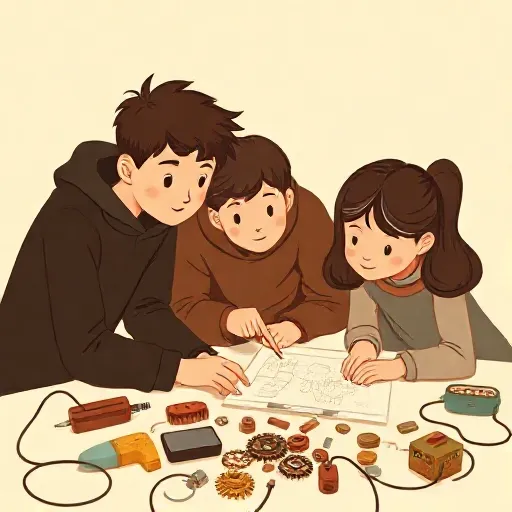
The next generation of pragmatists, especially John Dewey (1859–1952), moved the focus from individual beliefs to collective problem-solving. Dewey saw every thought as a response to an unsettled situation. An ant on a hot sidewalk, a mechanic with a stalled engine, a town debating how to clean its river — all are in the grip of an incomplete experience, and all are doing inquiry, the effort to transform an uncertain, tangled situation into a unified and satisfying one.
For Dewey, this meant that experimenting and reflecting belong to everyday life, not just to science labs. And because we are irreducibly social — we become persons only in relationship — the best inquiry is shared. This is why he called democracy a way of life, not just a voting system. A school, a factory, a neighborhood are democratic when they invite every person to contribute their insights to the problems that affect them. His vision of a problem-centred pedagogy put students in charge of genuine investigations, guided by a teacher. That idea later grew into the worldwide Philosophy for Children movement, which many young readers will have met in their own classrooms.
Why We Still Fight About Truth

You live in a world where people say “That’s just your truth” or accuse each other of living in “alternate facts.” Peirce and James saw this problem coming. James wanted to honour the personal meanings that guide a life, including religious ones, but he insisted that any belief that clashes with shared experience and future consequences will eventually break against reality. Peirce wanted to hold truth as a single, distant star that all honest inquirers steer by, even if nobody ever fully reaches it. Both would agree on the method: when a claim leads to no observable difference at all, arguing about it is empty. And when it does lead to practical consequences, we are responsible for testing it together.
The squirrel dispute was solved by clarifying what “going round” really amounts to in action. The bigger disputes — about justice, climate, what it means to be free — are not that simple. But pragmatism’s bet is that we get closer to truth not by closing our eyes tighter but by opening them wider, in company with people who see things differently, and by asking the humblest and most powerful question of all: what difference would it make?
Think about it
- If a belief makes you genuinely happier and doesn’t seem to hurt anyone, does that give you a good reason to call it true?
- Peirce imagined truth as what investigators would agree on after asking every possible question. Can you think of a question that might never be settled, no matter how long people inquire? Would the idea of a true answer to it still make sense?
- In a group argument, people often talk past one another without realizing it. The next time a debate gets stuck, what specific practical difference would help you discover whether the two sides actually disagree?