

Can You Believe Something Just Because It Makes Life Better?
The Icy Ledge: A Problem About Belief

You are alone on a mountain trail. In front of you, the path narrows to a slick, icy ledge no wider than your foot. One slip could send you tumbling. You don’t know for sure that you can make it across, but standing still is not an option. If you believe you can cross, that belief could calm your breathing, steady your legs, and actually help you succeed. Is it okay to trust a belief that hasn’t been proved yet?
William James (1842–1910) thought the answer was yes — but only in certain special cases. He built a whole philosophy around questions like this. James was born in New York City, studied painting and science as a teenager, went to medical school, and then fell into a deep depression. Instead of becoming a doctor, he became a groundbreaking psychologist and a philosopher who never stopped being curious about the messy, feeling-driven way human beings actually think and choose.
Two Kinds of Thinkers: Tough-Minded and Tender-Minded

James believed that our temperament — our emotional style and personal passions — secretly guides the philosophies we find convincing. In his book Pragmatism he divided thinkers into two camps. Tough-minded people love hard facts, logic, and concrete details. Tender-minded people care more about ideals, feelings, and unity. Most of the big fights in philosophy, James said, happen because a tough-minded thinker and a tender-minded thinker stare at the same world and their hearts pull them in opposite directions.
He didn’t think one temperament was right and the other wrong. He saw himself as a mediator — someone who could respect cold facts while still caring deeply about hope, religion, and human purpose. But he also claimed something bolder: that even our sense of what counts as rational is driven by feelings. In an early essay he argued that an idea strikes us as rational when it gives us a feeling of ease, peace, and “the sufficiency of the present moment.” He called this the sentiment of rationality — the sense that a thought just fits. When you finally grasp a math proof or see how two paragraphs connect, that little click of understanding is a feeling, not just naked logic.
The Right to Believe When You Can’t Wait for Proof

Science often lets us wait. A chemist can run experiments for years before deciding what to believe about a new element. But in daily life, many questions won’t wait. James called these forced options — you must choose one answer or the other, and refusing to choose is itself a choice. The icy ledge is a momentous option: the stakes are huge, and the chance won’t come again.
When an option is forced, momentous, and unsupported by solid evidence, James said you have a right to believe — not a duty, and not a license to believe anything you daydream about, but a permission. That permission is especially strong when the belief can help bring about its own truth. If believing that you can cross the ledge makes you more likely to succeed, then the belief helps bring about its own truth.
James applied this to religious belief. Suppose someone tells you that a meaningful relationship with God is possible only if you first believe in God without watertight proof. In that case, holding the belief may open up an experience that confirms it later. But he also applied the right to believe to everyday trust: “A government, an army, a commercial system, a ship, a college, an athletic team” — all of these hold together because people believe other people will do their part, often without having proof ahead of time.
What Makes an Idea True? James’s Pragmatism
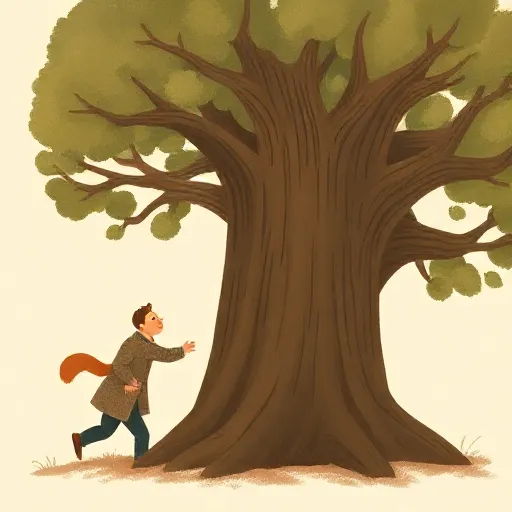
James is most famous for pragmatism, a way of thinking he developed alongside Charles Sanders Peirce (1839–1914). Pragmatism starts with a simple question: what difference would it make in practice if an idea were true? If two beliefs lead to exactly the same actions and expectations, then for a pragmatist the dispute between them is empty.
He illustrated this with a story. A squirrel clings to a tree trunk. A man walks around the tree, trying to see the squirrel, but the squirrel scuttles so that the man is always on the opposite side. Does the man go around the squirrel? It depends on what you mean by “go around.” If you mean moving so that you pass north, east, south, and west of the animal, then yes. If you mean moving so that you face the squirrel’s front, then one side, then its back, then the other side, then no. Once you spell out the practical meanings, the argument disappears.
James extended this into a theory of truth. He said truth is a kind of good — something like health. True ideas are the ones we can “ride” into the future without getting painfully surprised. They help us navigate the world, connect with other people, and avoid dead ends. Truths are made, not just found, as we test ideas in experience and keep the ones that work. But that doesn’t mean you can declare anything true just because you wish it. There are resisting facts — a brick wall will still hurt if you run into it — and our whole web of already-tested beliefs puts pressure on new ideas to fit together.
The Stream of Thought: Your Mind Isn’t a Train of Separate Cars

Before he was a famous philosopher, James spent twelve years writing a massive psychology textbook, The Principles of Psychology. In it he introduced an idea that changed how people picture the mind. Traditional thinkers had described consciousness as a chain of separate ideas, like beads on a string. James said that’s wrong. Consciousness is a stream of thought — it flows, it blends, and every moment shades into the next.
Think about trying to remember a person’s name. The name hovers just out of reach, a blurry sense of its rhythm or first letter. That blurry sense isn’t a clear idea — it’s a fringe, a felt tendency that doesn’t yet have a shape. James insisted we experience those fringes and relations directly; they are not added later by some logical trick. This was part of a bigger view he called radical empiricism: the claim that relations between things are just as real and just as directly experienced as the things themselves.
Late in his career he went even further. He proposed that mind and matter are not two fundamentally different substances. They are both made of the same stuff, which he called pure experience — a flowing, neutral material that can be arranged into physical objects or into a person’s thoughts depending on the connections it enters into. A single pure experience, like the sight of a chair, might belong both to the sequence that makes up the chair and to the sequence that makes up your mind.
Why This Still Matters: Respect, Tolerance, and an Open Future

James once told a story about riding through the North Carolina mountains and seeing a landscape that looked destroyed — tree stumps everywhere, scars in the earth. To his eyes it was ugly. But after talking to the settlers who had cleared the land to build farms, he saw it their way: a place of hard work, duty, and hope. He called our habit of missing what matters to other people “a certain blindness in human beings.”
That blindness, he thought, has both a moral and a philosophical lesson. Because the whole truth and the whole good are not handed to any single person, we have reason to tolerate and even appreciate outlooks that seem strange to us. “Even prisons and sick-rooms have their special revelations,” he wrote.
James’s philosophy leaves the future open. He saw the universe as still in the making, with room for real newness and for human choices that matter. You are not a spectator watching a finished movie; you are a co-author, picking your way across ledges whose outcomes are not yet fixed. That doesn’t mean every belief is equal, or that you can skip careful thinking. But it does mean that where proof runs out, your hopes, your trust, and your willingness to take a step can be part of what makes something true.
Think about it
- If believing you’ll ace a test helps you study more calmly and actually do better, does that make the belief true in some way? Why or why not?
- Can you think of a time you trusted someone without proof — a teammate, a friend, a new classmate? Did that trust turn out to be a good idea independent of the outcome?
- James thought every philosopher’s ideas reflect their personality. Do you think your own temperament makes certain ideas feel right to you, even before you’ve examined them fully?