
Why Some Truths Just Seem Right (and Should You Trust That?)
That “Aha!” Moment

You look at a square drawn on paper. Without thinking, without measuring, you just know it can’t have five sides. The idea seems true in a flash — obvious and certain. Now try another one: “If it is not the case that it is not raining, then it must be raining.” Read it again slowly. That feels true, too, right? Here’s a harder one: torturing someone just for fun is wrong. That hits you with the same force. And what about this — if doctors took your brain and placed it in a new body, the person who wakes up would still be you. That also just seems right, even before anyone gives you reasons.
Philosophers call these quick, powerful feelings intuitions. An intuition is a mental event where a proposition — a claim that can be true or false — suddenly seems true to you, as plainly as sunlight. No math class or rulebook was needed. But what exactly is happening inside your head when you have one? And can you really trust it?
More Than Just a Belief?
Some philosophers, like David Lewis (1941–2001), said an intuition is simply a belief — just an opinion you happen to hold. If you intuit that a square can’t be round, you believe it. That’s tidy. But a lot of thinkers, including George Bealer (born 1947) and Peter van Inwagen (born 1942), showed this can’t be the whole story.
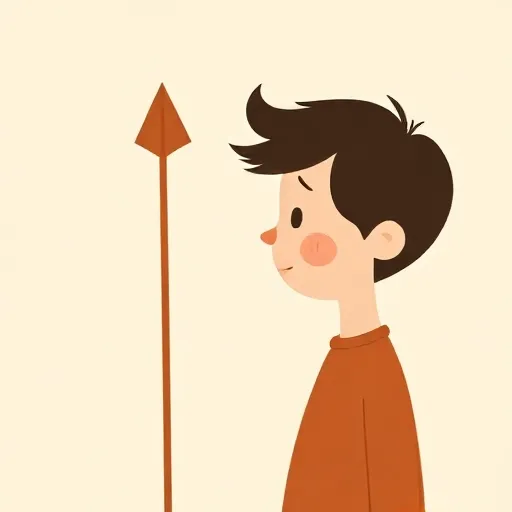
Imagine a classic magic trick: the Müller‑Lyer illusion. Two lines have arrowheads at the ends. One line looks longer, even after you measure and believe they are equal. The visual seeming stays put, tugging at you. Intuitions work the same way. Suppose you study a paradox, a puzzle where every step starts out intuitive but the steps can’t all be true. After you figure out which step is false, you stop believing it. Yet the feeling that it was true often lingers — you still have the intuition. So an intuition is not the same as a belief. You can lose the belief while the intuition hangs on.
What about being “disposed” to believe? Van Inwagen suggested that might be enough: an intuition is a tendency to find a claim attractive, even if you don’t fully accept it. But that doesn’t capture the conscious “flash” of obviousness. Right now you may be disposed to believe thousands of things that aren’t on your mind. An intuition, by contrast, is an occurrent experience — it’s happening right now in your awareness.
Most researchers who study philosophical intuitions land on a third view: an intuition is a distinctive kind of conscious experience, an intellectual seeming. When you consider de Morgan’s laws or the idea that a whole is bigger than its parts, something clicks. It suddenly seems true, not because you saw it or remembered it, but because your mind just “sees” it. This flash isn’t seeing with your eyes or hearing with your ears; it’s an inner grasp. Philosophers call it a rational intuition when it presents something as necessarily true — not just happening to be so, but impossible to be otherwise.
The Armchair Detective: Testing Theories with Stories
Philosophers rarely use microscopes. Instead, they test big ideas by dreaming up short, imaginary scenarios and checking whether an intuition fires. This is the method of cases, and it’s their main tool.
Take knowledge. For centuries, many people thought knowledge was just justified true belief — you have a good reason to believe something, it’s true, and you believe it. Then in 1963, Edmund Gettier (1927–2021) asked us to imagine this: Smith has excellent evidence that Jones will get a job and that Jones has ten coins in his pocket. Smith concludes, “The man who gets the job has ten coins.” But, unknown to Smith, he himself gets the job, and he himself happens to have ten coins. So his belief is justified and true. Yet almost everyone who hears this story has the intuition that Smith does not really know the statement is true. That single intuition cracked the old theory open.
Another famous case: Suppose you are a surgeon, and you could secretly kill one healthy visitor to save five dying patients. Would that be morally okay? Most people’s intuition shouts no — even though the numbers add up. This instinct, explored by Judith Jarvis Thomson (1929–2020), challenged the idea that right action is just about producing the best overall result.
Intuitions also fire for general principles, not only for stories. The claim “nothing can be red and green all over at the same time” is an intuition. So is “if A is taller than B and B is taller than C, then A is taller than C.” These feel just as solid. When a proposed theory clashes with such intuitions, philosophers treat the clash as a strike against the theory.
When Intuitions Start to Wobble
If intuitions are evidence, what if they’re bad evidence? Some critics argue we can’t calibrate them like a thermometer — you can’t hold an intuition up to reality and check it. But that demand is too sweeping. If you needed to calibrate every source of evidence by some other source, you’d never start. Even your eyesight would be in trouble.
A sharper challenge is disagreement. Experimental philosophers have run surveys asking people around the world about the same hypothetical cases. They sometimes find that answers vary — depending on culture, order of questions, or even which part of your brain is most active. If your intuition that Smith doesn’t know clashes with someone else’s intuition that he does know, and that other person is just as smart and careful as you, shouldn’t both of you back off a bit?
Many philosophers push back. They say that in surveys, subjects often misunderstand the stories or use words in different ways. For example, some people say “I know” when they merely mean “I’m pretty sure.” When experimenters screen out those confusions, the disagreements shrink. And when it comes to the most basic, abstract intuitions — like those of math and logic — genuine, deep disagreement is extremely hard to find.
The Stubborn Defense

Defenders of intuition point out a curious fact: every skeptical argument against intuition itself relies on intuition. To say “you should distrust intuitions because they can’t be externally checked,” you must trust your own intuition about what counts as a good reason. This is epistemic circularity — using a source to defend itself — and critics worry that it’s a vicious circle.
But philosophers like Laurence BonJour (born 1943) and Michael Huemer (born 1969) reply that some circles are unavoidable. Your senses can’t be justified without using your senses at some point. Your memory can’t be validated without relying on memory. Intuition is the only tool that can weigh justification itself. If you try to prove intuition is worthless, you’re doing philosophy — and that very act treats intuitions as valuable. So the skeptic’s project may be self‑defeating.
There is also a simpler argument. Imagine you are staring at a red apple. The way it visually seems red gives you a reason to think it is red. Similarly, when the claim “a square can’t have five sides” intellectually seems true, that very seeming gives you a reason to believe it. This view is called dogmatism about seemings — a technical name that just means the seeming itself provides some justification, unless you have a strong reason to doubt it.
Why All This Matters for Your Own Thinking

Next time you solve a puzzle and the answer suddenly “clicks” — that’s an intellectual seeming. When you feel, deep down, that a playground rule is unfair — that’s an ethical intuition. The same flash that made Gettier’s story obvious to you powers real‑life decisions about what’s true and what’s right.
Philosophers are still wrestling with whether these glows in the mind are windows onto reality or just quirks of human wiring. The debate? It’s alive and unsettled. Your own intuitions are shape‑shifters: they can be shared across the globe or split a classroom in two. Learning to recognize them, listen to them, but also question them, is part of learning to think clearly.
Think about it
- If a friend has a completely opposite intuition about whether a made‑up case is fair, should both of you change your minds? How would you decide which intuition is more trustworthy?
- Can you remember a time when a “gut feeling” turned out to be wrong? Does that mean such feelings should always be ignored, or can they still sometimes be a useful starting point?
- Imagine a world where nobody ever had the intuition that hurting others for fun is wrong. Would that make it not wrong? Why or why not?