Can You Decide to Believe Something — Just Like That?
Can You Believe the Sky Is Green for a Million Dollars?

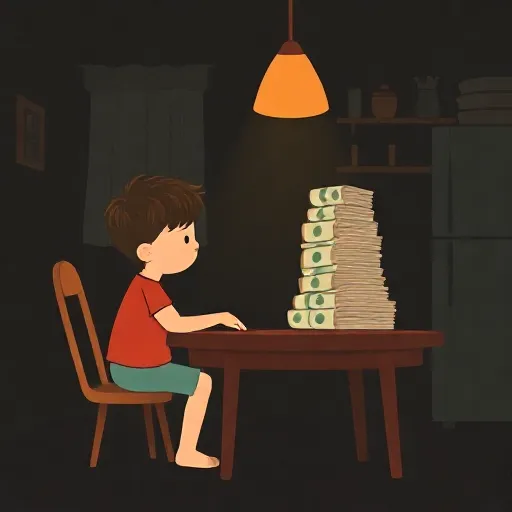
Imagine a billionaire offers you a fortune — stacks of crisp bills — on one condition: you must truly believe that the sky is green. Not just say it, but believe it, deep down, the way you believe that 2 + 2 = 4. Could you do it? Just decide, right now, that the sky is not blue but green, and instantly, genuinely take that as true? If you are like most people, you will feel that you simply cannot. The belief won’t stick, no matter how badly you want the cash.
This puzzle is at the heart of a centuries-old debate in philosophy. It goes by the name doxastic voluntarism — a fancy label for the idea that our beliefs are under our voluntary control, that we can believe at will. “Doxastic” comes from the Greek word for belief. The opposite view, doxastic involuntarism, says we have no such power; beliefs happen to us, they are not actions we perform.
The question matters far beyond billionaires and green skies. If you cannot control what you believe, can you ever be blamed for believing something hurtful or mistaken? Do religions make sense when they ask people to believe certain things? And can you steer your own thinking over time, or are you just a passenger in your mind?
Switches, Doors, and Habits: Different Ways to Control Your Mind
Philosophers have noticed that “control” is not a single, simple thing. One helpful map comes from William Alston (1921–2009). He distinguished several ways we might control something.
Direct control is like a light switch: you flip it and the light turns on immediately, just by deciding. Think of imagining a pink elephant. You can bring that image to mind right now, just like that. This is a clean, sharp kind of control.
Alston also described non-basic immediate control: actions that work right away, if the world cooperates. Flipping a light switch works only if the bulb isn’t blown and the power is on. In the case of belief, if you are holding a book, you can immediately form a belief about the first word on page 3 by opening it and reading — provided the book is there and your eyes work.
Then there is long-range control: the sort of control you have over learning to play guitar or training for a race. It takes time, practice, and many repeated actions. You can, over months, slowly change many of your beliefs by choosing what evidence to seek out, which books to read, whose opinions to listen to. But you cannot do it instantly or guarantee the results.
Finally, Alston noticed indirect influence: your beliefs can be nudged by things you do without even intending to change a belief. If you decide to spend more time with friends who love science, your scientific beliefs might gradually shift — even if you never set out to alter them.
The real fight among philosophers is this: which kind of control, if any, is needed for a belief to count as voluntary? Most think that the heart of doxastic voluntarism is about direct control. Can you ever flip a mental switch and change a belief in a single, immediate act of will? Many answer no — we cannot — and so they hold that beliefs are not voluntary things we do.
Why Many Philosophers Say No: The Involuntarist’s Case

The most famous argument against doxastic voluntarism comes from Alston himself. He simply asks you to try: right now, decide to believe that the United States is still a colony of Great Britain. If you need motivation, suppose someone promises you $500 million to do it. Can you? Alston thinks the answer is a clear, firm no. You can picture it, you can pretend, but you cannot make yourself believe it. Your mind pushes back.
This is the psychological argument for involuntarism. It points to our everyday experience of being stuck with certain beliefs, no matter what we wish. We just seem not to have that direct switch.
A different line of thought appeals to the nature of belief itself. The philosopher Bernard Williams (1929–2003) argued that belief essentially “aims at truth.” When you believe something, you take it to be true. That’s just what believing is. If you could decide to believe the sky is green just because someone paid you, you would have to believe it while knowing that you chose it for a reason that has nothing to do with truth. But then you would, in a way, be believing something you regard as false — and that, Williams argued, is impossible. You can’t genuinely take something to be true and at the same time know it’s only there because you willed it for money. Many philosophers find this idea deeply persuasive: you simply cannot tailor your beliefs to your wishes.
Others, like Holcot in the 14th century and many thinkers since, have insisted that “every man experiences in himself” that he cannot just command himself to believe a proposition when the evidence seems balanced. The mind, they say, is not a tool you can steer with raw willpower in a single moment.
But What If the Evidence Is Fuzzy? Arguments for Voluntarism

Not everyone agrees that beliefs are entirely out of our control. Some philosophers point to situations where the evidence is ambiguous, and more than one conclusion could reasonably be drawn. This is called epistemic permissivism — the idea that sometimes the available reasons do not strictly force one belief; they permit more than one.
Imagine you are on a jury. The case against the defendant is strong but not airtight. The evidence does not scream “guilty” or “not guilty” — it wobbles. In such moments, some philosophers argue, you have a genuine choice. You can deliberate carefully and, at the end, form a verdict that feels like a mental action you performed. Carl Ginet (20th–21st centuries) gave examples like a poker player deciding her opponent is bluffing, or a traveler convincing herself she locked the front door — cases where the evidence is “noncompelling” but you can still settle your mind one way. Blake Roeber (21st century) has argued that when the reasons for belief and for withholding belief are in perfect balance, you can opt for either. In that moment, you might be able to believe at will.
Another line of defense is doxastic compatibilism. The key idea is this: even if your beliefs are fully determined by your personality, your brain, and the reasons you see, they can still count as free in the same way ordinary actions count as free. You cannot run over a mother and child in the street just for money — you find the idea too ghastly. But that does not mean your decision not to run them over is involuntary and forced. It comes from who you are, and it is still you choosing. Matthias Steup (20th–21st centuries) argues that when you weigh reasons and reach a belief, your mind is doing something freely, just as you freely choose to brush your teeth even though you do it automatically and could not easily choose to stop forever. So the inability to believe crazy things does not prove beliefs are not voluntary; it just shows they are anchored in your character.
Some thinkers also explore the power of doubt. Philosophers from Descartes (1596–1650) to Danny Frederick (21st century) have noted that you can decide to question a belief you have. By turning your attention to skeptical possibilities — “What if I dreamed all that?” — you can, sometimes, withhold belief voluntarily. And later you can drop the doubt and believe again. If that works for many ordinary beliefs, it might give you a kind of control.
There is even a startlingly narrow case where believing seems to make itself true. Imagine a perfectly reliable mind-reading machine that will give you $10 only if you believe you will receive $10. Your belief becomes evidence for its own truth. In that unusual laboratory set-up, philosopher Rik Peels (21st century) argues, you really could form a belief at will for a practical reason. But such cases are extremely rare; most of life is not a mind-reading machine.
What Your Beliefs Cost: Responsibility, Faith, and Friendship
Why does all of this matter? Because the question of doxastic voluntarism feeds straight into how we hold one another responsible for beliefs — and even into religious traditions and your own friendships.
If Alston is right that you cannot directly believe at will, then it seems unfair to blame you simply for having a mistaken or prejudiced belief — at least if “ought” implies “can.” But that doesn’t mean you are off the hook. Even hard-line involuntarists agree that you have indirect control over your beliefs over time. You can choose which sources to trust, whether to seek out evidence, how carefully to reflect, and which voices to surround yourself with. These choices, made over weeks and years, slowly sculpt your mind. And that is where responsibility sneaks back in. You may not be able to decide, right now, to stop believing something hurtful, but you can decide to listen to new perspectives, to read differently, to ask hard questions. In that sense, you become the gardener of your own beliefs.
Religious doctrines often ask believers to hold certain convictions — that God exists, that certain events occurred, that a path leads to truth. If doxastic involuntarism is correct and we can never directly choose a belief, then commands to “just believe” seem impossible to obey. Some philosophers reply by shifting the requirement: the core of faith might not be a forced belief but a commitment or a way of living — a will to trust and act as if, which you can choose. Early Christian thinkers like Augustine (354–430) thought the will plays a key role in preparing the mind for faith, even if belief itself arrives gradually through evidence and practice. In Hinduism, too, practice often matters more than precise belief. And in Jewish tradition, actions have frequently held primacy over inner conviction.
The debate also touches something closer to home: your relationships. Suppose you have a friend who never checks facts and always believes the wildest stories. You might feel frustrated — but if belief is involuntary, should you blame them? The small, daily acts of attention (clicking a headline, scrolling past a source you trust, asking “why do I think that?”) start to feel deeply important. You are not a puppet of your beliefs. You are, slowly, choosing what sort of thinker you will grow up to be.
Think about it
- If a classmate believes something cruel about another person just because they heard a rumor, is it fair to blame them for that belief? Why or why not?
- Suppose you know that spending time with a certain group of friends will slowly change your opinions in ways you do not want. Do you have a responsibility to spend less time with them, or is it okay because beliefs are not something you directly control?
- If a computer someday could perfectly predict all your future beliefs based on your brain, would that mean you never really choose what to think? Does being predictable take away responsibility?