
Do You Know What You Believe? The Puzzle of How Our Thoughts Connect
The Detective’s Dilemma: Sorting Clues in Your Mind

You are a detective. A witness tells you she knows the thief’s identity. But later you discover she only believes it — she saw a blurry figure in the dark. What’s the real difference between knowing and believing? And what happens when you try to think about both at the same time?
Philosophers have spent centuries studying different modalities — particular ways of describing a statement’s status. “Necessary” and “possible” are one kind. “Known” and “believed” are another. “Obligatory” or “permitted” add still more. Each modality has its own logic. Multi‑modal logic is the tool that lets us mix these modes together and study how they interact. Sometimes the combinations are neat and tidy. Other times they produce puzzles that force us to re‑examine our most basic assumptions about the nature of thinking.
Necessity and Possibility: The First Connected Pair
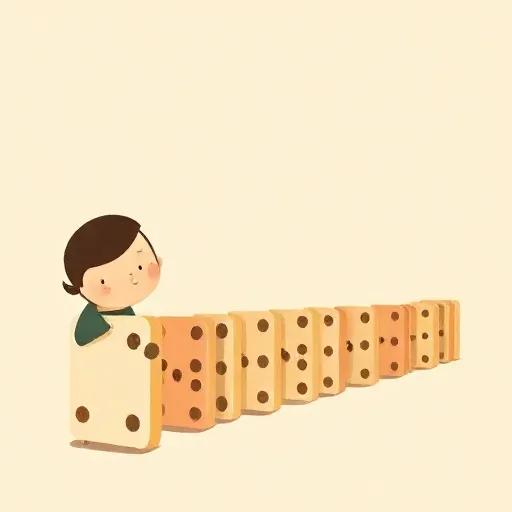
The simplest case of two modalities linking together is necessity (something must be the case) and possibility (something might be the case). In the most common logical system, these two are like two sides of the same coin: “necessary” can be defined as “not possible not,” and “possible” as “not necessary not.” If it is necessary that it’s raining, then it is not possible that it isn’t raining.
This seems harmless, but already a big philosophical choice is hiding. In classical logic those definitions work perfectly. Yet in a different kind of logic — intuitionistic logic, which asks you to build proof rather than just rely on “either true or false” — the connection breaks. From “it’s not true that everything makes the statement false” you cannot jump to “there exists a possibility where the statement is true.” Just because not every scenario rules out rain doesn’t guarantee a scenario where rain actually happens. So even the most basic pair of modalities already forces us to decide what we think possibility really means.
When Believing You Know Backfires

Now imagine mixing epistemic logic (the logic of knowing) with doxastic logic (the logic of believing). Many philosophers once thought knowledge could be defined as “true belief plus a justification.” But in 1963, Edmund Gettier (1927–2021) showed with a clever example that you can have a justified true belief and still not really know — your justification might be a lucky accident.
Even without that complication, simply joining the logics creates trouble. Suppose you use a strong standard logic for knowledge (the S5 system, which says knowledge is always true, and you can introspect about what you know) and a standard logic for belief (KD45, which requires beliefs to be consistent). Add the reasonable bridge principle that knowing implies believing. Now imagine a person who believes she knows something — say, believes she knows who committed a crime — but actually does not know it. Using the formal rules alone, the logic forces out a contradiction: the person would end up believing a contradiction, which is impossible for a consistent believer.
In the 1990s, Dutch logician Frans Voorbraak pinpointed this as the paradox of the perfect believer. Something has to give. Perhaps we should drop the idea that knowledge always implies belief. Or allow that people can have inconsistent beliefs after all. Or else weaken what we mean by “knowledge” itself. In plausibility models later developed by Alexandru Baltag and Sonja Smets, a weaker type of knowledge — indefeasible knowledge, which cannot be overturned by any true information — avoids the paradox while still doing serious logical work. The lesson: mixing modalities forces hard choices about the concepts themselves.
Should You Know What You Owe?

Another startling interaction arises when we fuse deontic logic (the logic of obligation and permission) with epistemic logic. A classic puzzle goes like this: A bank is being robbed. The guards ought to know about the robbery. In symbols, O(K r). But knowledge is factive — if you know something, that something is true. So K r implies r. Combine these, and you seem to get O(r): the bank ought to be robbed! That makes no sense.
This is the paradox of epistemic obligation. It shows that simply joining “ought” and “know” with standard rules produces unacceptable results. The exact solution is still debated. One proposal says an obligation only applies when the agent knows about it. Another says obligations can be “knowledge‑based”: you are obliged to act only if you know that the act is good, and that obligation disappears when you learn contrary information. Whatever the answer, the paradox forces us to carefully connect our ideas about duty and awareness.
Why It Still Matters: Logic in Everyday Life

Multi‑modal logic is not just a game for ivory‑tower philosophers. The puzzles above echo situations you face every day. When you hear a rumor, you must separate what you know from what you merely believe. When a friend says “you ought to help me,” you have to figure out whether that duty depends on what you knew at the time. These distinctions matter for real decisions.
There is also a broader surprise. In the 1960s, logician Frederic Fitch uncovered an argument showing that if every true statement were knowable in principle, then every true statement would already be known. But we are not all‑knowing, so not every truth can be known — even in principle. That result comes from carefully combining the logic of possibility and the logic of knowledge. It teaches us that the way our thoughts connect actually limits what we can ever hope to learn.
Multi‑modal logic gives us the tools to study these connections clearly. By building formal systems and testing what they prove, philosophers can spot hidden contradictions and refine our deepest concepts — knowledge, belief, duty, time, and possibility — so we can think more honestly about the world.
Think about it
- Suppose you think you know something, but your reason turns out to be just a lucky guess. Does that really count as knowledge? Why or why not?
- If you have a responsibility to help a friend in trouble, but you honestly don’t know they need help, are you still responsible? Try to think of a real‑life example.
- Can you imagine a world where every single truth is known by someone? What would that world look like — and would it be a good place to live?