
How Can You Know Something If You Can’t Tell What’s Real?
Zoe’s Chicken Problem: What Do You Really Know?

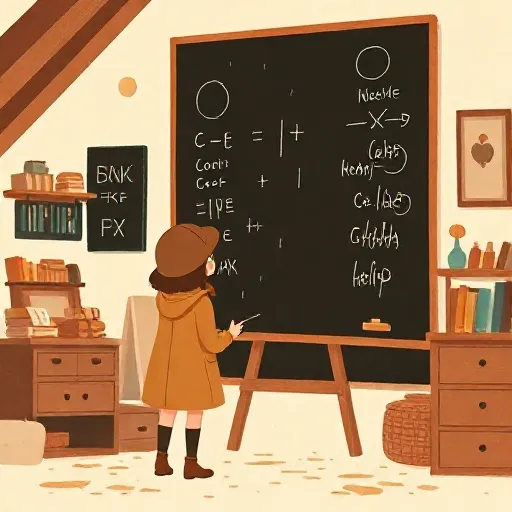
Zoe is standing by her back door. She can’t see the yard, but she can hear perfectly. The hens are clucking—she’s sure of that. The dog, though, never makes a sound. So even if a dog were there, she would not know. She has to feed the hens, but she refuses to step into the yard if a dog is present. All Zoe really knows is that one of two situations is true: only a hen or both a hen and a dog. Both feel equally possible. She cannot tell them apart.
Philosophers call this a problem of indistinguishability. When two possible ways the world could be look exactly the same from your point of view, you can’t know which one is actual. The study of what we can know, given what we can and can’t distinguish, is the heart of epistemic logic — the logic of knowledge and belief.
Epistemic logic began in earnest in the 1950s, when G.H. von Wright (1916–2003) showed that sentences about knowing could be treated like mathematical formulas. Jaakko Hintikka (1929–2015) took this further in his 1962 book Knowledge and Belief, where he introduced the powerful idea of possible worlds as a way to give knowledge a precise meaning. Since then, philosophers, computer scientists, and economists have used these tools to understand everything from traffic lights to artificial intelligence.
Possible Worlds: The Map of Everything That Could Be

Think of a possible world as a complete snapshot of how things might be. In Zoe’s tiny universe there are only two things that matter: whether a hen is present (call that p) and whether a dog is present (call that q). Because each can be true or false independently, there are exactly four possible worlds: one with both, one with just the hen, one with just the dog, and one with neither.
Zoe’s hearing gives her information: she always hears the hen, so she can rule out any world where the hen is absent. That leaves two worlds. But she cannot tell those two apart — the dog might be there or not. In epistemic logic we draw arrows between worlds to show which ones are accessible from which. A world w′ is accessible from a world w if everything the agent knows in w is still true in w′. Here, from the world where only the hen exists, Zoe considers both the “hen only” world and the “hen + dog” world as possible. The relation is reflexive (every world is accessible to itself) and symmetric (if one is accessible, so is the other), but it is not transitive in all cases.
We can now say exactly what it means to know a proposition φ: φ is known if and only if φ is true in every world accessible to the agent. In Zoe’s case, p (the hen) is true in all her accessible worlds, so she knows p. But q (the dog) is false in one of them, so she does not know q. This definition captures the intuition that knowledge rules out uncertainty.
Epistemic logicians write “K_a φ” to mean “agent a knows that φ.” The semantics uses Kripke models, named after the logician Saul Kripke. A model is a set of worlds, a relation that says which worlds an agent can’t distinguish, and a valuation that says which atomic facts hold at each world. The whole machinery lets us represent not just what Zoe knows, but also what she knows about what she knows — and so on.
The Mirror Test: Do You Know What You Don’t Know?

Once you have a model, you can ask which general principles of knowledge hold for all agents. Three principles have been especially controversial.
- Veridicality (T): If you know φ, then φ must be true. (K_a φ → φ.) Almost everyone accepts this — you can’t know a falsehood.
- Positive introspection (4): If you know φ, then you know that you know φ. (K_a φ → K_a K_a φ.)
- Negative introspection (5): If you don’t know φ, then you know that you don’t know φ. (¬K_a φ → K_a ¬K_a φ.)
These principles correspond to properties of the accessibility relation. T requires the relation to be reflexive (every world sees itself). 4 requires it to be transitive (if world A sees B and B sees C, then A sees C). 5 requires it to be Euclidean (if A sees both B and C, then B and C see each other). A logic that includes all three is called S5, and it is very powerful: agents know everything about their own knowledge.
Many philosophers think S5 is too strong for real human knowers. Hintikka himself rejected 5, arguing that when you learn something new, some worlds that were once possible become impossible — so the relation is not symmetric. If you start with a small amount of information and later gain more, the earlier world doesn’t see the later one as equally uninformed; therefore 5 fails. Others have defended S5 for an idealized concept of knowledge, the kind we might want to program into a computer.
One big worry that arises from this formal approach is the problem of logical omniscience: if you know a fact, should you automatically know every logical consequence of that fact? The standard semantics says yes, because if φ is true in all accessible worlds, and φ logically implies ψ, then ψ is also true in all those worlds. Real people obviously don’t know all the logical entailments of what they know — we are not logically omniscient. That mismatch has spurred many alternative models.
When Belief Isn’t Truth: The Logic of Maybe

Alongside knowledge, epistemic logic studies belief. We use “B_a φ” for “agent a believes that φ.” Unlike knowledge, belief does not have to be true — you can believe something that happens to be false. However, most philosophers agree that beliefs should be consistent: you should not believe a flat contradiction (like “it’s raining and it’s not raining”). This requirement is captured by the principle D: B_a φ → ¬B_a ¬φ. On Kripke models, requiring D means that every world has at least one accessible world through the belief relation — you never believe something that is impossible in all scenarios.
A widely used system for belief is KD45, which adds to D the principles 4 (positive introspection for belief) and 5 (negative introspection for belief), but does not demand truthfulness. That mirrors the idea that our beliefs about what we believe are reliable, even if our beliefs about the world sometimes aren’t.
Combining knowledge and belief can lead to puzzles. If you accept that knowledge implies belief (K_a φ → B_a φ) and also that whatever you believe, you believe you know it (B_a φ → B_a K_a φ), then in certain logics knowledge and belief collapse into the same thing. Most philosophers avoid this by tweaking the interaction principles or by choosing weaker logics for knowledge or belief. The debate is still open.
The Traffic Light Riddle: Why We All Need to Know the Same Thing
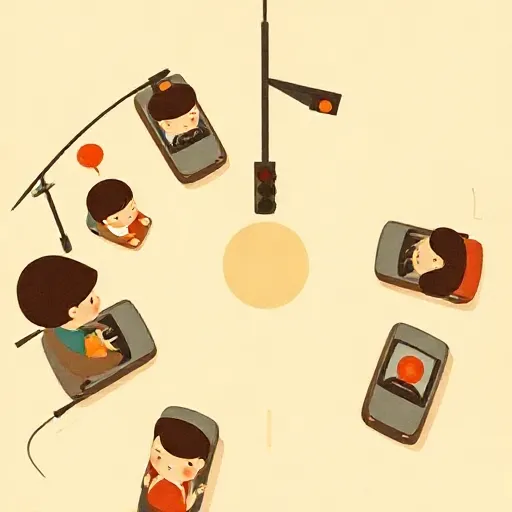
You stop at a red light because you know what it means. But traffic lights work only because of something deeper: common knowledge. You know the rule, but you also know that the other drivers know it, and you know that they know that you know it — and so on forever. The philosopher David Lewis (1941–2001) showed that many social conventions, from language to queuing, rely on this infinite cascade of mutual knowledge.
Epistemic logic captures this with a special operator C_G φ: it is common knowledge among group G that φ. Semantically, C_G φ is true when φ holds in every world reachable by following any chain of accessibility relations belonging to the agents in the group. In a two-car intersection, the world where both drivers intend to stop is linked to worlds where they don’t — but if they share common knowledge of the rule, those “wrong” worlds are cut off.
A related but different concept is distributed knowledge. The group G has distributed knowledge of φ if, by pooling everything each member knows individually, they could deduce φ — even if none of them knows it alone. Imagine you know only that it’s raining or not raining (you know nothing about which), and your friend knows it’s not sunny. Together you can figure out that if it’s not sunny it might be raining, but the formal tools let you pin down what combination yields a new fact.
Beyond Facts: Knowing How and Knowing Who

So far we have looked at knowing-that — knowing that a proposition is true. But everyday language is full of other kinds of knowledge: knowing who someone is, knowing how to ride a bike, knowing why something happened. Hintikka argued that “knowing who Mary is” means there is some person x such that you know that x is Mary. That reduces a know-who to a know-that plus an ability to identify an individual.
Know-how is trickier. Some philosophers treat it as a hidden know-that (you know that a certain method works), but recent logical work models know-how as a distinct notion. For example, imagine Doctor 1 knows how to let Doctor 2 know how to cure a patient, even though neither doctor alone knows how to cure the patient. This kind of planning requires a richer formal language with actions and strategies. Logics of know-how are now used to design intelligent systems that reason about what agents can achieve, not merely what facts they possess.
These extensions show epistemic logic moving closer to the way we actually use the word “know” — not just as a label on a proposition, but as a guide to what we can do.
Why It Matters: Secrets, Surprises, and Smart Computers

Every time you try to keep a surprise secret, you’re thinking about what others know. When you wonder whether a friend figured out your plan, you’re asking higher-order questions: “Does she know that I know she’s planning something?” Epistemic logic sharpens these everyday thoughts into a precise language.
Computer scientists use the same tools to build secure communication systems. When two phones send encrypted messages, they rely on distributed knowledge about secret keys and common knowledge about how the protocol works. The logic helps verify that no outsider can learn the secret, even if they intercept the signals. Game theorists apply it to understand negotiation and strategy: what you can achieve depends on what you know about the other players’ knowledge.
By starting with a simple image — Zoe at her door, unable to tell two worlds apart — epistemic logic opens a way to study the structure of knowledge itself. It shows that knowing is not just a private sensation. It is a map of the possibilities you are forced to live with, and of the social fabric that ties those maps together.
Think about it
- If you could perfectly predict what your best friend would do next, would you still say she “knows” her own choices, or would something be missing?
- Imagine you and a stranger both see an accident. You don’t know what the stranger saw. Can the two of you ever reach common knowledge about what really happened? What would it take?
- Is knowing how to tell a good joke the same as knowing a list of facts about humor? Could a computer ever really know how to make someone laugh?