Why Is 'Green' More Real Than 'Grue'?
Carving the World at Its Joints
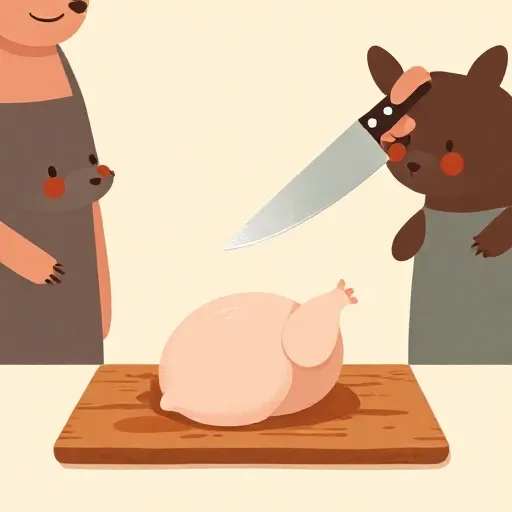
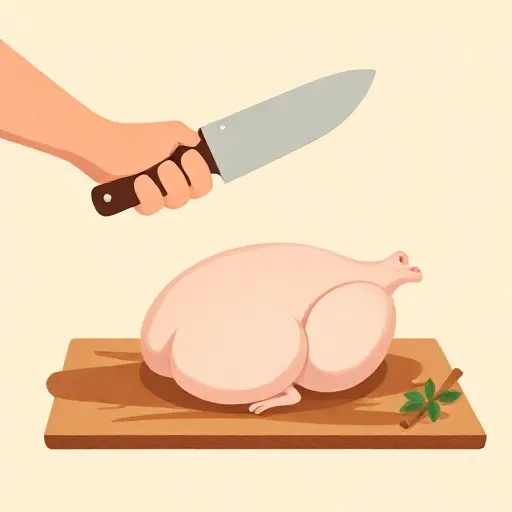
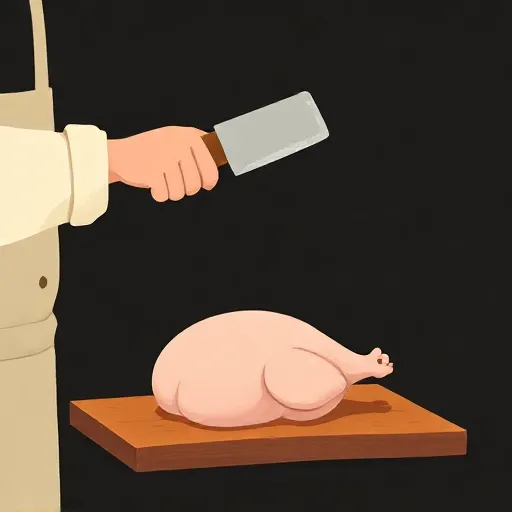
Imagine a butcher preparing a chicken. A good butcher cuts where the bones meet—the natural joints. A sloppy butcher hacks through bone, making a mess. Over two thousand years ago, Plato (c. 428–348 BCE) used this image to explain how we should define things in philosophy. We ought to divide the world “where the natural joints are, and not try to break any part, after the manner of a bad carver.” In other words, some ways of sorting things are better than others.
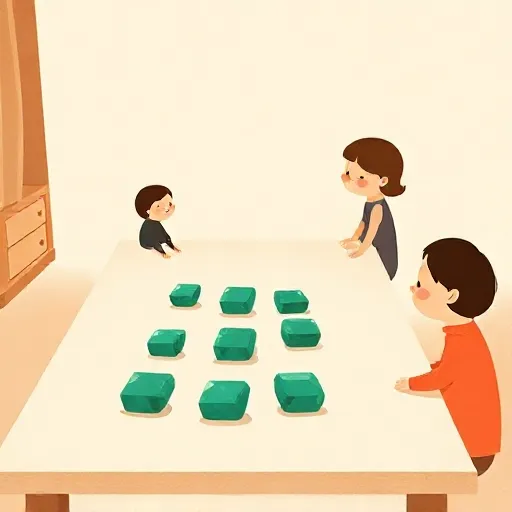
Take colors: ‘green’ groups things that look similar. But consider a strange word like ‘grue’, invented by philosopher Nelson Goodman (1906–1998). An object is grue if it is green and observed before some future time t, or blue and not observed before t. All the emeralds we’ve seen so far are green, so they’re also grue. Yet nobody thinks ‘grue’ picks out a real kind of thing. It feels artificial, like a bad carving. But why? What makes ‘green’ a better category than ‘grue’? The answer might be that green is a more natural property—it carves reality at a genuine joint. The idea that some properties are more natural than others is the central topic of this article.
David Lewis and the Perfectly Natural
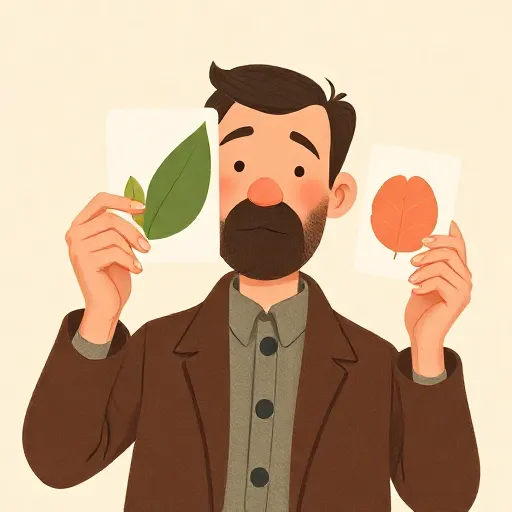
The philosopher most closely associated with naturalness is David Lewis (1941–2001). He didn’t invent the idea; he credited David Armstrong (1926–2014) for convincing him that it was “commonsensical and serviceable.” But Lewis turned it into a powerful tool for explaining many different puzzles.
Lewis proposed that properties (ways things can be, like being green, being negatively charged, being a cat) can be ranked by how natural they are. At the top are perfectly natural properties—the fundamental joints of reality. They are all equally natural, and nothing is more natural than them. Lewis also called them “fundamental” properties. He thought that if you described which things have each perfectly natural property, you would in principle describe the whole world completely.
What are these perfectly natural properties? Lewis admitted we don’t yet know for sure. He looked to physics as the best guide; maybe properties like mass, charge, and spin are perfectly natural. But the project is tied up with deep debates. A dualist about the mind might say that conscious experience is a perfectly natural property, not reducible to physics. A moral realist might say goodness is perfectly natural. So identifying the perfectly natural is a bold hypothesis about what reality’s basic furniture is.
Lewis also had a way to compare degrees of naturalness beneath the top. He suggested that one property is more natural than another if it has a shorter and less complex definition in terms of perfectly natural properties. Imagine a language whose only simple words name the perfectly natural properties. Then the more natural properties are the ones you can describe with fewer, simpler words. For example, if being next to something charged takes a simpler definition than being next to something uncharged that is next to something charged, then the first property is more natural. This is called the simplicity-of-definition idea.
How to Measure Naturalness
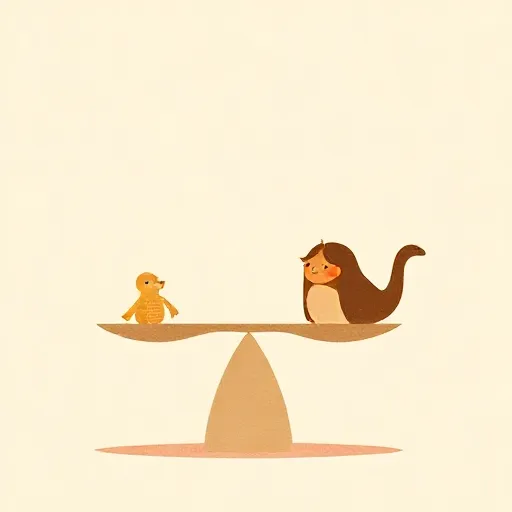
The simplicity-of-definition approach gives us a rough measuring stick. But philosophers have raised worries. One big problem, noted by Theodore Sider (born 1967) and others, is that many ordinary properties might have infinite definitions in terms of the perfectly natural ones. If green and grue both need infinitely long definitions, then they’d come out equally natural, which seems wrong. Lewis would reply that the length and complexity of definitions is still a good rule of thumb, even if it doesn’t always give perfect scores.
There’s a deeper issue. To make definitions work, we need to be careful about what counts as a property. Some philosophers think that necessarily equivalent properties are identical. For instance, being (F) and being (F)-and-(G)-or-not-(G) might be the same property if (F) and (G) always co-vary. If that’s true, then the “definition” trick collapses because any property can be defined in trivially complex ways. So defenders of naturalness often need a more fine-grained view of properties, where being green and being green-and-not-a-donkey are different properties. Building such a theory is tricky and leads to paradoxes, but many think it’s worth the effort.
Despite these difficulties, the rough idea is powerful: there is a real difference in naturalness between green and grue, and between being charged and being charged-and-not-a-donkey.
Why It Matters: Similarity, Laws, and Magnets
Why should we care about naturalness? Because it connects to many big ideas. First, similarity. Two things are similar, Lewis said, when they share natural properties and are divided by few natural ones. That makes sense: two green apples are more alike than a green apple and a grue one. Without naturalness, any two objects share infinitely many properties, so why are some pairs more similar? Naturalness gives a standard.
Second, laws of nature. Lewis offered a famous analysis of what makes something a law. A law is part of the simplest, strongest true system of statements. And simplicity here depends on naturalness: you get a simpler system if you use predicates that refer to perfectly natural properties. So the laws that physics discovers are likely stated in terms of very natural properties. This is why ‘(F = ma)’ seems better than a gruesome alternative.
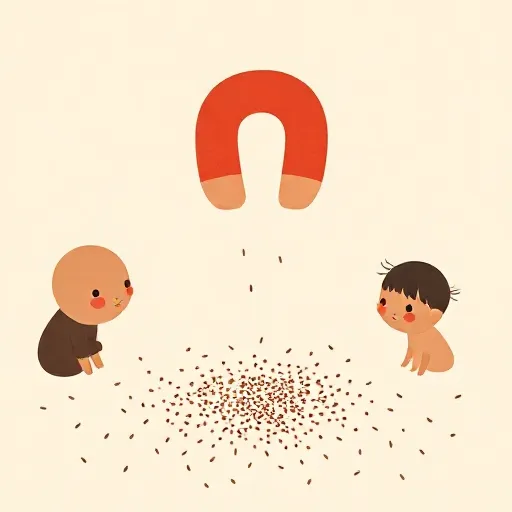
Third, reference—how our words hook onto the world. Lewis called natural properties “reference magnets.” The more natural a property, the easier it is for a community to end up using a word to refer to it. For example, it’s much easier for a word to latch onto the property being green than onto being grue. This explains why, across languages and cultures, basic color terms pick out similar ranges: those ranges are natural joints. This idea also helps solve a puzzle: how do we know we’re talking about rabbits and not “undetached rabbit parts” or “temporal stages of rabbits”? The more natural candidate wins out.
All these roles make naturalness a workhorse. But there’s another classic argument: the problem of grue and induction.
The Grue Puzzle: Why We Can Predict Green but Not Grue
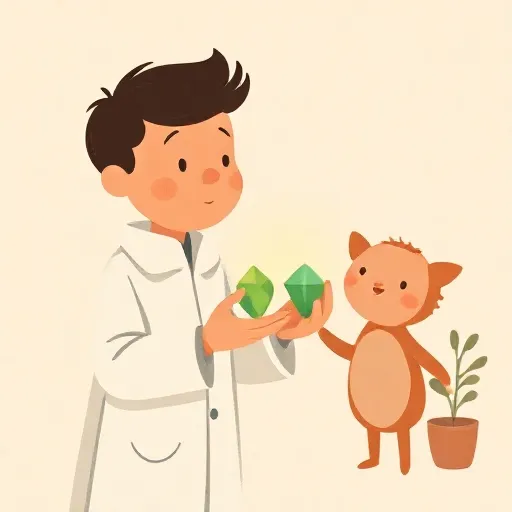
Goodman introduced ‘grue’ to challenge our understanding of scientific reasoning. Suppose you examine many emeralds before time (t), and all are green (and therefore grue). You confidently predict the next emerald will be green. But you wouldn’t predict it will be grue—because after time (t), grue things are blue, so if you predicted grue, you’d be saying the next emerald might suddenly be blue. That seems irrational. But what makes the green prediction rational and the grue prediction irrational? Goodman called this the new “riddle of induction.”
Many philosophers think the answer involves naturalness. Green is projectible—you can rationally project it from observed cases to unobserved ones. Grue is not projectible. One proposal: a property’s degree of projectibility matches its degree of naturalness. Since grue is less natural (its definition is more complex), it isn’t projectible. So we should trust generalizations about more natural properties. This links naturalness directly to how we should think and learn.
There’s also a value twist. Some philosophers argue that it’s better to know truths about natural properties than about unnatural ones. Learning the mass of a neutrino seems more worth knowing than memorizing a phone book, even if both are true. Naturalness may be a second aim of belief, alongside truth. This is controversial, but it suggests that which categories we carve matters for what knowledge is worth having.
Doubts and Open Questions
Not everyone agrees that there is a real ranking of naturalness. Some philosophers think that no property is more natural than any other. They suspect that talk of “joints” is just a metaphor that doesn’t withstand scrutiny. One worry: the many roles Lewis assigned to naturalness—similarity, lawhood, reference, projectibility—may not all be satisfied by the same ranking. Maybe the properties that make for the best laws are not the ones we refer to most easily. If no single ranking fits all roles, then saying “this property is more natural” might be ambiguous or confused.
Another concern is that naturalness might be vague or mind-dependent. Maybe it’s just a reflection of our interests or habits, not an objective feature of the world. However, even if the rankings are not perfectly precise, they might still be useful. And defenders note that without some notion of naturalness, it’s hard to explain why green is easier to learn, remember, and communicate than grue.
The debate remains lively. Instead of asking “are some properties more natural?” in one big swoop, many now examine whether specific groups of roles can be satisfied simultaneously. This shifts the conversation from a simple yes/no to a more nuanced investigation. In the end, the idea of natural joints still grips philosophers because it touches everyday experience. When you sort toys into “things that go together” — blocks with blocks, cars with cars — you might be feeling for real similarities. But is that feeling reliable? Is there a right way to sort? Next time you organize your stuff, you’re doing a little metaphysics.
Think about it
- If you had to sort a big pile of random objects, what rule would you use? How would you argue that your sorting is “better” than someone else’s?
- Imagine an alien species that finds ‘grue’ a perfectly natural category and ‘green’ weird and artificial. Could we convince them they are wrong? What would that argument even look like?
- Suppose we discovered that what we call “jade” is really two different minerals, jadeite and nephrite. Does that change how natural the property of being jade is? Why or why not?