Is a Ship Still the Same Ship After Every Plank Is Replaced?
The Ship in the Harbor

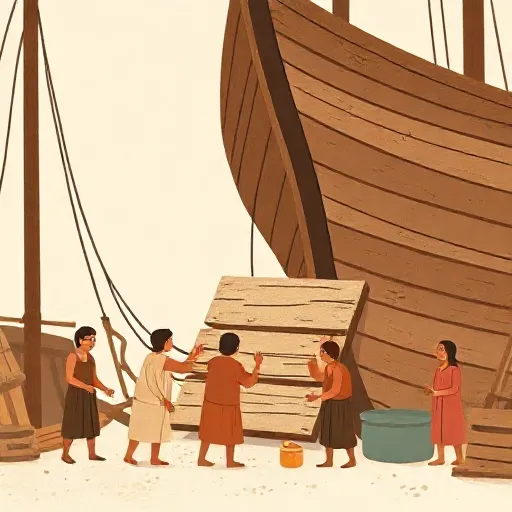
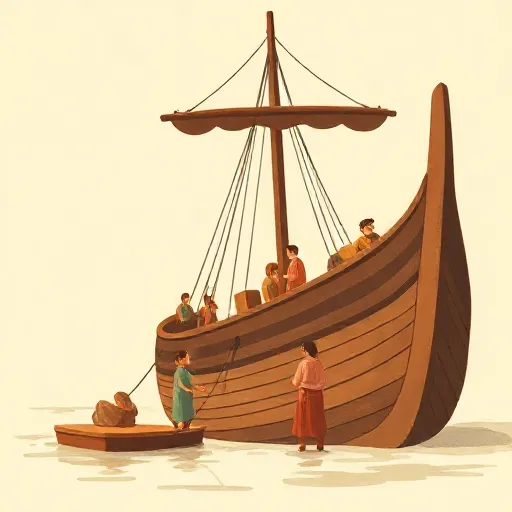
Plutarch, an ancient Greek writer, tells a story that philosophers still argue about today. The hero Theseus sailed back to Athens in a famous ship, and the city kept that ship on display for hundreds of years. As planks rotted, workers replaced them one by one, until eventually not a single original piece of wood remained.
Was it still the Ship of Theseus?
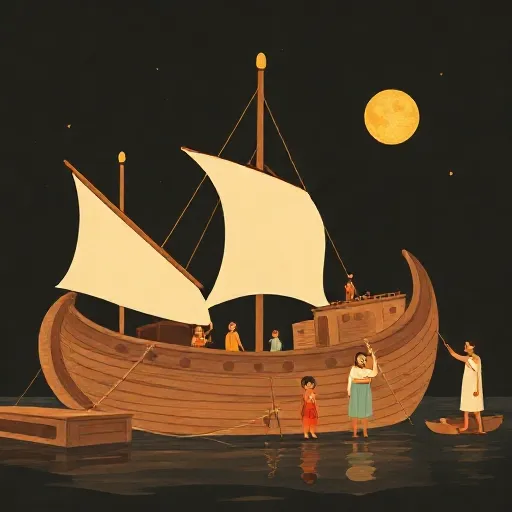
In the 17th century, the English philosopher Thomas Hobbes (1588–1679) added a twist. Imagine that a careful keeper collected all the original planks as they were removed. Years later, he reassembled them exactly as they had been. Now you have two ships — one in the museum, one with the collector. Which one is the real Ship of Theseus? If you point to both, you are saying the same ship is in two places at once. If you say both were always there from the start, then two ships occupied the same spot at the same time.
This is not just a riddle about boats. It is the puzzle of material constitution: what makes a material thing the very thing it is, even as its parts change? And if it changes completely, does it survive at all?
The Lump and the Statue
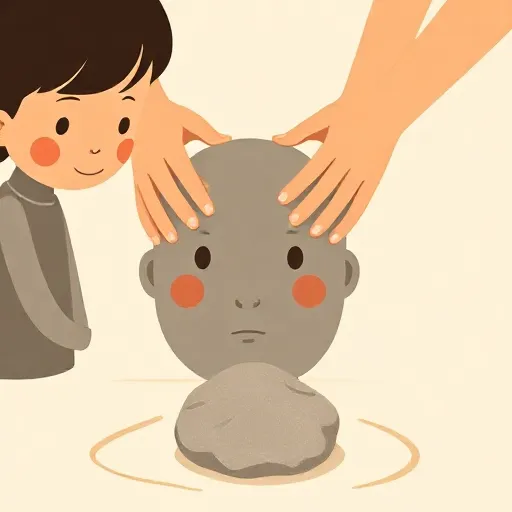
Ancient philosophers like Aristotle already noticed a simpler version of the puzzle. Imagine a sculptor on a Monday with a shapeless lump of clay, whom she calls Lump. On Tuesday she molds that same clay into a statue of King David and calls it David.
You might say David just is Lump — one object, two names. But look closer. Lump existed on Monday; David did not. Lump can survive being squashed into a ball; David cannot. According to Leibniz’s Law, if two things are genuinely identical, they must share all the same properties. Since Lump and David differ in what they can survive and when they began, they cannot be identical. Yet they fill exactly the same space at the same time. That seems impossible.
The puzzle puts us in an uncomfortable spot. We want to say there is one object there. But the logic pushes us toward saying there are two objects occupying the same place — a lump of clay and a statue, distinct but coincident. How do philosophers get out of this tangle?
“Yes, Two Things in One Place”

The most popular answer today is simply to accept the conclusion: Lump and David are two different things that share the same matter at the same time. Philosophers call this the constitution view, and it has been defended by thinkers like David Wiggins (20th century) and Lynne Rudder Baker (20th–21st century). Their slogan: constitution is not identity. The lump constitutes the statue, but it is not the same thing as the statue.
An obvious objection hits you immediately. Try walking through a wall — two solid things cannot be in the same place at once! Constitution theorists reply that David and Lump are not like you and the wall. They share exactly the same parts, which explains how they can coincide. And when you put them on a scale, they do not weigh twice as much, because you would be counting the same matter twice, just as you would not weigh a wall by adding up the weight of every brick and every molecule separately.
But a deeper worry remains. If David and Lump are exact duplicates — down to every atom — what makes them different? Why can one survive squashing and the other cannot? Defenders of the view often point to kinds: David is a statue, and statues cannot survive squashing. Lump is a mere lump of clay, and lumps can. Yet you might still wonder: if two things are exactly alike in every physical detail, how can they belong to different kinds at all? This is called the grounding problem, and it keeps constitution theorists busy.
“They Are Different Time-Slices of One Thing”

Another influential answer comes from the temporal parts theory, often defended by David Lewis (1941–2001). Think of a highway, like Interstate 5, that runs through several states. The road does not sit entirely in any one state; it has a Washington segment, an Oregon segment, and so on. Lewis suggested that objects exist through time in the same way — by having different temporal parts at different times.
On this picture, the lump of clay exists for a long stretch, and the statue exists for only a short segment within that stretch. The statue is a proper temporal part of the lump, just as a street in Charlotte might be a proper spatial part of a longer highway. When both exist, they share a single temporal part, so there is no mystery about two whole objects crammed into the same space. The impenetrability worry disappears.
But the temporal parts view also multiplies objects in its own way. If any collection of temporal parts makes an object, then alongside the statue you have objects like the instatue (which exists only when the statue is indoors) and the litstatue (which exists only when it is in the light). Some philosophers think this is an acceptable explosion of reality; others find it wildly implausible. For Lewis, the real power of the view is that it gives a tidy answer to the grounding problem: the lump and the statue differ because they have different temporal parts overall, even if they coincide for a while.
“Maybe Some of These Things Don’t Exist”

What if the whole puzzle rests on a mistake? Some philosophers, like Peter Unger (20th century) and Peter van Inwagen (b. 1942), have proposed eliminativism — the idea that certain ordinary objects simply do not exist. Unger at one point defended mereological nihilism, the view that there are no composite objects at all. Only microscopic simples exist. There are no statues, no ships, no lumps of clay. There are only simples arranged statue-wise.
If that sounds shocking, eliminativists reply that we can still make sense of everyday talk. “There is a statue on the table” just means “there are simples arranged statue-wise on some simples arranged table-wise.” Van Inwagen takes a milder path: living beings are the only composite objects. So you exist, but a statue or a lump does not. This avoids the puzzle, but many philosophers find it hard to believe that a cat is a real whole while its tail — before it is detached — is not a real part.
Eliminativism faces a challenge of its own: if there are no composite objects, what about you? Can we make sense of a person as just a cloud of simples? The view pushes us to ask whether we are really more than the tiny bits that make us up.
Why This Mess Matters to You

It is tempting to think this is all an ancient puzzle about mythical ships and blocks of clay. But it touches your life directly. The Debtor’s Paradox, from the playwright Epicharmus, gets at the heart of it. A man refuses to pay a debt, arguing that he is not the same person who borrowed the money because his body’s matter has changed. His creditor responds by hitting him — and then claims he cannot be blamed, since he too is a different person now. The joke is sharp, but the question is real: if all your cells are replaced over years, are you still the same person? Can we hold people responsible for promises made by their earlier selves?
Some philosophers, like Rudolf Carnap (1891–1970) and more recently Eli Hirsch (20th–21st century), think the whole debate comes down to a verbal dispute — a fight about words, not facts. Maybe “exist” means different things in different philosophical languages, and there is no right answer. If so, the Ship of Theseus puzzle fades into a choice of how to speak, rather than a discovery about the world.
But even if the dispute is verbal, the experience of change and persistence is not. You feel like the same person who started reading this sentence. Your friendships, your promises, and your plans all rest on the idea that things and people survive change. Philosophy may not settle the Ship of Theseus once and for all, but it gives you the tools to wonder — and to know why the question is worth asking.
Think about it
- If every atom in your body were replaced over ten years, would you still be you? What makes you the same person at different times?
- Imagine someone destroys a famous painting and then repaints it exactly, atom for atom. Is it the original artwork or a copy?
- If two people disagree about whether a reconstructed ship is really the original, could both be right? What does “really” mean here?