Is the Ship Still the Same Ship After Every Plank Is Replaced?
The Ship That Changed Every Plank — and Stayed the Same?
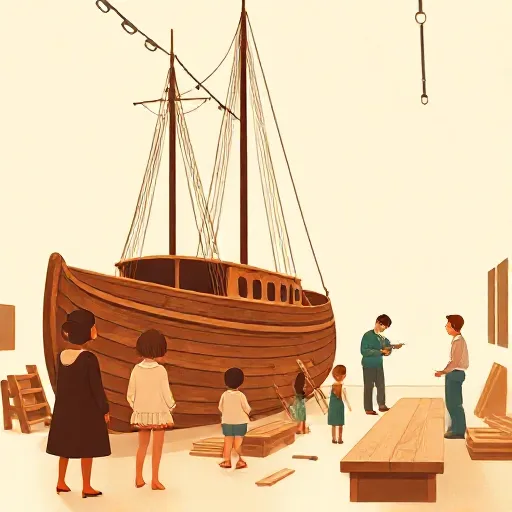
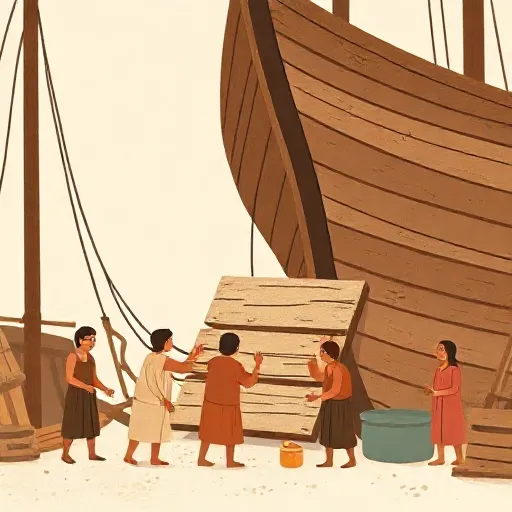
In a museum in Athens, there is a ship. According to legend, the ancient hero Theseus sailed it back from Crete. Over the centuries, every plank, every nail, every rope was replaced as it rotted. By the end, not a single original piece remained. Was it still the same ship?
At first, the answer seems obvious. It has the same name, the same shape, the same history. If you look at it, you point and say, “That’s the ship.” But suppose a clever curator collected all the original planks as they were removed, stored them in a warehouse, and later reassembled them into a second ship — identical piece for piece with the original. Now which one is the real Ship of Theseus? The one whose material was gradually swapped out, or the one rebuilt from the discarded parts?
This ancient puzzle is not just about boats. It gets to the heart of a question that has puzzled philosophers for more than two thousand years: what does it mean for something to remain the same thing over time, even when it changes? That question is about identity through time — also called diachronic identity. It asks how a person, an object, or even an idea can survive alteration and still be itself. If you cut your hair, move to a new town, and forget your first day of school, are you still the very same person you were at six? Your answer to that question shapes how you think about promises, responsibility, and who you really are.
Leibniz’s Law: If Two Things Are Identical, They Share All Their Properties
To tackle puzzles like the ship, philosophers first need a clear idea of what identity is. The German thinker Gottfried Wilhelm Leibniz (1646–1716) gave us one of the most important tools: a principle now called Leibniz’s Law or the Indiscernibility of Identicals. It says that if a and b are truly and completely the same thing, then any property of a is also a property of b, and the other way around. If your left shoe has a grass stain, and your right shoe does not, they cannot be the identical shoe. No two distinct things can be exactly alike in absolutely every respect.
That seems simple, but trouble brews when things change. A metal plate can be round on Monday and square on Tuesday. If it is round at one time and square at another, how can the very same plate have two incompatible properties? You might respond: no problem; it has them at different times. But what does it mean to have a property at a time? For Leibniz’s Law, if the Monday plate is identical to the Tuesday plate, then whatever is true of the Monday plate must be true of the Tuesday plate — including being round. But the Tuesday plate is not round. Suddenly, change itself looks like a violation of Leibniz’s Law.
This difficulty is what philosophers call the problem of temporary intrinsics. An intrinsic property is a feature something has all by itself, like its shape or its mass, not a feature that depends on other things (like being taller than your friend). A plate’s shape is an intrinsic property, yet it can change. If we cannot explain how one and the same thing can bear incompatible intrinsic properties at different times, we are stuck.
The Cup, the Handle, and the Problem of Parts
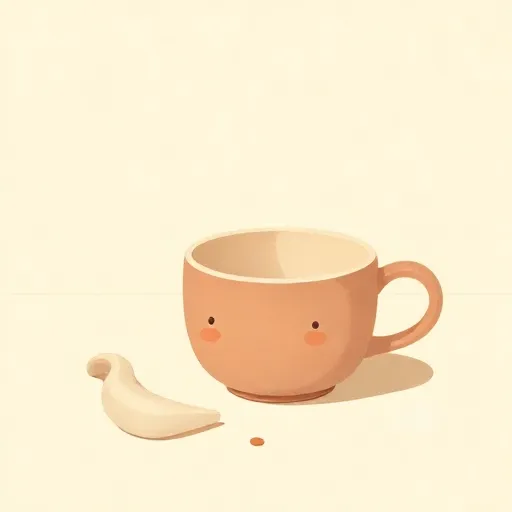
Some of the trickiest identity puzzles involve not just properties like shape, but physical parts. Imagine a favorite mug — call it Cup. At breakfast, Cup has a handle. Call the rest of Cup without the handle Tcup (the truncated cup). At breakfast, Tcup is a proper part of Cup: Cup and Tcup are clearly two different things, because Cup has a handle and Tcup does not. Later that morning, you accidentally knock Cup against the table and the handle breaks off. Now Cup and Tcup occupy exactly the same space, made of exactly the same atoms. They are as alike as two peas in a pod.
If you say that after the accident Cup and Tcup are one and the same object, you run into trouble with Leibniz’s Law. After the accident, Cup has a property that Tcup never acquires: the property of having once had a handle that morning. That historical property distinguishes them, so they cannot be identical. Yet it seems deeply unnatural to say that Cup vanished and a new object (Tcup) popped into existence the moment the handle cracked. This clash is a classic case of apparent temporary identity — the idea that a and b are identical at one time but not at another. Most philosophers reject temporary identity exactly because it seems to violate Leibniz’s Law. But if temporary identity is off the table, we need a different story.
How Can One Thing Have Two Shapes? The Dance of Time and Parts
In the 20th century, the American philosopher David Lewis (1941–2001) put the problem of temporary intrinsics front and center. He rejected the idea that a property like round secretly hides an extra slot for a time — as if the plate is not simply round, but stands in a round-at relation to Monday. Lewis thought that turned intrinsic properties into relational, extrinsic ones. His solution was to treat time like space. Just as a road has a northern stretch and a southern stretch, an object can be spread out in time and have different temporal parts.
On this view, called four-dimensionalism, a persisting object is a whole composed of instantaneous stages, like a movie made of frames. The plate has a Monday temporal part that is round and a Tuesday temporal part that is square. Neither temporal part changes its shape; the longer-lived plate simply has different parts at different times. The cup and Tcup case is resolved without temporary identity: Cup and Tcup never become identical, but at certain times they share temporal parts. The whole Cup includes a handle-bearing stage earlier and a handle-less stage later. Tcup includes only the handle-less stages. So they are distinct four-dimensional objects that overlap in space and time.
Four-dimensionalism has become hugely influential, but it is not the only game in town. Some philosophers hold instead that when the cup loses its handle, the cup is constituted by Tcup without being identical to it. Constitution is a special relationship weaker than identity — something can constitute something else without being the very same thing. Others argue that identity itself comes in kinds: you are never just “identical” full stop; you are the same ship, or the same lump of wood, or the same person. This is called relative identity. Each of these views tries to keep the cup intact and the handle’s breaking intelligible while respecting some version of Leibniz’s Law.
Am I the Same Person Who Ate Breakfast This Morning?
The puzzles get even more personal when we ask about ourselves. In the 17th century, the English philosopher John Locke (1632–1704) asked: what makes a person at one time the same as a person at another? He distinguished between being the same man (the same human animal) and being the same person. For Locke, what matters for personhood is consciousness and memory. If you can remember doing something, you are the same person as the one who did it — even if your body has changed completely. This became known as the memory criterion of personal identity.
Locke’s critics quickly spotted two problems. First, if memory is what ties a person to a past self, then you define “remembering” in terms of identity, because remembering already assumes it’s your own past experience. The modern philosopher Sydney Shoemaker (1931–) sidestepped this by introducing Q-memory — a kind of memory that feels just like remembering but does not require that the person having the memory is the one who originally lived it. With Q-memory, we can ask whether a chain of psychological links connects you to your earlier self without sneaking in identity first.
The second problem is transitivity. Identity must be transitive: if A = B and B = C, then A = C. But the memory criterion can break that chain. An elderly general might remember being a young lieutenant, and the lieutenant might remember being a schoolboy, but the general may recall almost nothing of the schoolboy. By the memory criterion, he is not the same person as the child — yet he is the same as the lieutenant, who is the same as the child. To fix this, philosophers moved to a psychological continuity theory: you are the same person as a past self if there is an overlapping chain of psychological connections, even if you don’t directly remember every moment.
But fission cases — imagine your brain’s two hemispheres transplanted into two different bodies, each resulting person believing they are you — still threaten transitivity. The Oxford philosopher Derek Parfit (1942–2017) argued that what matters for survival is not strict identity but psychological continuity and connectedness. In a fission case, you survive as two people, even though you are not identical with either one. This bold move separates what you care about (memories, character, projects) from the metaphysical demand of one-and-only-one identity.
Why This Matters: Promises, Regrets, and Growing Up

You might think these are dusty museum puzzles that have nothing to do with your afternoon. But every time you apologize for something you did last week, you assume that you are the very same person who did it. If you were a different person, you couldn’t rightly be blamed or praised. The entire idea of keeping a promise, of being trusted, of growing as a person relies on the fact that the you who makes a commitment and the you who later fulfills it are, in some deep sense, the same. Even if every atom in your body is replaced over seven years, you feel continuous, and society treats you that way.
The question of identity also touches the worries you might have about changing as you grow older. Will you be the same person at twenty as you are at twelve? If your tastes, beliefs, and memories shift so much that you barely recognize your former self, what holds the two of you together? Philosophy doesn’t hand out a single neat answer, but it gives you tools to think about what you value: your body, your memories, your commitments, or the unbroken story you tell yourself about who you are. The ship of Theseus sails on, and so do you.
Think about it
- If every atom in your body were gradually replaced over a decade but your memories and personality stayed exactly the same, would you still be you? What if, instead, your body stayed the same but all your memories and personality traits were replaced — who would you be then?
- Imagine scientists create an exact atom-for-atom duplicate of you. Both “yous” share all the same memories and think they are the original. Could either of you be held responsible for what the other does the next day? Why or why not?
- Think of a promise you made a year ago that you now regret. Are there any circumstances in which you could truly say you are no longer the same person who made that promise, and so you are not bound by it? What would those circumstances need to be?