If You Lose a Finger, Are You Still You?
A Ship in the Harbor
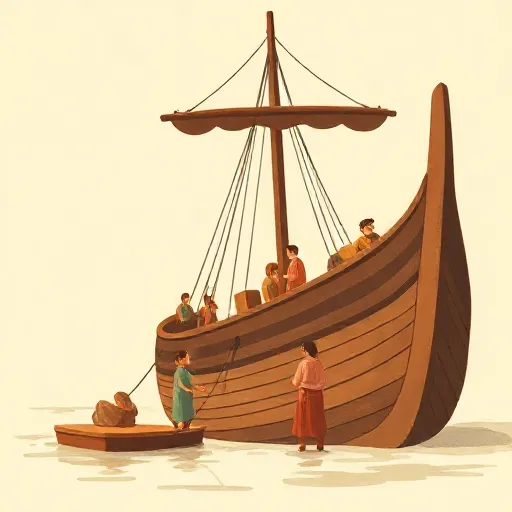
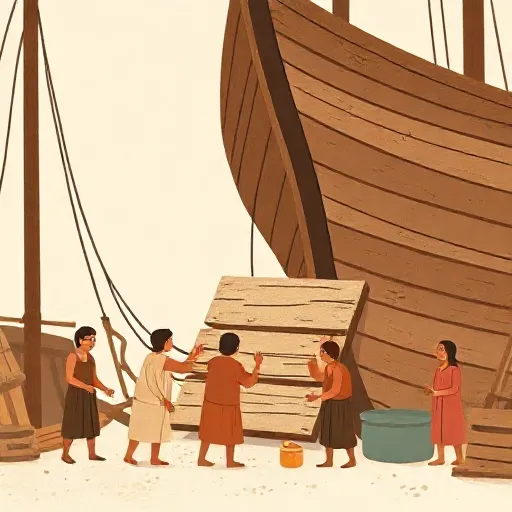
Imagine a wooden boat tied up at the dock. Over the years, the owner replaces old planks one by one. After a long time, not a single piece of the original timber remains. Is it still the same boat?
You might say yes. After all, it never stopped being a boat, and you watched each change happen gradually. But what if you took all the discarded planks and rebuilt them into a second boat? Which one would be the real boat?
Puzzles like this are very old. They are about parts and wholes — what thinkers call mereology (from the Greek word meros, meaning “part”). In the Middle Ages, philosophers turned this into a lively battlefield, asking what keeps a thing itself through change. They didn’t just talk about ships. They talked about houses, stones, and even people — including you.
Boethius and the Rule That Worried Everyone
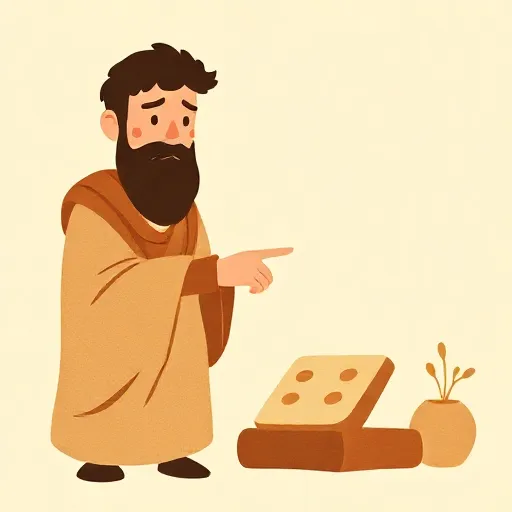
The medieval obsession with parts and wholes started with a Roman philosopher named Boethius (c. 480–524). He wasn’t just the guy who wrote The Consolation of Philosophy in prison. He also wrote handbooks on logic that became school texts for a thousand years.
In one handbook, Boethius laid out rules for how wholes and parts relate. The most troubling rule was about integral wholes — the kind of whole whose parts are arranged side by side, like the boards of a boat or the limbs of a body.
The rule said: If the part does not exist, the whole does not exist.
At first, that sounds reasonable. If there had never been any planks, there couldn’t be a boat. But the rule also seemed to say something scary: if you lose even one part, the whole thing is destroyed. So if Socrates stubs his toe and loses a toenail, he no longer exists as the same Socrates. That seemed extreme.
Most medieval thinkers didn’t go that far. They tried to soften the rule. A principal part was a part without which the whole couldn’t survive at all — like a human heart or a ship’s keel. A secondary part was something you could lose and still be you — like a strand of hair or a plank in the deck. The rule, they said, really only applied to principal parts.
But a fiery logician named Peter Abelard (12th century) asked: How do you decide which parts are principal? If you just say “the ones whose removal destroys the whole,” the extremist can reply that every part is principal, because losing any part destroys the original whole and leaves you with something new. That debate was far from settled.
A House That Was Nothing More
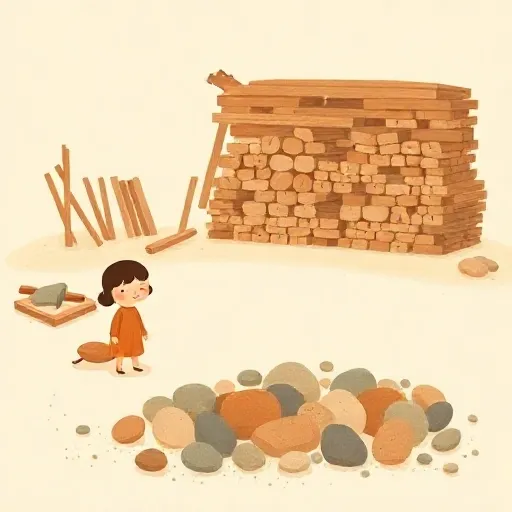
Abelard had a striking answer to what makes a whole. He said: A whole is nothing other than the sum of its parts. There isn’t an extra “whole thing” hovering above the boards and bricks.
Think of a house. You can take a specific pile of wood, stones, and nails. When they sit in a messy heap on the ground, they aren’t a house. But when they are arranged with walls and a roof, they are a house. Abelard insisted that no extra thing was added when the heap became a house. The arrangement was real — he called it a condition — but it wasn’t a part. Only concrete stuff counts as a part. So the house is just that exact collection of materials in that exact arrangement.
This led to a surprising result. If you replace even one nail, the collection of materials is no longer exactly the same. So, strictly speaking, it’s not the same house anymore. Abelard’s followers, called the Nominales, embraced this fully. They declared that nothing really grows or shrinks while staying the same thing. Any change in parts meant a new thing had replaced the old.
Most people found this too wild. If your neighbor fixes a broken window, is it suddenly a different house? Common sense says no. But Abelard had a point: the identity of a pile of stuff does depend on exactly which stuff is in the pile.
When Too Many Socrateses Walk In
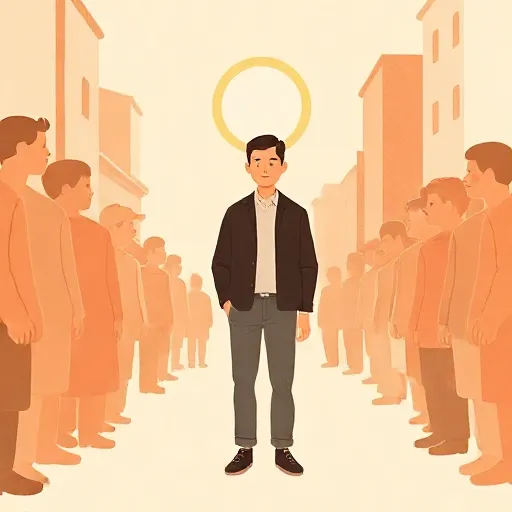
The same puzzle popped up in a weird problem called the Problem of the Many Men. Picture Socrates standing there, whole and healthy. Now think about the whole of Socrates minus his right index finger. That’s a slightly smaller lump of flesh and bone, but it still has a human shape, and it still is filled by his soul. So, is that also a full human being?
If you say yes, then there are now two men standing in the same place: Socrates whole, and Socrates minus a finger. But you can subtract just a fingernail, or two fingers, or an arm. You get dozens — hundreds — of overlapping wholes, each seemingly a human being. That’s absurd.
Abelard offered a clever escape. He said that two overlapping wholes are different in essence (they don’t have exactly the same parts), but that doesn’t make them numerically different — meaning separate individuals. They share most of their parts, and because they are not entirely distinct, they aren’t separate people. It’s like considering your friend’s whole body and then your friend’s body with a missing hair. They are not two people, just two descriptions.
Other thinkers, like Albert of Saxony (14th century), took a different path. He said that nothing that is still a part of a complete human being can itself be a distinct human being. The fingerless lump is a part of Socrates, so it can’t also be a rival Socrates. Problem solved — or at least locked away.
What Holds You Through Time?
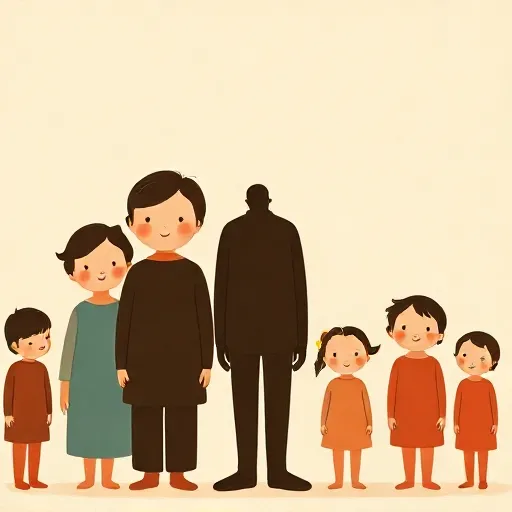
So far, we’ve seen puzzles about losing parts. But you are changing all the time. Your cells replace themselves. Your hopes and fears shift. What makes you the same person now that you were when you were six?
Thomas Aquinas (13th century) and others leaned on the idea of a substantial form — a kind of organizing principle that makes a thing the kind of thing it is. For a living being, that form is the soul. The soul, Aquinas said, is present as a whole in every part of the body, holding it together. Material parts can come and go, but as long as the same soul is there, the human being stays the same substance.
But the 14th-century thinker Jean Buridan pushed on this a bit. He said that for beings like plants and horses, there is no thinking soul that can guarantee identity through huge material changes. A horse from ten years ago shares parts and shape with today’s horse, but strictly, it’s only “the same” in a looser, less proper sense. For humans, the intellective soul — the thinking, reasoning part — could serve as the anchor that makes you genuinely the same person over a lifetime.
Buridan’s picture is startling. In the strictest sense, almost nothing in the material world stays the same thing for more than an instant. The oak tree in the park is a continuous succession of very similar trees, not one unchanging thing. You, however, may have a core so deep that you really persist.
The Echo in the Mirror
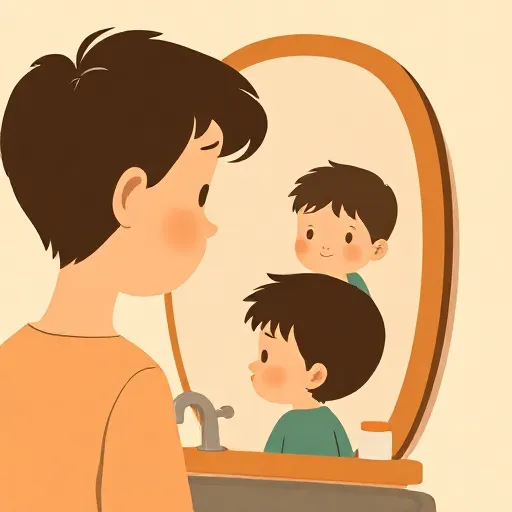
So why does all this dusty medieval logic matter now?
Every time you say, “That’s the same old bike I’ve had since I was little,” even if the tires, chain, and seat have all been replaced, you’re stepping into a medieval argument. You’re deciding that something beyond the parts — a form, a history, a continuity — makes it the same bike.
And when you look in the mirror and know you’re the same person who laughed at a joke yesterday and cried at a movie years ago, you’re siding with those who said a deeper unity holds you together, even as your parts change.
Medieval thinkers didn’t have microscopes or brain scans. They sat in candlelit rooms and pushed logic as far as it could go. Their debates about planks, fingers, and souls remind us that identity isn’t as simple as it seems. A whole is never just a pile of parts — and neither are you.
Think about it
- If every atom in your body were replaced over ten years, would you still be the same person? What if all your memories were replaced too?
- Your favorite old sneakers have a new sole and new laces. Is it silly to say they’re still the same sneakers? Does it matter if you feel they are?
- Could two things made of exactly the same kind of parts, arranged in exactly the same way, really be two different things? Why or why not?