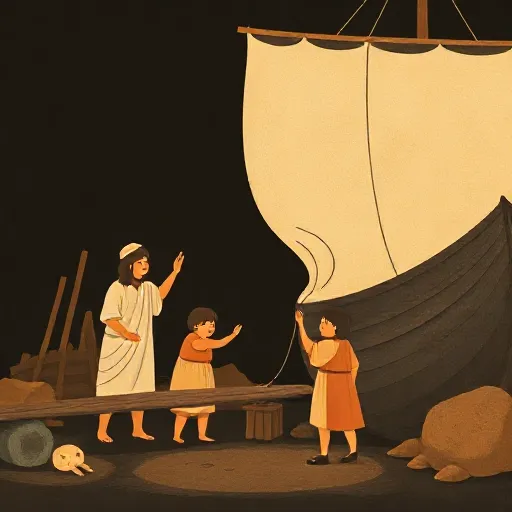
After Every Plank Is Replaced, Is It Still the Same Ship?
The Ship in the Harbor
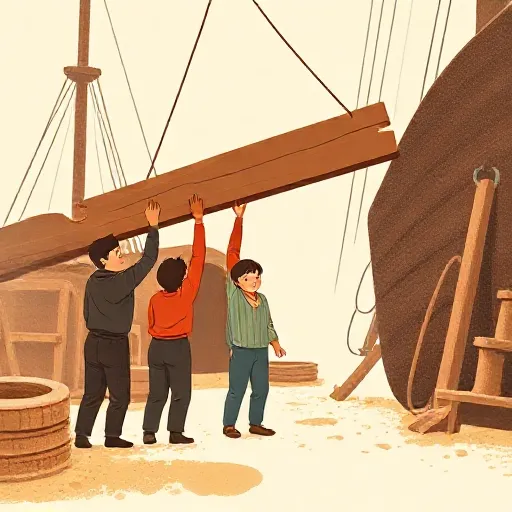
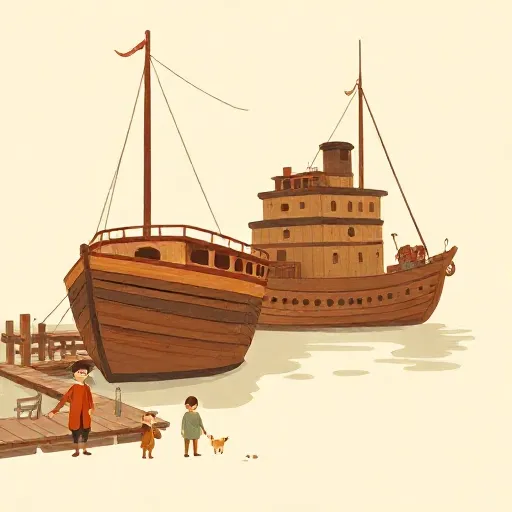
Imagine a wooden ship tied up in a Greek harbor. Over decades, every rotten plank is pulled out and replaced with a new one, every beam swapped, every rope freshened. Finally, not a single original splinter remains. Is it still the same ship?
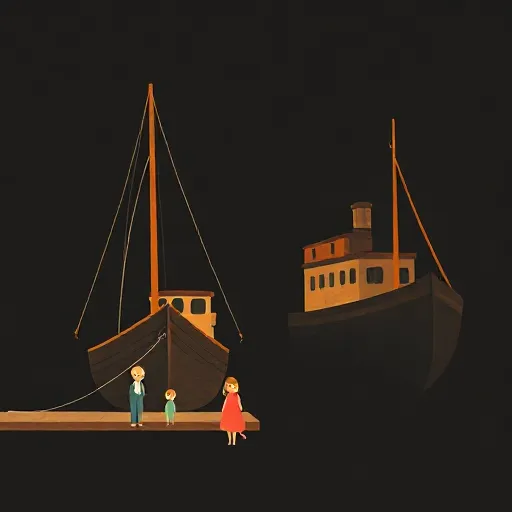
The historian Plutarch wrote about just such a vessel — the Ship of Theseus — and said it became a model for philosophers who could not agree whether it stayed the same or changed into something new. A later thinker, Thomas Hobbes, added a wicked twist: what if someone gathered all the discarded original parts and reassembled them into a second ship exactly like the first? Now you have two ships, each with a claim to be the original. The puzzle forces you to ask a deeper question: what does it really mean for a thing to be the same thing over time?
Leibniz’s Rule: Same Thing, Same Properties
Most philosophers start with a crisp rule introduced by Gottfried Wilhelm Leibniz. It is called Leibniz’s Law, or the indiscernibility of identicals. The idea is stunningly simple: if two things are identical — really one and the same object — then they must share every single property. If your bicycle is the same bicycle you rode yesterday, then it cannot have a scratch today that it lacked yesterday, unless something changed. And if something did change, you have a puzzle on your hands.
This rule is part of the standard account of identity: identity is an equivalence relation, which means it is reflexive (everything is identical to itself), symmetric (if a is b, then b is a), and transitive (if a is b and b is c, then a is c). And on top of that it obeys Leibniz’s Law. For a long time, that seemed like the whole story.
But change won’t sit still. Take a dog named Oscar. As a puppy, Oscar has a smooth, dark muzzle. As a very old dog, his muzzle is gray. Yet we want to say it is the same dog — Oscar throughout his life. Leibniz’s Law seems to forbid this: puppy Oscar lacks the property having a gray muzzle, while old Oscar has it. If they were truly identical, they’d share every property. So something must give.
Philosophers have cooked up two main replies. One says that properties like “having a gray muzzle” are actually relations to times: Oscar has-the-muzzle-at-time-t2 but not-at-time-t1, and that’s no contradiction. The other reply carves Oscar into temporal parts — the puppy stage and the old-dog stage are distinct slices of a four-dimensional Oscar stretched out through time, like a film reel. Both answers keep Leibniz’s Law safe, but some object that they treat time from a “God’s‑eye” view that doesn’t match how we actually experience living through change. The debate is wide open.
A Lump of Clay and a Statue
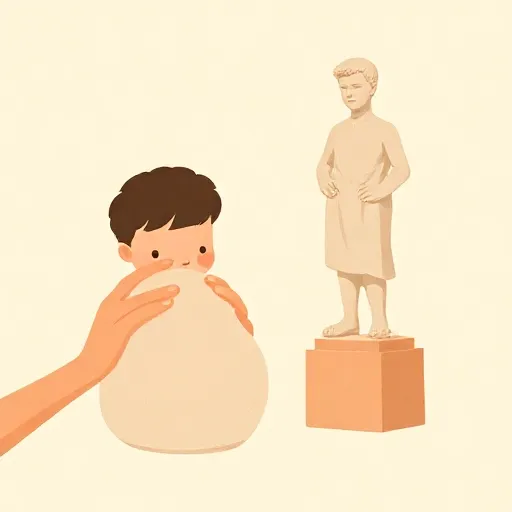
Here is a stranger puzzle. Suppose a sculptor takes a lump of clay and molds it into a beautiful statue. The clay and the statue fill exactly the same space, down to the last molecule. Are they the same thing? If you answer yes, Leibniz’s Law lands you in trouble. Squash the clay into a ball; the clay survives perfectly well, but the statue is destroyed. So the clay has a property the statue lacks: able to survive being squashed. By Leibniz’s Law, the clay and the statue cannot be identical.
Some philosophers accept that two distinct physical objects can occupy the same space at the same time, as long as they belong to different kinds. That brings its own headaches — why should the universe double its items like that? Others say the clay and the statue are not two separate things but a single thing described in two ways. Yet that clashes with the idea that identity is necessary: if a and b are identical, then they are identical in every possible situation. If the clay is the statue, there is no possible world where the clay exists but the statue doesn’t. And that seems false — you can easily imagine squashing it.
Enter an alternative. What if identity is not one absolute relation but many? The clay and the statue are the same piece of clay but different statues. This view is called relative identity. It insists that whenever we say “x is the same as y”, we are leaving something out — the real statement is always “x is the same F as y”, where F names a kind of thing. And it can happen that x and y are the same F yet different Gs.
Back to the Ship: Same Vessel, Different Wood?
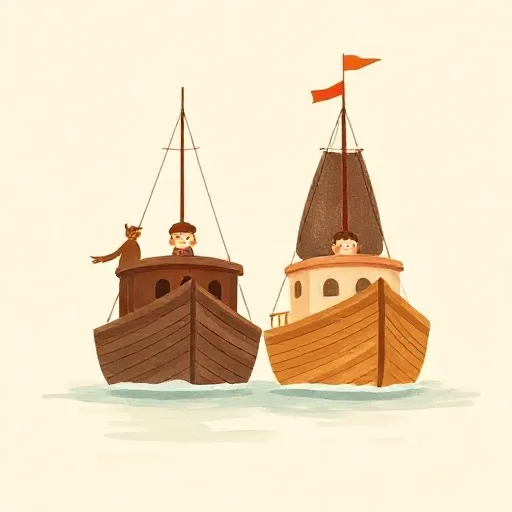
Relative identity offers an elegant escape from the Ship of Theseus. You can say that the continuously repaired ship is the same ship as the original, even though it is not the same collection of planks. Meanwhile the reassembled ship from the old planks is the same collection of planks as the original, but not the same ship. The two competing claims are no longer contradictory.
But does the “same ship” relation really count as an identity relation? It does not obey Leibniz’s Law without limits. Two ships that are the same ship may differ in colour, scratches, or even — as here — every plank. For relative identity to work, you have to restrict the law: a “same F” relation preserves only those properties that matter for being that kind of F. A same‑ship relation preserves properties such as having a continuous history, but not being made of exactly these planks. Similarly, same‑dog preserves biological identity but not muzzle colour. This is a live and controversial trade‑off. Many philosophers prefer to keep Leibniz’s Law absolutely and instead explain away the puzzles through temporal parts, time‑indexed properties, or other devices.
The philosopher P.T. Geach, who championed relative identity, went further: he argued that there is no such thing as absolute identity at all — all identity is relative to a kind. Most relative identity theorists today are less radical; they think we need both absolute identity (for things like numbers and logical objects) and relative identity (for changing, everyday things like ships and dogs). But even the weaker view has to give up the idea that one simple sameness relation rules them all.
Why This Morning’s Fight Matters

You may never have to decide who owns a rebuilt trireme, but you bump into identity puzzles all the time. If a game console’s shell and screen are replaced after a drop, is it still the same console you got for your birthday? If a friend changes so much that they seem like a different person, are they still the same friend? Questions of fairness, punishment, and ownership often rest on whether something is “the same” — and our ordinary talk can wobble.
The ship in the harbor, the gray‑muzzled dog, the lump of clay — each pushes us to see that “same” is not a single, simple idea. Leibniz gave us a crisp logical rule, but the world of change and material objects keeps straining against it. Relative identity offers one set of answers, temporal parts another, and philosophers are still hard at work sorting out which picture best fits reality. The next time you look at a repaired object and wonder if it’s really yours, you’ll be asking a question that has been sailing for two thousand years.
Think about it
- If a scientist could track every cell in your body as they are replaced over time, would you still be the same person at age eighty? Why or why not?
- Imagine you build a robot from a kit, then replace every part one by one. A friend uses the old parts to build an identical robot. Which robot, if either, should get the name on the box? What makes it fair?
- When a piece of music is rewritten in a different key with new instruments, is it the same song? Try to defend both a “yes” and a “no” answer.