
Why Can’t She Speak? Margaret Fell’s Unshakeable Answer
A Wife Bewitched? The Preacher Who Changed Everything

It was 1652, and Thomas Fell was riding home to Swarthmoor Hall in Lancashire, England. Before he could even greet his wife, neighbors rushed up with alarming news: Margaret had been bewitched by a traveling preacher. This preacher was George Fox (1624–1691), a founder of the Society of Friends, better known as the Quakers.
What had really happened? Margaret Fell (1614–1702) had heard Fox speak at her church, and his words turned her world upside down. She later described how, in that moment, her understanding opened. She realized that people had been treating the Bible like a dead object they owned, instead of letting its message live inside them. She wept in her pew — and from that day, she was a Quaker.
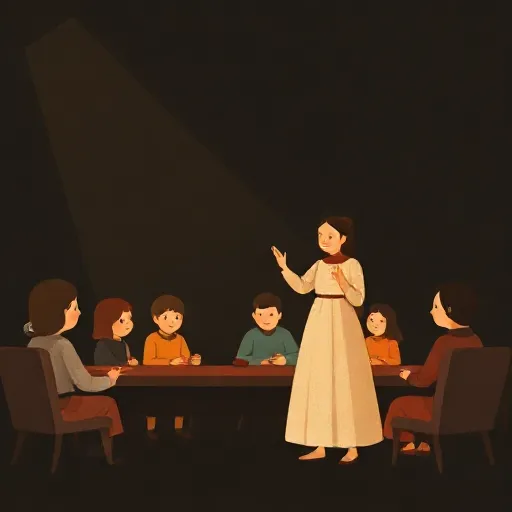
Thomas Fell, despite his worries, supported his wife. Their home became a meeting place for Quakers, who believed every person had the Light of Christ within them. No priests. No special buildings. Just ordinary people waiting in silence until the light stirred someone to speak. Margaret helped lead the movement, traveling widely, writing pamphlets, and even going to prison for her beliefs. She and Fox later married, and together they organized the first official Quaker women’s meetings.
A Candle Inside You: Why Quakers Didn’t Need Priests

Imagine you had a direct line to the truth — no teachers, no complicated books, no special titles needed. That was the Quaker idea. The Inner Light, Fell taught, is something divine placed in every human being. It’s not reason or book-learning; it’s “the Law of God written in the heart.” If you turn your mind to it, the light shows you what is good and what is sinful. It reproaches you when you lie or harm someone. Above all, it doesn’t depend on education or social rank.
This belief led to some shocking behavior. Quaker men refused to remove their hats in front of magistrates. Quaker women would not curtsey. They all rejected oaths of allegiance and titles like “Your Lordship.” To outsiders, this looked like chaos — a levelling of all social order. Fell, however, was no rebel against the king. In a letter to Charles II, she promised that Quakers would never use weapons or plot against the government. But she insisted that true worship could happen anywhere, at any time, with no priest standing in the way.
Fell’s anti-clericalism (opposition to professional clergy) ran deep. She scolded university-educated preachers who “study out of their own brain” and lead people away from God. The apostles, she pointed out, didn’t have Oxford or Cambridge degrees. So anyone — even a woman — could be called to speak.
The Command to Silence: What the Bible (Supposedly) Said

Fell’s claim that women could preach flew in the face of what most people believed. Critics reached for two famous Bible verses: “Let your women keep silence in the churches” (1 Corinthians 14:34) and “I suffer not a woman to teach, nor to usurp authority over the man, but to be in silence” (1 Timothy 2:11–12). Combined with the story of Eve’s transgression, these passages seemed to lock women out of any spiritual leadership.
John Knox (c. 1514–1572), a fiery Scottish reformer, had already called female authority “monstrous.” Nature, he argued, shows that women are physically weak and mentally feeble. God’s words to Eve — “thy desire shall be to thy husband, and he shall rule over thee” (Genesis 3:16) — confirmed that men should govern. For Knox and many others, a speaking woman was a violation of both nature and divine order.
Joshuah Miller, writing in 1655, called Quaker women preachers a “monstrous Doctrine.” He cited the same Corinthians and Timothy verses, lumping the Quakers with ancient groups he considered heretical. To these critics, women who claimed the Spirit’s authority were dangerous and unnatural. Fell had to answer them — but she did it by reading the very Scriptures they used against her.
Margaret Fell Opens the Bible — and Finds a Different Story

In 1666, while imprisoned in Lancaster Castle, Fell wrote Womens Speaking Justified, the most thorough Quaker defense of female preaching. She didn’t dodge the silencing verses — she dug into them.
She started at the very beginning. In Genesis, God created male and female in God’s own image, with no distinction. After the fall, God promised that the “Seed of the Woman” would bruise the serpent’s head. Fell saw this as a prophecy that a woman (the Virgin Mary) would bring Christ into the world. Spiritual equality was restored with Christ: his Spirit was poured on “all flesh, both Sons and Daughters.” To stop a woman from speaking for God, Fell argued, is to stop Christ himself.
Then she turned to the hard verses. First Corinthians says a woman should keep silent — but, Fell noted, just before that it also says a man must keep silent when there is confusion. So the command applies only to those who speak out of order or malice, not to those filled with the Spirit. The Timothy passage tells a woman to learn in silence — yet the same apostle praised Philip’s four virgin daughters, who were respected as prophets. If the command covered all women, Fell reasoned, those daughters could not have prophesied. So the injunction must apply only to certain situations, like a wife trying to seize authority over her husband at home.
She also embarrassed her opponents by pointing out that they happily quoted women like Deborah in their own sermons — but still insisted women must be silent. “They make a Trade of Womens words,” she wrote, “and still cry out, Women must not speak.” Her logic was simple: you can’t have it both ways.
Beyond the verses, Fell showcased women throughout Scripture who spoke with God’s voice: the judge Deborah, the prophetess Huldah, Miriam, Mary Magdalene, and the women who first announced Christ’s resurrection. If those women had stayed silent, she asked, “what had become of the Redemption of the whole body of Mankind?” The very story of salvation depended on women’s words.
But Did She Want Women Equal in Everything? The Debate Continues

Modern readers often ask: was Fell a full-blown feminist? The answer is complicated.
Critics point out that Fell never challenged the husband’s authority in marriage. When she commented on the Timothy verse, she accepted that a wife should be in subjection to her husband — she just denied that this meant women couldn’t preach. She didn’t call for equal education for girls or for women’s political rights. For many historians, this means her arguments stop short of demanding social equality. They remain inside a religious frame, not a political one.
Some Quaker writers even redefined “woman” as weakness. They sometimes called their opponents “women” as an insult, meaning those who speak with carnal weakness rather than spiritual strength. This retained a negative picture of actual female bodies.
Fell, however, stood out. Instead of ignoring the female body, she celebrated it. The Virgin Mary’s motherhood was essential — “made of a woman,” she wrote, Christ came. The women at the tomb showed love and loyalty, staying when the male disciples fled. Their natural womanhood wasn’t something to be erased; it was part of the story. By honoring such women, Fell quietly challenged the idea that women were mentally and morally inferior.
More deeply, her whole approach assumed that women could think for themselves. To hearken to the inner light, someone must discern what is truly good, exercise free will, and find the courage to question misguided teachers — even if those teachers were fathers or priests. That demand for independent moral judgment planted a seed that would grow in later centuries.
The Argument That Echoes: Why It Still Matters

Fell never called for women’s colleges or voting rights. But later thinkers like Mary Astell (1666–1731) and Damaris Masham (1659–1708) would build on a similar insight: a woman’s salvation — and her ability to think clearly — depends on her own reason, not blind obedience. They argued for women’s education, and from there the door opened to wider claims for equality.
Margaret Fell’s question is still alive. Who gets to speak for God, or for anything that matters? When someone tells you a group must stay silent because of an old rule or a single verse, Fell’s move was to read the whole book again. She didn’t reject authority; she asked her audience to examine it closely for themselves. That is not just a religious skill — it’s a philosophical one. The next time you hear “that’s just the way it is,” you might be holding a Fell moment in your hands: open the source, look for the stories that got left out, and ask whether the rule still makes sense.
Think about it
- If everyone has an inner light, why do people still disagree so much about what is right and wrong?
- Fell used the same Bible as her opponents to argue for opposite conclusions. If a text can support both sides, how should we decide which reading is correct?
- Traditions can feel safe and important, but they can also exclude people. When is it okay to challenge a tradition, and when should you respect it?