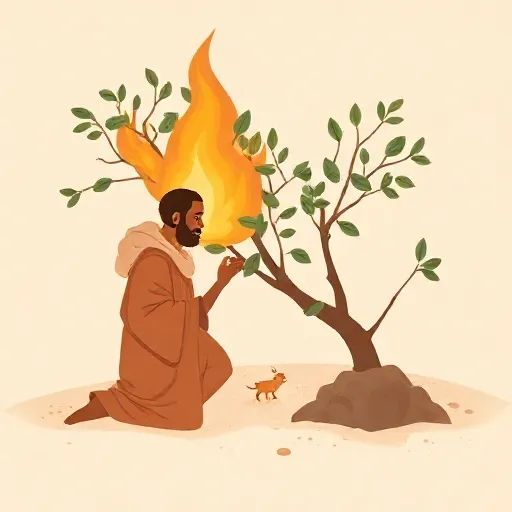

Can God Speak to You? The Philosophers' Debate on Revelation
What Does It Mean to “Reveal” Something?

One evening, twelve-year-old Sofia was lying on her bed when an unfamiliar warmth spread through her chest. A thought seemed to arrive in her mind — not her own voice, but clear: “You are not alone.” She sat up. Did God just speak to her? Or was it a trick of her brain?
For thousands of years, people have reported moments like Sofia’s and called them a divine revelation — God making something known that was hidden. The philosopher George Mavrodes (1926–2019) pointed out that any true revelation needs four pieces: a revealer (God), an audience (a person or group), a content (what is revealed), and a means (the way it gets through). Without all four, no revelation has really happened.
Theologians make a further split. General revelation (or natural revelation) is available to everyone — through the natural world, human reason, or the beauty of a sunset. Special revelation is aimed at a particular audience at a particular time, like a message given to a prophet. Much of the modern debate focuses on special revelation. After the Enlightenment, some thinkers asked: if general revelation is enough, why would God need a special one? Many religious traditions answer that human sin has clouded our minds, so God must act in history to speak to us directly. The discussion never really went away.
Words or Presence? The Great Divide

Suppose your best friend wants to tell you something important. She could send a text — a string of words that carry her message. Or she could walk into your room, look you in the eye, and let her presence speak for itself. The philosopher Nicholas Wolterstorff (1932–) used a similar contrast to describe the two main ways God might reveal something.
Propositional revelation (sometimes called non-manifestational) works like a text message. God communicates through sentences, teachings, or directly caused thoughts — vehicles that carry propositions, the shareable meanings that can be true or false. “Snow is white” and “Schnee ist weiss” express the same proposition. If God puts a sentence into a prophet’s mind or inspires a sacred text, propositions are central to the means of revelation.
Manifestational revelation works more like a friend walking through the door. God shows something directly — perhaps God’s own self. No words are needed; the reality itself is the medium. In this picture, you are confronted with “raw” divine presence, an event, or an overwhelming experience.
Here’s a twist: even in manifestational revelation, propositions seem to slip in. If God shows himself to you, you will likely come to know that God exists, that God is powerful, that you are loved. Those “that”-thoughts are propositional knowledge. So many philosophers argue that while propositions don’t act as the means of manifestational revelation, they always become part of its content. Knowing a person — even God — seems to require knowing at least some facts about that person.
Some theologians have pushed back hard against propositional revelation, fearing it turns the Bible into a dry handbook of literal statements. They point out that Scripture is full of poetry, metaphor, and culturally shaped stories. Defenders reply that propositions can be wrapped in metaphor, and that God could “borrow” human authors’ words without endorsing every outdated idea they held — much as a president can authorize an ambassador to speak on her behalf.
How Might God Show Up? Four Pictures

Beyond the words-or-presence debate, scholars have imagined different models of revelation — big pictures of where and how revelation happens. The theologian Avery Dulles (1918–2008) grouped them into four main types, all focusing on manifestational (non-propositional) ideas.
First, Revelation as History. God shows up in dramatic public events — the parting of a sea, a dead man rising. The Bible, in this view, is not the revelation itself but the record of it, like a newspaper report describing a miracle.
Second, Revelation as Inner Experience. Here, the real encounter happens deep inside a person, sometimes at a level beneath words. It feels like a direct, immediate communion with God, much like what Sofia felt. The challenge is explaining how a wordless feeling can justify specific beliefs about God — how do you know which God you are meeting?
Third, Revelation as Dialectical Presence, influenced by the theologian Karl Barth (1886–1968). Barth insisted that God is so wholly other that no created thing — not even a sacred text — can capture God. Revelation is a moment when God “unveils” himself through the Bible’s story, but the Bible itself is just the channel, not the revelation. God remains hidden even while being revealed.
Fourth, Revelation as New Awareness. This model sees revelation less as a message from outside and more as a transformation of how you see the world. You suddenly perceive everything — yourself, other people, the universe — in a new, sacred light. God might be mysteriously present at the edges, but the focus is on your changed consciousness.
None of these models is meant to be exclusive. Many thinkers mix them, but philosophers still argue over whether any purely manifestational picture can explain how we learn God’s specific traits — like being all-powerful or perfectly good — without some propositional help somewhere along the way.
The Detective’s Work: Can We Prove It’s Really God?

Return to Sofia on her bed. The hardest question is not what revelation is, but how we can ever be justified in believing one has occurred. A claim that God has spoken is a monumental thing — it would change everything. Can such a belief be reasonable?
The English philosopher Richard Swinburne (1934–) argues that rational belief in a revelation requires evidence, like a detective building a case. He proposes you first need good reason to think God exists (through arguments from nature, for instance). Then you test any alleged revelation with four criteria:
- Content test: The message must be about our deepest good and not wildly unlikely on its own.
- Miracle test: It must come with a divine signature — an authenticating miracle that only God could do, like a resurrection.
- Church test: There must be a reliable community (a church) to interpret the message correctly across time.
- Coherence test: That community’s teachings must not conflict badly with what we already truly know.
Swinburne then applies these tests to world religions and concludes that only Christianity’s revelatory claim passes all four, largely because of the evidence for Jesus’s resurrection. The sheer coincidence of meeting all the tests, he believes, makes the Christian revelation very probable.
Not everyone is convinced. The American philosopher Alvin Plantinga (1932–) offers a very different path. He imagines that if God exists, God likely built humans with a sensus divinitatis — a natural “sense of the divine.” Just as your eyes produce perceptual beliefs when you look at a tree, your sensus divinitatis produces beliefs about God when you encounter a majestic mountain or a selfless act. These beliefs aren’t inferred from evidence; they arise directly, and they can be non-inferentially justified — reasonable without arguments. For special revelation, Plantinga adds another layer: the Holy Spirit directly causes believers to accept Scriptural teachings as true. The process is not a natural part of human makeup, but it is (if Christianity is true) a reliable belief-producing mechanism, so the resulting beliefs count as knowledge.
Plantinga doesn’t try to prove God exists. He only claims that if God is real, belief in revelation can be fully rational without being an expert detective. But that means the whole case depends on a starting assumption many people don’t share.
Worries pile up. Religious diversity looms large: if a Buddhist monk has equally powerful experiences and a non-inferential sense that the Buddha revealed deep truths, why should we favor one tradition over another? And the hiddenness of God feels like a problem: if a loving God wanted to be known, wouldn’t the evidence be more obvious? Swinburne’s answer is that a certain amount of hiddenness invites humans to search, cooperate, and grow — God doesn’t overwhelm us. Plantinga adds that sin might damage our ability to perceive God clearly.
Why It Matters When You Wonder

Sofia eventually talked to a trusted friend. She didn’t get a final answer, but she learned to ask better questions: Could this message be coming from my own worries? Is it encouraging me to become kinder and braver, or just making me feel special? Does it line up with anything wise I already know?
Philosophers don’t hand us a certificate of authenticity for any one tradition. But they give us tools to think carefully when someone claims to have heard from God — including ourselves. The conversation about revelation isn’t just for dusty libraries; it plays out whenever you encounter a life-changing religious claim, whether in a sacred text, a testimony from a friend, or a quiet feeling in your own chest.
The puzzle remains wide open, and that’s okay. Asking hard questions about the biggest ideas is what thinking humans do. You don’t need to have every answer. You just need to stay curious, brave, and fair-minded as you listen, read, and examine what feels true.
Think about it
- If a friend told you God spoke to them in a dream, what would you ask them to help you decide if it might be real?
- Why might a good God choose to stay partly hidden instead of showing up in an obvious way to everyone at once?
- Imagine two people have contradictory religious experiences that they both believe came from God. Can both be partly right? How would you go about figuring that out?