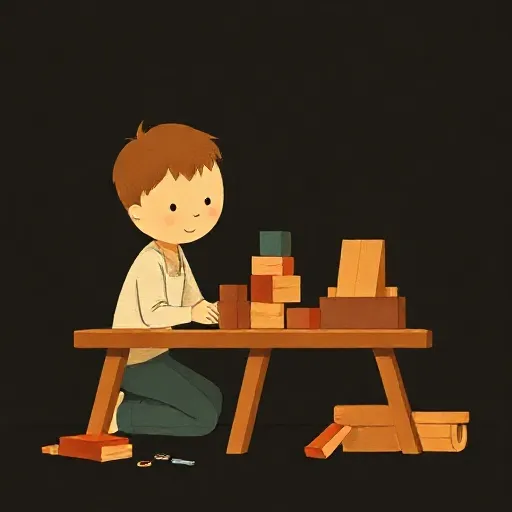

Can You Build the Whole Universe Out of Simple Facts?
The Day Philosophy Broke Free from the Blob

In 1899, a young philosopher named G.E. Moore (1873–1958) wrote a paper that shook the ground under his friend Bertrand Russell (1872–1970). Until then, the dominant school in Britain, led by F.H. Bradley (1846–1924) and J.M.E. McTaggart (1866–1925), held a view called idealism. On this picture, nothing is truly separate. Every object, property, and relation is woven into a single giant whole. Take a red mug: its redness ties it to every other red thing, and those ties are part of what the mug really is. If you tried to pull the mug out of the web and look at it alone, you would simply lose the mug. The idealists even claimed that analysis is falsification — breaking things into pieces misses the true, unified reality.
Russell and Moore said that was nonsense. They argued for external relations: a thing can be related to other things without those relations sneaking into its core identity. The mug’s redness doesn’t mean it carries its connection to every red object inside itself. A cat can sit on a mat, but the cat is still a cat even when the relation of sitting-on is absent. This simple shift allowed Russell to see the world as a collection of many independent objects, each with its own nature. You no longer had a blurry cosmic blob; you had a rich population of separate entities that could be studied one at a time. That was the seed of what he later called logical atomism.
Facts, Not Things, Make Up the World

Russell’s atomism started with a surprising claim: the basic furniture of the world isn’t things, but facts. A thing, like a cat, is just a participant. A fact is what you get when things enter into relations or bear qualities. “The cat is on the mat” names a fact — a complex made of the cat, the mat, and the being-on relation. It’s not the cat by itself, nor the mat; it’s the way they are arranged.
The simplest kind of fact Russell called an atomic fact. An atomic fact consists of one or more individuals standing in a simple quality or relation — for instance, this apple is red or the cup is to the left of the saucer. The simplest sentences that express such facts directly he called atomic propositions. In a logically ideal language, he imagined, every word would name a simple ingredient of an atomic fact. All other truths could be built from atomic propositions using logical words like and, not, all, and some. If you knew every true atomic proposition, plus logic, you could in principle reconstruct every other truth about the world. The whole messy universe would be a neat tower of facts — no glue required.
The King of France and the Trick of Meaning

Russell knew that ordinary language often pretends to name things that aren’t really there. Take “The King of France is bald.” At the start of the twentieth century, France was a republic; there was no king. If the sentence were about a real king, it would sputter in confusion — it can’t be true, but it seems false only if there is a king with hair. So what makes it meaningful?
His famous theory of definite descriptions (1905) gave the answer. He argued that the sentence is actually a compressed bundle of simpler claims: there is at least one thing that is King of France, there is at most one such thing, and whatever is King of France is bald. Because the first piece is false, the whole statement is false — but perfectly understandable. The phrase “the King of France” doesn’t pick out a single lurking object; it’s an incomplete symbol, a tool that has meaning only in the context of the full sentence. The grammar fooled us into seeing a ghost-king. Russell had shown that analyzing language can dissolve puzzles about what exists — without inventing fictitious entities.
Turning Ghosts into Useful Fictions

The King of France trick was just the beginning. Russell applied the same strategy to whole categories of suspected entities: numbers, classes, physical objects, even minds. He insisted that many things we think of as solid, independent objects are really logical constructions — bundles of simpler facts, talked about as if they were a single thing for convenience.
Consider a class, like the class of all dogs. Russell’s paradox (the class of all classes not members of themselves) showed that treating classes as real objects leads to contradiction. So he argued that a sentence apparently about a class is really a coded sentence about all the individual dogs, not a separate entity. The class is a “logical fiction.” Likewise, a physical object such as a table could be analyzed as a series of sense experiences — patches of colour, textures — that hang together in a lawful way. You don’t need to infer an invisible substance behind the sensations. Russell often summarized this move with a razor-sharp slogan: wherever possible, substitute logical constructions for inferred entities. That way, your ontology — your list of what truly exists — shrinks, and philosophical headaches often dissolve.
Are the Ultimate Bricks Really Simple and Independent?

Russell’s talk of “atoms” suggests that analysis eventually hits something absolutely simple, something that cannot be taken apart further. Early on he defended logical atoms — entities with no internal structure. But as the years passed he grew cautious. He admitted we probably can never know if we’ve reached a genuine simple. Instead, he came to emphasize relative simplicity: showing that one thing can be broken into smaller pieces counts as progress, even if those pieces might themselves be breakable later.
Coupled with this was the idea of logical independence. In the ideal language, no atomic fact would force any other atomic fact to be true or false. If “this patch is red” seems to rule out “this patch is green all over,” Russell suspected that “red” and “green” are not yet the genuinely simple properties. Further analysis would reveal a hidden logical structure that turns the clash into a truth of logic — just as “three is greater than two” turned out not to be a brute atomic fact about mysterious number-objects but a truth about sets and counting. For Russell, whenever you spot a necessary connection between two plain-looking claims, you have a sign: dig deeper. The surface isn’t fully analyzed yet.
Why a Hundred-Year-Old Idea Still Buzzes

Russell’s logical atomism directly shaped thinkers like Ludwig Wittgenstein (1889–1951) and the logical positivists, and it helped give birth to the whole tradition of analytic philosophy. Even today, when a philosopher carefully defines terms, or when a scientist asks “what do we really mean by this measurement?”, they are walking a path Russell helped pave.
You already do a version of this every day. When you say “my room is a mess,” someone might ask “what do you mean exactly — clothes on the floor or books everywhere?” You zoom in, clarify, analyze. Russell’s vision of a perfectly transparent language built from independent fact-atoms may be too tidy for our messy world, but the habit of asking what are the simplest facts that make this true? is still one of the most powerful tools for straightening out confusion. Next time a sentence puzzles you, imagine yourself as Russell: take it apart and see what you’re really committed to.
Think about it
- If someone says “the King of France is bald,” do you think it’s true, false, or neither? Why?
- Can you think of something in your own life that seems simple but might really be made of smaller parts when you look closer?
- If all truths were built from independent atomic facts, would the future be completely predictable, or would there still be room for surprise?