Why Build It Yourself? Bertrand Russell's Honest Toil
The Problem with Just Saying “It Just Is”

In 1919 the philosopher Bertrand Russell (1872–1970) made a mischievous comparison. Some mathematicians, he said, simply postulate — assume without proof — the things they want, like saying “let there be numbers.” That, he joked, has “the same advantages as theft over honest toil.” Russell preferred to build.
Imagine you’re in a video game. One cheat code can spawn a castle, fully formed and floating in the air. That’s like postulating: you get a thing for free, but nobody knows why it’s there. The alternative is to gather blocks of wood and stone, piece them together, and watch the castle rise from rules you understand. Russell thought philosophy and science had cheated for too long. He set out to do the hard, honest work of logical construction — defining complicated ideas using only simpler, familiar ingredients, so that nothing mysterious had to be assumed.
This wasn’t just a matter of tidiness. Russell believed that if you can’t show how an idea is built from basic parts, you don’t really understand it. Logical construction became his signature method, and it changed the way we think about numbers, language, and even everyday objects like tables and chairs.
Numbers Without Magic: How Two Is Built from Pairs

What is the number two? You use it constantly, but you’ve probably never needed to define it. In Russell’s day, many mathematicians relied on the Italian Giuseppe Peano (1858–1932) and the German Richard Dedekind (1831–1916), who had listed axioms — basic starting claims — for arithmetic. Peano’s axioms said, for example, “0 is a number,” “every number has a successor,” and “no two numbers have the same successor.” If you accept those, you get all of arithmetic. But Russell was unhappy: those axioms just assume numbers exist, without saying what a number really is. It’s theft again.
Russell’s honest toil was to define the numbers. He started with the idea of similarity. Two collections are similar if you can pair their members one-to-one, with nothing left over. A pair of shoes and a pair of socks are similar: each shoe can be matched to a sock. Russell called such collections equinumerous. Then he made a bold move: the number two just is the class of all pairs — the set of all collections that are similar to a standard pair.
With numbers defined this way, the Peano axioms could be proved as logical theorems. You didn’t need to assume numbers anymore; they emerged from the logic of classes and relations. Russell announced his logicist program: “the proof that all pure mathematics deals exclusively with concepts definable in terms of a very small number of fundamental logical concepts… and that all its propositions are deducible from a very small number of fundamental logical principles.” The number two is no longer a mysterious entity; it’s a pattern you can see in the world.
The Bald King and the Missing Thing
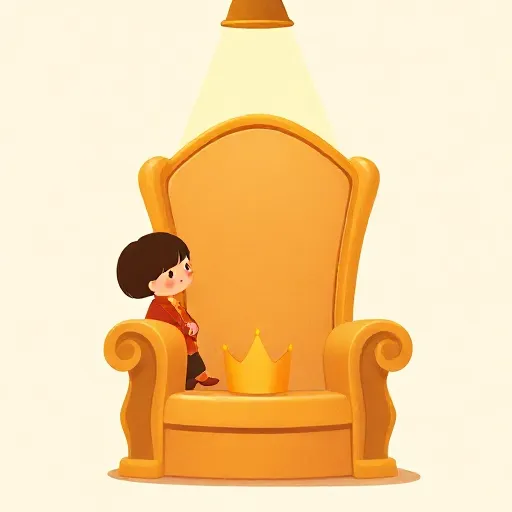
In 1905 Russell introduced another piece of honest toil: the theory of definite descriptions. Consider the sentence “The present King of France is bald.” France has no king, so what is the sentence talking about? It feels meaningful, even true or false, yet there is no real thing for the phrase “the present King of France” to latch onto.
Russell’s solution was to unpack the sentence’s hidden logical structure. Behind the innocent words there is a complicated claim: There exists exactly one thing that is the present King of France, and that thing is bald. Because there is no such thing, the whole statement is simply false. No ghostly non-existent king haunts the sentence; we’ve just made a mistake about the world.
This analysis introduced the notion of an incomplete symbol. The phrase “the present King of France” doesn’t refer to any object; it gets its meaning only as part of a whole statement. Russell called this a contextual definition — you don’t replace the phrase with a single equivalent symbol; you rewrite every sentence where it appears. The same trick explains talk about “the average family.” No real family has 2.2 children; the phrase works because we can translate it into a statement about total children divided by total families.
Later he would describe such incomplete symbols as logical fictions — not because they are imaginary, but because they don’t name pieces of the world the way a proper name like “Socrates” does. Instead, they are useful scaffolding that dissolves under careful analysis.
The Table That Isn’t There: Building Matter from Sense Data
Russell next turned his constructive energy to the physical world. What is a table? You see its brown color, feel its hard surface, hear a thud when you knock on it. These are sense data — the immediate experiences you have. But you don’t directly encounter “the table itself.” The ordinary view is that an unknown material object causes your sense data. That’s another assumption, another theft.
Instead, Russell proposed to construct physical objects from collections of sense data and sensibilia — possible sense experiences that would exist even when no one perceives them. A table, on this view, is not a hidden thing behind your sensations; it is the entire pattern of actual and possible experiencings of table‑like shapes, colors, and resistances. Points in space and moments in time likewise become logical constructions: classes of overlapping events, not mysterious containers in which events happen.
Russell credited his collaborator Alfred North Whitehead (1861–1947) with this bold approach. By substituting constructions for inferred entities, philosophy could stop guessing about unseen causes and instead talk about how experience hangs together. The payoff was a vision later called neutral monism — the idea that mind and matter are both built from the same neutral stuff (sense data), just arranged differently.
Why Honest Toil Still Matters

Russell’s dedication to construction didn’t end with him. The philosopher Willard Van Orman Quine (1908–2000) later called the ordered pair — a simple pair of objects like (x, y) — a “paradigm” of philosophical construction. Mathematicians needed a definition of an ordered pair that satisfied one neat property: (x, y) = (z, w) only if x = z and y = w. Two Polish logicians, Norbert Wiener (1894–1964) and Kazimierz Kuratowski (1896–1980), proposed defining ordered pairs as certain sets. There are multiple ways; any works, and we use them not because they capture some hidden essence, but because they do the job.
That’s the legacy of honest toil. When scientists build a computer model of the climate, they aren’t assuming a planet exists inside the machine; they construct a simplified system from known rules and data. When game designers let you build a character by choosing stats like strength and agility, they’re constructing an avatar, not summoning a person from another world. Even everyday phrases like “the average family” are miniature logical constructions — useful fictions that let us talk about patterns without imagining magic.
Russell’s maxim, borrowed from Occam’s Razor, still stands: “Whenever possible, substitute constructions out of known entities for inferences to unknown entities.” It’s a reminder that understanding something often means building it yourself, block by block, with no cheating.
Think about it
- If a scientist defines “happiness” as the sum of all happy moments divided by total moments, is that the same as what you mean when you say you’re happy? What gets lost in the construction?
- When you say “the average family has 2.2 children,” nobody exists in reality with 2.2 kids. Does that make the statement useless, or does it tell you something real? Can completely fictional talk still be true?
- Imagine you could choose between spawning a finished robot with a cheat code or building one from circuits and code. Which robot would you understand better? Does understanding even matter if both work?