Is Tomorrow Already Written? The Sea-Battle and the Open Future
Aristotle and the Sea-Battle: A Strange Kind of Puzzle
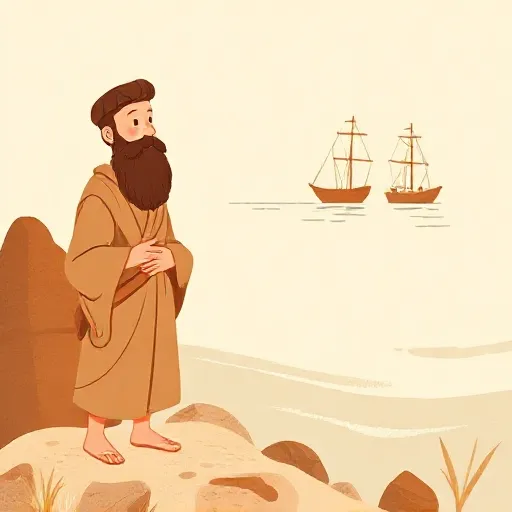
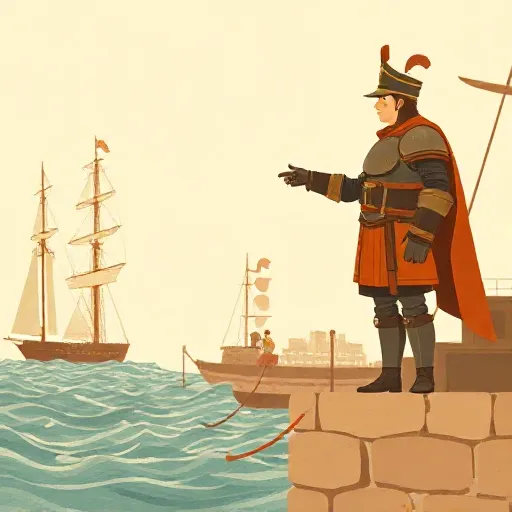
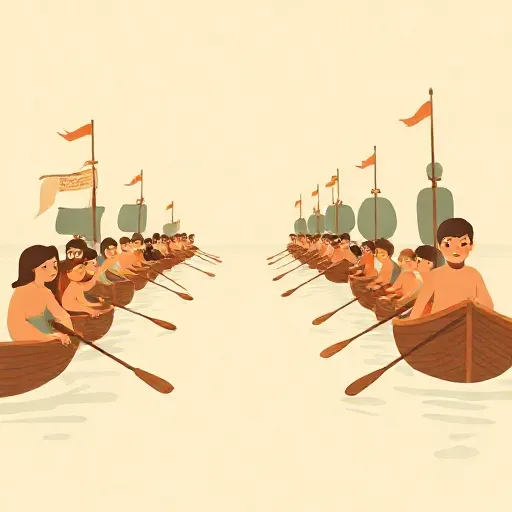
Imagine standing on a hillside overlooking the ocean. Tomorrow two fleets might fight. You turn to your friend and say, “There will be a sea-battle tomorrow.” Is that sentence already true right now — or is it not true yet? And what about the opposite sentence: “There will not be a sea-battle tomorrow”? Is one of them already true, even though no one knows which?
Around 350 BCE, the philosopher Aristotle wrestled with exactly this puzzle in his book On Interpretation. He noticed that statements about the future seem different from statements about the past or present. If I say “It rained yesterday,” that statement is already true or false — yesterday is fixed. But if I say “It will rain tomorrow,” it feels as though tomorrow could go either way. So does the sentence already have a definite truth value (true or false) right now? And if it does, wouldn’t that mean the future is already settled, as if everything that will happen is already inevitable?
Aristotle introduced the idea of a future contingent — a statement about a future event that is neither necessary nor impossible, like a sea-battle that might or might not occur. He suggested that such statements do not yet have a definite truth value. It is necessary that either there will be a sea-battle tomorrow or there won’t — but neither half is necessary by itself. Not everyone agreed, and the debate has echoed through philosophy ever since.
The Master Argument: When Possibility Shrinks
A generation or two after Aristotle, a philosopher named Diodorus Chronus sharpened the puzzle into an argument so clever that it earned the nickname the Master Argument. It supposedly showed that the only possible events are those that actually happen. That sounds wild: if you could have eaten toast or cereal for breakfast, and you chose toast, Diodorus would say that eating cereal was never really possible. Only what is or will be the case counts as possible.
Diodorus started from three ideas that seem hard to reject:
- Every true proposition about the past is necessary — you can’t change the past.
- An impossible thing cannot follow from a possible thing.
- Something that neither is nor will be true can still be possible. (For example, “It rains tomorrow” might be possible even if in fact it never actually rains tomorrow.)
The Master Argument claimed these three cannot all be true together, so we must give one up. Diodorus chose to reject the third idea. He concluded that what is possible is exactly “what is or will be the case.” In other words, the future is a single, unbending track. This view is deeply fatalistic: no matter what you do, the future is already the only one there could ever be.
For centuries, philosophers worried about arguments like this. If Diodorus was right, human choices cannot really be free — only one outcome was ever genuinely possible.
Prior’s Tense Logic: Making Room for “Maybe”
The 20th-century logician Arthur N. Prior thought the fatalist conclusion was a mistake — one that came from a sloppy way of talking about time. In the 1950s and 1960s, he invented a formal language for reasoning about past and future, which he called Tense Logic. (Today it is often called temporal logic.)
Prior introduced special symbols — temporal operators — to capture the tense of a sentence. The two most basic were P (for “it was the case that…”) and F (for “it will be the case that…”). So, F(p) means “It will be the case that p,” where p might stand for “a sea-battle happens.” He also had H (for “it has always been the case that…”) and G (for “it is always going to be the case that…”).
With these operators, you can translate everyday sentences about time with precision. “It was light, it is dark, and it will be light again” becomes P(light) ∧ dark ∧ F(light). That may look like algebra, but it simply makes the logic of time visible and testable. Critically, Prior’s basic system did not itself settle whether the future is open or closed. It was a neutral tool for exploring the question.
Prior believed that a good formal language could help untangle the knots that gave us the Master Argument. Instead of talking vaguely about “the possible,” he wanted to see exactly what assumptions led to fatalism — so we could decide whether to keep them.
Branching Time: The Tree Picture
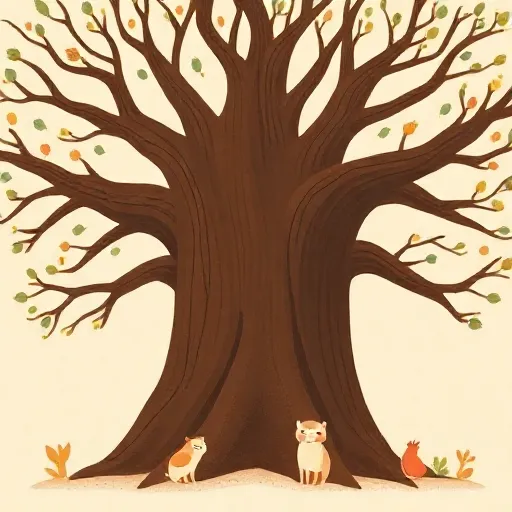
If time is not a single line but more like a tree, can we make sense of future statements without trapping ourselves in fatalism? Prior explored exactly that with the help of a letter from the logician Saul Kripke. He developed branching time logic, where time is represented as a tree that is linear toward the past and branches forward into multiple possible futures. The trunk is the shared, fixed past. Each branch is a possible future history.
In this picture, when you are standing at the present moment, you are at a point where several branches split off. The sentence F(p) cannot simply mean “p will happen” on the future line — because there is no single future line yet. Prior considered two different answers to what F(p) should mean, which he associated with two earlier thinkers.
The Peircean view (named after the American philosopher C. S. Peirce) holds that F(p) should mean “It will necessarily be the case that p” — that is, p happens on every possible branch passing through now. So if you say “There will be a sea-battle tomorrow,” that claim is true only if the battle occurs on all possible tomorrows. That makes such predictions very bold — and many statements about ordinary future events come out false, because rarely does the same event happen on every branch. Unsettlingly, the Peircean logic rejects the principle that either F(p) or F(not-p) must be true (the principle of future excluded middle). Saying “Either there will be a sea-battle tomorrow or there won’t be” is not automatically true on this view, because maybe on some branches it happens and on others it doesn’t, so neither the “necessarily will” nor the “necessarily will not” claim holds.
The Ockhamist view (named after the medieval philosopher William of Ockham) tries to preserve more of our ordinary way of speaking. It says that to evaluate a future statement, we need to pick a particular branch — a specific history through the tree — and check whether p happens on that branch. The operator F then means “on the given history, it will be the case that p.” In addition, the Ockhamist language includes a modal operator ◇ (possibility), which lets you say things like “It is possible that there will be a sea-battle” (true if a sea-battle occurs on at least one branch). This approach keeps future excluded middle — on each branch, either the battle happens or it doesn’t — and it treats the future as open at the level of possibility while still allowing us to talk about what will actually happen along a chosen timeline.
Prior himself preferred the Peircean option, but the Ockhamist version has been far more influential, especially in computer science. It gives us a way to say “the future is open” and still use ordinary future-tense statements meaningfully.
Why the Open Future Matters to You

You probably do not spend your days worrying about Diodorus or tense operators. But the problem they wrestled with shows up every time you think about your own choices. When you decide what to have for lunch or whether to start your homework now, you feel as though more than one outcome is genuinely possible. You take for granted that the future is not a single locked chain of events.
The branching-time picture captures that feeling. It says the past is settled, but the future consists of real alternatives — branches that are equally real possibilities. Yet it also forces a tough question: if we say “I will finish my homework tonight,” does that sentence already have a truth value? And if it does, does that mean the outcome is already determined, even if we do not know it? The Ockhamist logic lets us say yes — the sentence is true or false relative to what will actually happen — while still insisting that, from the standpoint of the present, other possibilities are genuinely available. But not everyone thinks that is logically airtight.
These questions are not just abstract games. They touch on free will, responsibility, and how we make sense of a world where we seem to affect the future. Computer scientists use branching-time logics to design programs that must handle multiple possible outcomes. Philosophers still debate whether the future is open or closed. And whenever you say “maybe” about tomorrow, you are stepping into the same maze Aristotle entered over two millennia ago.
Think about it
- If a supercomputer could perfectly predict every choice you will make tomorrow, would it still be fair to say that you could have chosen differently? Why or why not?
- Imagine you tell a friend, “I will definitely finish my project tonight.” Is that sentence true right now, only after you finish, or not at all? What if you later change your mind and don’t finish?
- Some people believe that God knows everything that will happen. If God knew yesterday exactly what you would eat for breakfast today, could you have eaten something else? How might that belief affect your sense of freedom?