Was Everything Always Going to Happen? The Sea-Battle Puzzle
A Bet on a Sea Battle

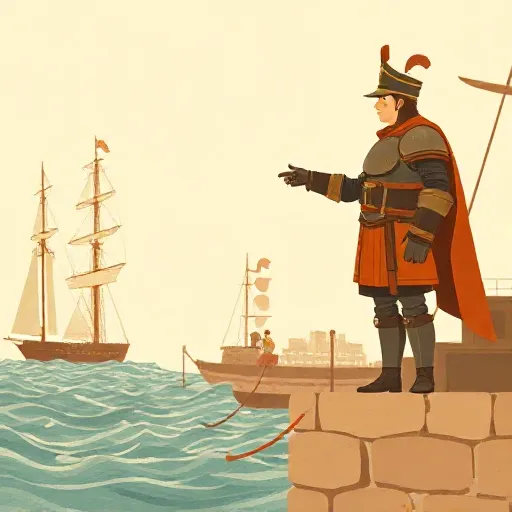
It is the year 1900. Two friends stand on a pier, looking out at the empty sea. One says, “On January 1, 2100, there will be a sea battle right here.” The other shakes her head. “No, there will not.” The battle is two centuries away. Neither person can possibly know what will happen. But could one of them already be right?
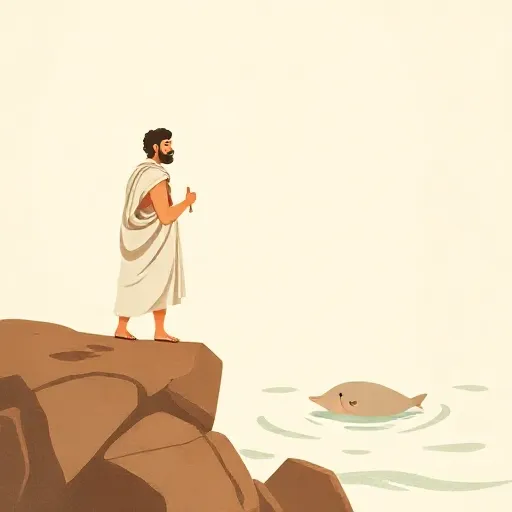
The ancient Greek philosopher Aristotle (384–322 B.C.E.) used a similar scenario to ask a terrifying question: does the simple fact that a statement is true or false now mean the future is already fixed? If so, everything that ever happens—including every choice you make—was inevitable all along. This idea is called fatalism: the view that all events happen of necessity, and no one ever has the power to do anything other than what they actually do.
Aristotle’s argument goes like this. Suppose any claim about the future, like “a sea battle will take place on January 1, 2100,” must be either true or false. If it is true, then a sea battle will happen. But if it was already true in 1900, then the state of the world in 1900 already determined that a sea battle was coming. And if the world in 1900 made that fact true, then nothing later could change it—the battle was necessary, meaning it was unavoidable, no matter what anyone did. The year of the prediction doesn’t matter; even if no one actually spoke the words aloud, the argument would still seem to work. So, if the argument holds, everything that ever happens was always going to happen.
The Domino of Truth

The argument’s trickiest step is the move from truth to necessity. Why should a sentence being true in 1900 force a battle in 2100? Here is one answer. Many people think that when someone says something true, there must be a fact in the world at that moment that makes it true. That is a version of the correspondence theory of truth: true words match up with how things really are. So if it was true in 1900 that a sea battle would occur two centuries later, the world in 1900 must have contained some fact that made it so. But if that fact already existed, it was just as solid and unchangeable as any stone. And Aristotle himself admitted, “What is, necessarily is, when it is.” So if a future-battle fact was already baked into the universe in 1900, the battle could never be stopped.
Aristotle spotted a way out. He said we are not forced to accept that every statement about the future is already true or false. Some statements, he argued, are about future contingents—events that are neither guaranteed to happen nor guaranteed not to happen. For those statements, Aristotle simply denied the law of bivalence, which is the rule that every proposition must be either true or false. In his view, “There will be a sea battle on January 1, 2100” was, in 1900, neither true nor false. It became true only when the battle actually took place (or stayed false if it never did). By cutting off truth until the event occurs, Aristotle prevented it from forcing the future.
This solution has a startling consequence: some propositions are not true at one time but become true later. The statement sitting on the tip of your tongue right now might not yet have a truth value.
Why Some Philosophers Push Back

Not everyone is comfortable with Aristotle’s fix. Imagine it is 1972, and a racing fan declares, “Red Rum will win the Grand National next year.” When Red Rum thunders across the finish line in 1973, don’t we naturally say the fan was right all along—that what he said in 1972 was true, not just later? If we take Aristotle’s route, we have to call the 1972 statement neither true nor false, which seems to clash with how we treat ordinary predictions.
There is also a worry about logic. Aristotle still wanted to say that “Either there will be a sea battle or there will not” is a necessary truth. You cannot avoid one of the two outcomes happening. But if each half is neither true nor false, how can the whole “or” sentence be true? Philosophers have shown this can work if you treat truth a bit differently: you imagine all possible futures and see if the complex sentence holds in every one. Even if each simple statement is unsettled, the combination “p or not-p” comes out true in all futures. Still, this means words like “or” stop behaving in the simple, truth-table way we learn in school.
Despite these oddities, many thinkers have found Aristotle’s idea attractive, because it seems to rescue free will from the sea-battle argument. Others, however, think there is a better way—one that does not require giving up the law of bivalence.
Richard Taylor and the Power to Order a Battle

The twentieth-century philosopher Richard Taylor offered a different argument for fatalism, one that does not start with the ancient puzzle about truth. Instead, it focuses on the conditions needed for you to have power over an action. Taylor suggested several common-sense rules, including: (5) No one can perform an action if some necessary condition for that action is missing.
Imagine you are an admiral in 1900, and you are about to decide whether to order a sea battle for tomorrow. If it is already true that a sea battle will happen tomorrow, then one necessary condition for you not ordering a battle—namely, the actual absence of a battle tomorrow—is missing. So, by Taylor’s rule 5, you could not have performed the act of not ordering the battle. A similar argument would show that if it is true no battle will happen, you could not order one. Since either the battle will happen or it will not (bivalence again), one of those actions is always impossible for you. The argument generalizes: nothing you do is ever freely chosen.
Many philosophers have replied that Taylor’s rule 5 needs a small but crucial tweak. You lack the power to perform an act only if the missing necessary condition is something you cannot bring about. The fact that there will be no battle tomorrow is exactly what your not-ordering would help to bring about. So you are not powerless just because the condition does not yet exist. Replacing rule 5 with this refined version blocks Taylor’s argument without needing Aristotle’s rejection of bivalence. The debate, though, is far from over, because fatalists can still ask whether you really can bring about the missing condition if the future is already fixed by other truths.
What If It Doesn’t Matter? The Idle Argument

Even if fatalism were true, would it change how you should live? An ancient puzzle called the Idle Argument says yes—and it says you should do nothing. If you are fated to recover from an illness, you’ll get better whether you summon a doctor or not. If you are fated not to recover, the doctor won’t help anyway. Either way, calling the doctor is pointless.
The Stoic philosopher Chrysippus (c. 280–c. 206 B.C.E.) gave a sharp reply: it may well be fated that you recover because you call the doctor. The healing and your decision are not two independent things; your action can be part of the fate itself. So even if events are locked in place, your choices are still links in the chain that brings them about. The Idle Argument confuses “it will happen regardless of what I do” with “it will happen through what I do.”
This matters in everyday life. Suppose a friend tells you, “If my test grade is already set by fate, why bother studying?” Chrysippus’s answer would be that studying is probably part of the fate that leads to the grade. The deeper question—whether you could have studied or not—remains the heart of the free will puzzle. That puzzle is still wide open.
Think about it
- If a friend told you they “knew all along” you’d pick vanilla ice cream, does that mean you couldn’t have chosen chocolate?
- If a scientist could predict every choice you’ll ever make, would it still be fair to punish people for bad choices?
- Suppose someone says, “Why try if it’s already decided?” How would you answer them?