What Makes an “If” True? A 2,000‑Year‑Old Puzzle
If You Drop the Egg…

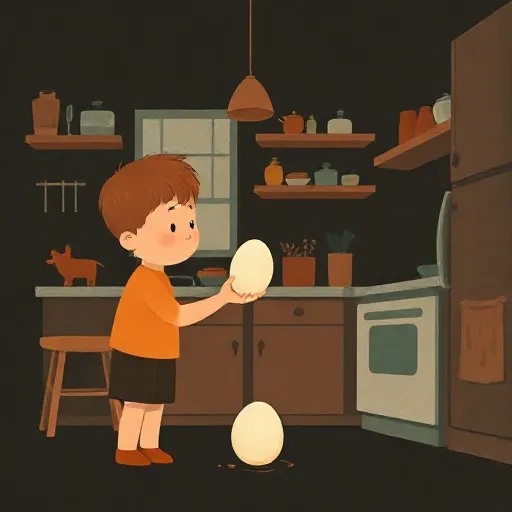
You hold an egg over the kitchen floor. Your friend says, “If you drop it, it will break.” How would you ever prove that sentence true or false? You could drop the egg and watch what happens. But what if you decide not to drop it? Is the sentence automatically true? That feels wrong. Something about the word if is slippery.
Philosophers have puzzled over “if” for more than two thousand years. Every time we plan, promise, or imagine what could have been, we lean on these tiny words. Yet there is still no single answer everyone agrees on. This article explores the main ideas philosophers have tried — and why each one breaks in surprising ways.
The Truth Table That Seems Too Simple

The earliest recorded idea comes from Philo of Megara, around 300 BCE. He said a conditional “If A, then B” is false exactly when A is true and B is false. In every other case — when A is false, or when A and B are both true — the whole sentence is true. This is the material conditional, often called the truth‑functional view because the whole truth depends only on the truth of the pieces.
It works beautifully in mathematics. “If 3 is even, then 4 is even” fits the table perfectly. But everyday language rebels.
Take a paradox noticed by the logician Hugh MacColl in 1908. Consider two sentences:
- If John is a physician, then he is red‑haired.
- If John is red‑haired, then he is a physician.
According to the truth table, at least one of those must be true, no matter who John is. But you probably find both of them hard to swallow. And because “not‑A” alone makes “If A then B” true, we get bizarre results: “If the moon is made of cheese, then I am a unicorn” counts as true — the moon isn’t cheese, so the whole thing holds. That’s one of the paradoxes of material implication.
The negation of a conditional raises another flag. If you deny “If God exists, all criminals will go to heaven,” the truth table says you must accept “God exists, yet not all criminals go to heaven.” But many people want to reject the original sentence without committing to God’s existence. Something deeper connects A and B — and the truth table ignores it.
Journey to Possible Worlds

If the truth table is too crude, where should we look instead? In the 20th century, philosophers turned to possible worlds — ways the world could be. The key idea: a conditional is not just about what actually happened; it’s about what happens in the most similar worlds where the antecedent is true.
Robert Stalnaker and David Lewis (1941–2001) developed this into a full theory. For a counterfactual like “If I had dropped the egg, it would have broken,” you don’t need to have dropped it. You imagine a world very much like ours — same kitchen, same gravity — but with one small change: your fingers let go. In that closest possible world, the egg hits the floor and cracks. So the conditional is true.
This approach sweeps away the material conditional’s weirdness. “If the moon is cheese, then I’m a unicorn” turns false: the nearest cheese‑moon world is not one where I suddenly sprout a horn. It also explains why counterfactuals with false antecedents can be meaningful.
But the possible‑worlds story forces us to give up some familiar logical moves. Consider Transitivity: if A leads to B, and B leads to C, does A lead to C? In everyday conditionals, not always. Here’s a famous example from the philosopher Ernest Adams (1926–2015):
- If Brown wins the election, Smith will retire.
- If Smith dies before the election, Brown will win.
- Therefore… if Smith dies before the election, he will retire.
That conclusion is absurd — a dead man can’t retire. Yet each individual “if” might be true. In the possible‑worlds framework, the nearest Smith‑dies‑before‑election world may be one where Brown wins, but it is not the nearest Brown‑wins world from your original viewpoint. So the chain doesn’t carry through. Many logics built on possible worlds happily reject Transitivity, Monotonicity, and other traditional rules.
From Certainty to Probability
So far conditionals have been treated as either true or false. But many conditionals feel chancy: “If you study, you’ll pass the exam” doesn’t guarantee a pass. In the 20th century, philosopher Frank Ramsey (1903–1930) suggested that when people argue “If p, then q,” they are not asserting a fact — they are temporarily adding p to what they believe and checking whether q follows. This is the Ramsey Test.
Ernest Adams turned this into a probabilistic logic. Adams claimed that for simple conditionals, the acceptability of “If A, then B” equals the conditional probability P(B | A) — the chance of B given that A is true. For instance, “If a fair die lands even, it lands on six” feels acceptable to degree 1/3, exactly the conditional probability.
Adams’s rule feels intuitive, but it hits a wall when we try to embed one conditional inside another: “If it rains, then if the game is canceled, we’ll stay home.” What is the probability of that? David Lewis proved that if conditionals are ordinary propositions with probabilities, a simple algebra forces every conditional’s probability to collapse into the probability of its consequent alone. That is, “If A, then B” would have the same probability as B, no matter what A is — clearly not what we want. These triviality results convinced many philosophers that conditionals don’t describe facts in the usual way. Instead they may be rules for updating your beliefs — more like instructions than statements.
When the Antecedent Doesn’t Matter

There’s one more piece of the puzzle that has attracted attention recently. Even if a conditional is highly probable, it can sound ridiculous if the antecedent has nothing to do with the consequent. “If you toss a coin a million times, you’ll get at least one head” is almost a sure thing. But “If Chelsea wins the Champions League, you’ll get at least one head” is just as probable — yet it feels weird. The weather can’t influence a coin flip.
Philosophers like Igor Douven, Vincenzo Crupi, and Andrea Iacona argue that a proper conditional must make a difference: the antecedent should raise the probability of the consequent. When it doesn’t, the sentence is not false — it is simply irrelevant, and we resist it. This thinking has led to new logics where the connection between the two parts matters. Those logics reject some familiar patterns, like the rule that if A∧B is true, then automatically “If A then B” is acceptable — a rule the older theories embraced. Relevance is now a lively frontier in the study of conditionals.
Why This Old Puzzle Still Matters

You use conditionals every day — when you promise, “If you come to my party, I’ll save you a slice of cake,” when you guess, “If the train is late, I’ll miss the start,” and when you regret, “If I had woken up earlier, I wouldn’t have missed the bus.” Even the code that powers websites and games runs on “if‑then” statements.
Philosophers haven’t finished arguing, and that’s a good thing. Sorting out what “if” really means pushes us to think harder about possibility, cause and effect, and how our minds work. The next time you say an “if” sentence, remember you are holding a 2,000‑year‑old piece of unfinished thinking — and no one yet has nailed it down perfectly.
Think about it
-
A computer program contains the line “if score > 100, then display ‘You win!’” Is that the same kind of “if” as when you say, “If I had trained harder, I would have scored higher”? Why or why not?
-
Someone tells you, “If you eat your vegetables, you’ll grow taller.” What sorts of evidence would you look for to decide whether that claim holds up? Does it matter whether the vegetables are actually connected to growing taller, or is a high probability enough?
-
Can a conditional be true even if its antecedent never actually happens — like “If I had jumped off the roof, I would have broken my leg”? How would you ever check whether such a sentence is true?