
Can a Lie Make Something True? The Strange Puzzle of ‘If…Then…’
The Puzzle That Started It All
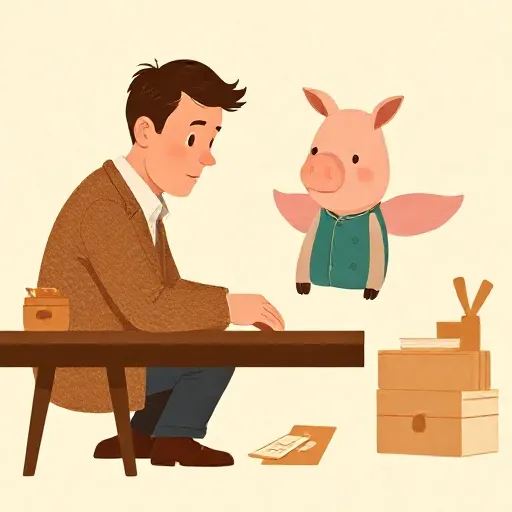
Imagine your friend says, “If pigs can fly, then I’m a millionaire.” You laugh. Pigs can’t fly, so her claim seems like a joke. But then she points out: in standard logic, the sentence “If pigs can fly, then I’m a millionaire” is actually true. If the first part is false, the whole “if…then…” counts as true, no matter how silly the second part is. That feels wrong. Shouldn’t “if…then…” mean something stronger — that the second part really follows from the first?
This is exactly what bothered the American philosopher C. I. Lewis (1883–1964). In 1912, he noticed that the logic book by Bertrand Russell and Alfred Whitehead contained two bizarre theorems: a false sentence implies any sentence, and a true sentence is implied by any sentence. In symbols, those theorems looked like this:
¬p → (p → q) p → (q → p)
Lewis called these “startling.” He didn’t say they were mistakes, exactly. They simply revealed that the symbol “→” (called material implication) had a very thin meaning: “it is not the case that the first part is true and the second part false.” That thin meaning works fine for many mathematical proofs, but it doesn’t capture what we mean when we say one idea logically follows from another.
In an everyday argument, you’d never say, “Grass is purple; therefore, I can fly.” That leap makes no sense. Lewis wanted a “proper” meaning of implication — one that matched real reasoning. So he set out to build a new logic, a logic of strict implication.
Lewis’s Better “If”: Strict Implication

Lewis’s big idea was that “p implies q” should mean something much tighter: it is impossible for p to be true and q to be false. He called this strict implication and wrote it with a double-lined arrow (or a fishhook shape). In strict implication, a false statement does not automatically imply every other statement, because it’s perfectly possible for a false statement to be true in some imagined situation. For example, it’s false that pigs fly, but we can imagine a weird universe where they do. In that universe, does “I’m a millionaire” have to follow? No — the connection isn’t necessary.
So Lewis built a series of logical systems, numbered S1, S2, S3, S4, and S5, starting in 1918 and finishing in 1932. The systems are like toolkits. Each one contains axioms (starting truths) and rules that let you prove new truths. The weakest, S1, has the fewest tools; S5 has many. Lewis aimed to find the system that exactly captured what “logically follows” means in real life.
To see what strict implication does, think of a chain of dominoes. In material implication, a false domino “pigs fly” could knock over any domino — even “2+2=5” — because once the first is false, the whole chain counts as true. In strict implication, the dominoes are locked together: you can only knock over a domino if there’s no possible arrangement where the first stands and the second falls. That’s much harder.
The Paradoxes Didn’t Disappear — They Just Moved
Even with strict implication, a strange thing remained. If a statement is impossible — like “2+2=5” — then it cannot be true. So, by Lewis’s definition, an impossible statement strictly implies any statement. Likewise, a necessary truth (something that must be true, like “all bachelors are unmarried”) is strictly implied by any statement. So the same kind of paradox pops up again, just relocated.
Lewis didn’t think this was a mistake. He argued that an impossibility really does logically force anything to follow. Imagine a contradiction, like “it is raining and it is not raining.” From that, you can prove any conclusion, because logic breaks down when a contradiction is admitted. His argument: from “p and not-p” you get “p” (by simplification). From “p” you get “p or q” for any q. From “p or q” and “not-p” you get q. So in a way, an impossibility does entail everything.
Not everyone agreed. Some philosophers, like E. J. Nelson (1893–1971) and later P. F. Strawson (1919–2006), thought that even this stricter “if” was too weak. They began developing a logic of relevance, where the parts of an implication must be genuinely connected — you can’t get something from nothing. That debate still rumbles today, but Lewis’s systems became the foundation for modern modal logic.
From Rules to Worlds: The Big Semantic Turn

For decades, logicians studied these systems by shuffling symbols around. But they hadn’t really settled what necessity and possibility mean. Then the German philosopher Rudolf Carnap (1891–1970) proposed an idea: think of necessity as truth in all state-descriptions, which are like complete pictures of how the world could be. A statement is necessary if it holds in every possible complete picture. This is the seed of possible worlds semantics.
However, Carnap’s system was so strong that it made things like “possibly pigs fly” into logical truths — any atomic sentence can be true in some state-description. That didn’t fit our intuitive notion of logical necessity. The breakthrough came with Saul Kripke (1940–2022) in the late 1950s and early 1960s. He said: don’t just think of all possible worlds; think of a set of worlds and a relation between them that tells you which worlds are accessible from which.
This accessibility relation is a kind of reachability. One world can access another if, from the standpoint of the first, the second is possible. For example, if we’re only considering worlds where the laws of physics hold, then a world with talking pigs is not accessible from ours. So “possibly, pigs talk” is false in our world under that accessibility relation.
Kripke’s model structures used frames — a set of worlds plus an accessibility relation — to interpret the □ (necessarily) and ◇ (possibly) operators. Suddenly, the different Lewis systems matched different properties of that relation. S4 required the relation to be transitive (if you can reach world B from A, and world C from B, you can reach C from A). S5 required it to be an equivalence relation (every world can reach every other). The famous system T (which just says “if necessarily p, then p”) required the relation to be reflexive (each world can reach itself). All this turned modal logic from a mysterious algebraic game into a vivid picture of universes.
Why Lewis’s Hunt Still Matters

Today, modal logic isn’t just a dusty corner of philosophy. The ideas Lewis, Carnap, and Kripke developed are used in computer science to reason about programs, in artificial intelligence to represent what agents know and believe, and in linguistics to explain words like “must” and “might.” When someone says, “It must be raining,” they’re not talking about all logically possible worlds; they’re talking about what follows from the evidence they have. That’s a restricted “must,” and it mirrors the idea of an accessibility relation.
The puzzle Lewis faced — what does “if…then…” really mean? — turned out to be a doorway. Pushing on that door opened up questions about what’s possible, what’s necessary, and how we can talk about things that could have been but aren’t. Even today, philosophers argue over the right logic for necessity. Does the past have to be necessary? Is the future open? These are live questions, and they all trace back to the wish to fix a tiny, frustrating paradox about false statements implying everything.
Think about it
- Suppose a computer could perfectly predict every choice you’ll ever make. Would any of your choices still be “possible” in a meaningful sense, or would everything become necessary?
- Your friend says, “If I had studied, I would have passed.” Does this “if” mean she’s talking about a different possible world where she studied — and if so, what makes that world accessible from ours?
- In a video game, you can save and reload to explore different story branches. How is that like the way possible worlds are used to understand “could have been”?